
Use a third-party sound level meter that meets IEC 61672-1 (Class 1 for compliance and disputes, Class 2 for screening), measure A-weighted Leq over day (6:00 a.m. to 10:00 p.m.) and night (10:00 p.m. to 6:00 a.m.)
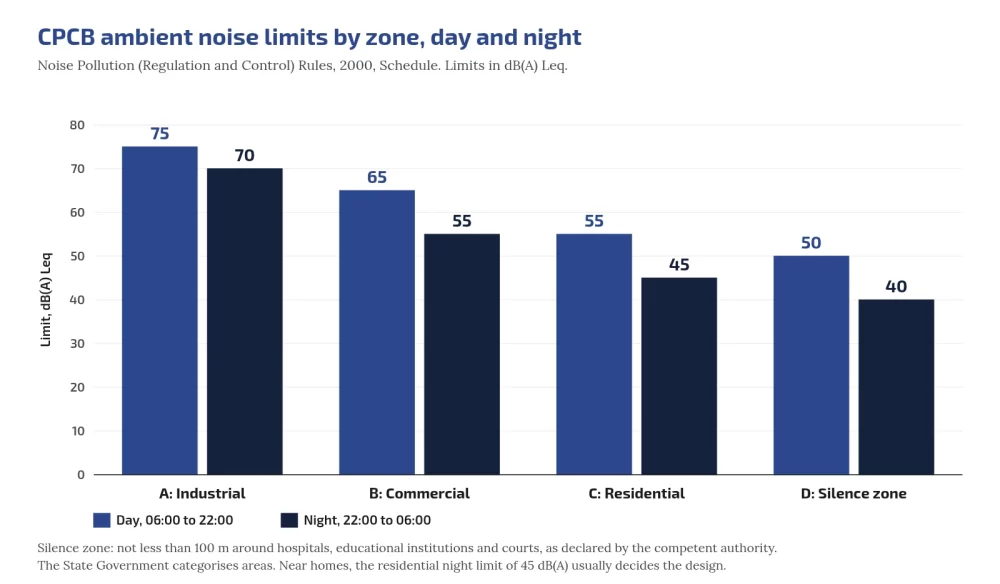
This is defined in India’s Noise Pollution (Regulation and Control) Rules, 2000, and compare with zone limits: industrial 75/70, commercial 65/55, residential 55/45, silence 50/40 dB(A) Leq (CPCB C1).
Add L90 for background, C-weighted levels and 1/3-octave spectra for low-frequency tones, and continuous logging with day/night alarms so you see problems before neighbours report them.
Who this is for: EHS managers, facility engineers and consultants responsible for noise compliance and community relations at data centers and plants with DG sets.
Class 1 or Class 2 (the meter, not Embedos)
IEC 61672-1 sets performance classes for sound level meters; Class 1 has tighter tolerances than Class 2 (IEC webstore). Both cover A/C/Z weightings, Fast/Slow time weightings and integrating (Leq) functions; periodic tests are in IEC 61672-3.
If a result may face a regulator, court or resident consultant, use Class 1 with calibration certificate and field calibrator checks before and after. Permanent screening points may use Class 2 if you state that in reports.
Never label Embedos Edge as Class 1; the class belongs to the third-party meter. Embedos does the intelligence, the continuous logging!
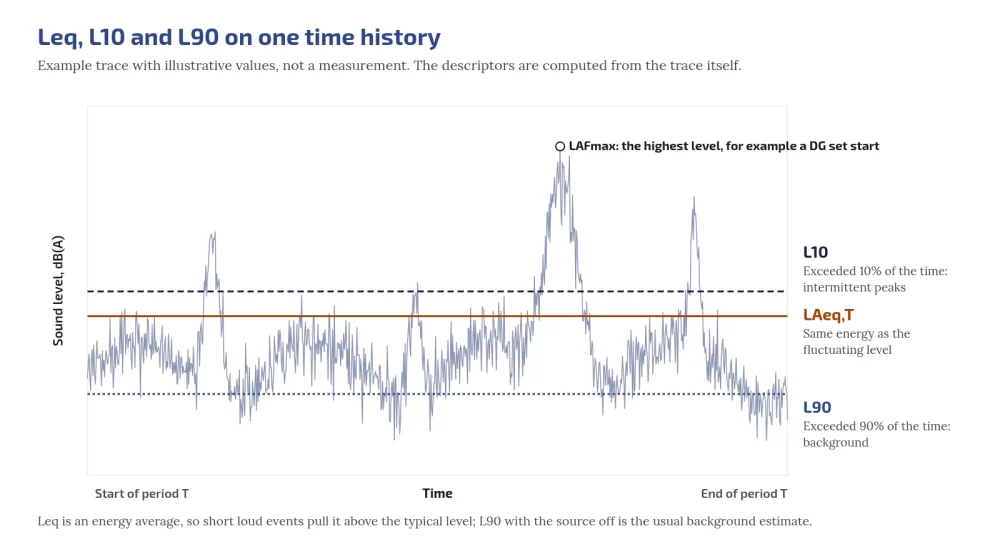
Descriptors: Leq, L90, spectra
- LAeq,T: A-weighted equivalent continuous level (NTi LAeq explainer).
- L90: level exceeded 90% of the time (background floor) (NTi percentiles).
- L10 / LAFmax: intermittent peaks and Fast maxima.
- 1/3-octave or FFT: transformer tones at 100 Hz multiples; engine firing; fan BPF (hum; fans).
Worked example: combining hourly Log
L_eq,total = 10 log10( (1/N) Σ 10^(L_i/10) ) (ISO 1996-1 definition). Eight night hours 44, 44, 45, 43, 43, 52, 44, 44 dB → about 46.2 dB. One loud genset hour can push a residential night over 45 dB(A).
Background correction
Source+background 52 dB, background alone 46 dB → source ≈ 50.7 dB. When the difference is under about 3 dB, correction is unreliable (ISO 1996-2 residual sound).
Tonal penalties and the C−A screen
ISO 1996-2 Annex C can add 0 to 6 dB for tonal audibility (Pedersen, Acoustics 2008).
India’s 2000 Rules do not specify a tonal penalty; using one internally still predicts complaints. WHO 1999 §4.3 is widely cited for recommending frequency analysis when dB(C)−dB(A) > 10 dB (IRIS handle)
CPCB ambient limits
| Zone | Day | Night |
|---|---|---|
| Industrial | 75 | 70 |
| Commercial | 65 | 55 |
| Residential | 55 | 45 |
| Silence | 50 | 40 |
Sources: C1 PDF; Delhi PDF; HTML. Day 6:00 a.m.-10:00 p.m.; night 10:00 p.m.-6:00 a.m.
Silence zone ≥100 m around hospitals, educational institutions and courts;
State Government may declare (S.O. 2555(E) 10.08.2017 footnote).
Night is 5 dB lower than day in industrial zones and 10 dB lower in commercial, residential and silence zones (never “10-15”).
Rule 7(1): complaint if noise exceeds the ambient standard by 10 dB(A) or more, or night restriction violated.
Which limit matters most for a DC next to homes?
Usually the nearest residential night limit: 45 dB(A) Leq.
DG set limits
From CPCB Limits; Diesel Genset Noise Limits; Noise Limits for Generators:
- New DG ≤1000 kVA manufactured on/after 1 Jan 2005: 75 dB(A) at 1 m from enclosure surface; integral acoustic enclosure.
- Other sets: enclosure/room ≥25 dB(A) IL or ambient, whichever higher (0.5 m points averaged); muffler ≥25 dB(A) IL.
Do not cite GSR 436(E) for these dB values (supply/transition only).
WHO context
- NNG 2009: target 40 dB Lnight,outside; interim 55 dB.
- ENG 2018 / compendium W4: road <53 Lden / <45 Lnight; rail <54 / <44; aircraft <45 / <40; wind <45 Lden. ENG 2018 made no industrial noise guideline.
Use WHO as health reference; CPCB for compliance. Neighbours framing: health effects post.
Measurement checklist
- Meter class stated (Class 1 for compliance); calibration current
- Field calibrator before and after, recorded
- Microphone 1.2 to 1.5 m above ground; windscreen; weather noted
- Day and night periods per CPCB times
- LAeq, LCeq, L90, L10, LAFmax
- 1/3-octave spectra
- Source on/off where possible
- Operating state: IT load, cooling stages, transformer load, DG status
- Zone category confirmed with competent authority
- Tonal assessment method stated
Continuous logging architecture
Embedos Edge is our platform.
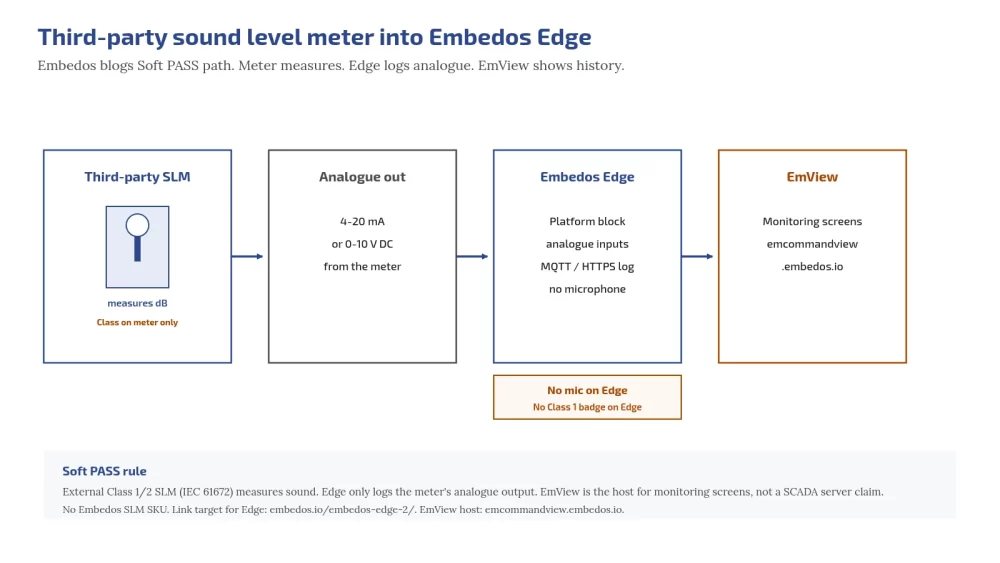
Edge can log readings from a third-party sound level meter, noise meter or recorder via 4-20 mA or 0-10 V analogue inputs.
Edge has no built-in microphone and does not do dosimetry; the meter measures. EmView monitoring/dashboard/SCADA (EmView=B) can show those logged readings at https://emcommandview.embedos.io/; report exports.
Class 1/2 under IEC 61672 refers only to the third-party meter. Scaling: https://tools.embedos.io/4-20ma-loop-scaling-calculator/.
Practical rules (set with your consultant):
- Outdoor monitoring-grade third-party meters at boundary and receiver-facing positions with analogue outputs.
- Edge logs those readings; compute period Leq, L90, C−A and selected bands in your analytics layer as agreed.
- Correlate with DG run and fan/chiller stage from existing plant systems.
- Separate day/night thresholds; projected night Leq warning; tonal/low-frequency flags.
Does Edge measure dB by itself?
No. A third-party meter measures; Edge logs its analogue output. Edge can add a microphone.
Next step. Drop a Mail!
Send your zone category, proposed meter positions and whether you need Class 1 compliance logging or operations screening, and we will help you with Edge.
Help Us Help You Leverage The Power Of Industrial Automation & Industrial IoT – IIoT.