
A warehouse temperature and humidity monitoring system for agri commodities measures two different things.
Ambient relative humidity (RH) and temperature tell you about the air in the shed;
Grain moisture tells you about the stock.
Mould risk rises when the air between the grains stays above about 70% RH, so log ambient RH and temperature continuously, spot-check or probe the commodity itself, connect remote godowns over 4G, and alert on trends rather than single readings. If you’re searching forr a warehouse moisture monitoring system; this is it.
Anyone who is looking for warehouse operations heads, quality managers and engineers at agriculture warehousing and commodity storage firms, cold storages, logistics units, storage units, running many sheds across India.

Ambient RH and temperature or grain moisture probes: what is the difference?
Grain and air trade moisture until they reach balance, the equilibrium moisture content (EMC). The Food And Agriculture Orgganisation of the United Nations (FAO) has procedures written for how one can efficiently store. Guidance on post-harvest losses treats 70% RH as the “safe” level and gives the moisture in equilibrium with 70% RH at 27°C, for example 13.5% for maize and wheat.
FAO’s manual on post-harvest grain losses notes that fungi start growing above 65 to 70% RH.
FAO’s chapter on grain drying and storage adds that for most cereals EMC drops by about 0.5% for every 10°C rise at the same RH, and that grain in sacks can usually be stored 1 to 2% wetter than in bins.
- Ambient sensors (RH and temperature in the shed air) are cheap, accurate and easy to network. A good digital sensor such as the Sensirion SHT45 is specified at ±1.0% RH and ±0.1°C. They tell you when ventilation will dry or wet the stock, and when the shed is drifting toward risk.
- In-stack or in-bulk probes measure temperature, RH or moisture inside the stock, where spoilage starts. They cost more per point and need care when stacks are built and moved.
- Moisture meters on samples remain the reference for each lot at intake and at intervals. FAO’s guidance describes the common measurement methods and their limits.
What is the safe moisture content for grain storage?
FAO gives the moisture in equilibrium with 70% RH at 27°C as the upper limit for safe storage: 13.5% for maize and wheat, with other values for other commodities. For long-term storage, aim lower. Always check the limit your quality contract or standard uses.
How many sensors does a shed need?
There is no single number; it depends on shed size, stack layout, roof heat and ventilation. A practical starting layout:
- One ambient RH and temperature sensor per ventilation zone, at stack height, away from doors and direct sun.
- One sensor near the roof on the hottest side, because roof heat drives moisture migration in the stock.
- One outdoor sensor per site, so you can decide when opening vents will dry the shed rather than wet it.
- In-stack probes in the stacks with the highest value or the longest planned storage first.

Connectivity for remote godowns: why 4G and store-and-forward matter
Agri warehouses are often outside town with no LAN. A gateway on 4G sends readings from each shed, and store-and-forward keeps them during network gaps so the history has no holes.
Check signal inside the shed, not at the gate: metal roofs and walls weaken it, and an external antenna may be needed.
Sensors inside the shed connect to the gateway over RS-485 Modbus RTU (see the Modbus specifications) or as 4-20 mA signals.
How should you set alert thresholds for spoilage?
- RH trend alert: ambient RH above your limit (for example 70%, from the FAO guidance) for a set number of hours, not for a single reading after a rain shower.
- Temperature rise in the stack: a probe reading rising while ambient is steady points to biological activity. Alert on the rise over a set period.
- Ventilation advice: outdoor RH lower than indoor RH means opening vents can help; the reverse means keep them shut.
- Sensor health: alert when a sensor stops reporting, so a dead sensor is not mistaken for a safe shed.
What humidity is too high in a grain warehouse?
Use about 70% RH as the warning line: FAO treats it as the safe level, and fungi start growing above 65 to 70% RH.
Alert on sustained readings rather than brief peaks, and check the stock itself when the alert fires.
What does a multi-site dashboard show?
A list of sites ranked by risk, then sheds within a site, with current ambient RH and temperature, outdoor RH, stack temperature trends and open alerts.
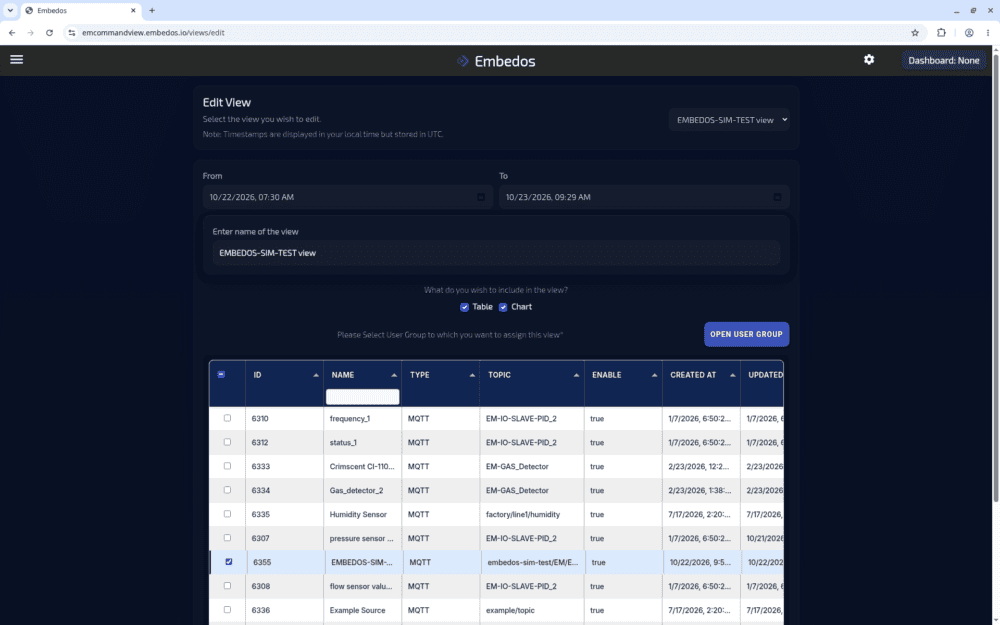
EmView, the Embedos cloud dashboard, provides monitoring, alerts and control views across sites. In EmView, a view groups sources such as humidity and temperature sensors into a table and chart for a set time window.
Automation angle: where Embedos Edge fits
Embedos Edge (the platform) reads RH and temperature sensors over RS-485 Modbus RTU or on 4-20 mA and 0-10 V inputs, sends data over GSM 2G/4G, Wi-Fi or Ethernet with MQTT or HTTPS, keeps it through outages with data buffering, and raises SMS and email alerts.
Logic on the device can run trend alerts locally, OTA updates and device health visibility help when sites are hundreds of kilometres apart, and EmView shows all sites in one place. Convert analog sensor outputs with our 4 to 20 mA loop scaling calculator.
Warehouse monitoring setup checklist
- List sites, sheds, shed sizes and the commodities stored in each.
- Mark ventilation zones, roof hot side and doors on a shed sketch.
- Choose ambient sensors and decide where in-stack probes are worth the cost.
- Check 4G signal inside each shed and plan antennas.
- Agree RH and temperature thresholds per commodity with the quality team.
- Decide who gets alerts at each site and who escalates.
- Plan sensor calibration checks and record them.
- Keep moisture meter readings at intake and at intervals alongside the sensor data.
Can an RH sensor measure grain moisture?
Indirectly. An RH sensor inside the grain mass reads the air in balance with the grain, and that can be converted to moisture using the commodity’s equilibrium curve. The curve varies with variety and temperature, so confirm with a moisture meter.
Do I need a separate sensor outside the warehouse?
Yes, if you want ventilation advice. Comparing outdoor and indoor RH tells you whether opening vents will dry or wet the shed.
Next step! Send us a Mail
Send your machine list, ages and what signals each one already has, and we will help you plan the wiring.
Help Us Help You Leverage The Power Of Industrial Automation & Industrial IoT - IIoT.