
Does stainless steel reduce sensing distance?
Yes, for most inductive sensors. Check the vendor’s guidance for your target material, or choose a sensor rated for all metals.
In the inductive vs photoelectric sensor choice, use an inductive sensor when the target is metal and can come within a few millimetres to a few tens of millimetres of the sensor face.
It ignores dust, light and most dirt.
Use a photoelectric sensor when the target is non-metallic, far away (tens of centimetres to metres), or must be detected by edge or colour.
In dusty steel and power plants, inductive is the default wherever geometry allows, because dust that blinds an optical lens does not affect an inductive field.
The requirement should specify 3-wire DC, PNP or NPN to match the input card, flush or non-flush mounting, sensing distance, and IP rating per IEC 60529.
Who this is for: instrumentation and electrical engineers writing sensor specs for conveyors, rotating shafts, gates and position feedback in heavy-process plants.
Flush or non-flush?
Non-flush for longer range when a metal-free zone is possible. Flush when the sensor must sit level with metal.
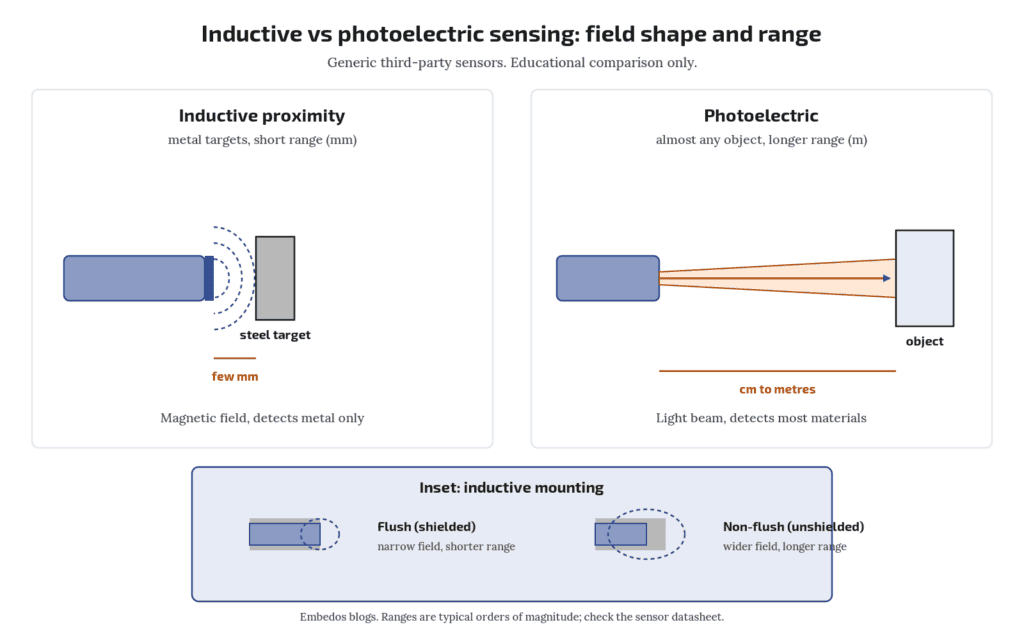
How each one works, in one line
- Inductive proximity: An oscillator makes a high-frequency field at the face; a metal target in the field draws energy (eddy currents), and the output switches. Construction and test requirements for proximity switches are covered in IEC 60947-5-2.
- Photoelectric: an emitter sends light (usually red, infrared or laser); the receiver switches when the beam is broken or reflected. Modes are through-beam, retro-reflective and diffuse. IEC 60947-5-2 also covers photoelectric proximity switches.
PNP or NPN?
Match the input card. Sinking inputs take PNP; sourcing inputs take NPN.
Inductive: what to check
Target material. Rated sensing distance (Sn) is stated for a standard mild steel target. Other metals reduce it; stainless steel, brass, aluminium and copper all give shorter range. Use the correction factors (or equivalent guidance) from the inductive sensor datasheet for your target metal; do not design to the mild-steel Sn alone.
Assured operating distance. Do not design to Sn. Use the assured switching distance (Sa) from the datasheet (typically about 80% of Sn, after tolerances), and leave margin for shaft run-out and wear.
Flush vs non-flush.
- *Flush (shielded)*: Can be mounted with the face level with surrounding metal. Shorter range.
- *Non-flush (unshielded)*: The field spreads sideways, so it needs a metal-free zone around the face, but gives longer range. Requirement specs for heavy plants often ask for non-flush to get more air gap from a moving target, which reduces the chance of a strike.
Size and thread. M12, M18 and M30 are common; larger bodies give longer range. Specify a robust housing (stainless or nickel-plated brass) and lock nuts.
Temperature. Near furnaces and hot shells, check the maximum ambient on the datasheet. Use a heat shield or high-temperature variant where needed.
Can an inductive sensor see through dust and scale?
Yes for non-metallic dust. Metallic dust or mill scale building up on the face can trigger it falsely, so keep the face clean or angle it so scale falls off.
Photoelectric: what to check
Mode.
- Through-beam: Separate emitter and receiver; longest range and most tolerant of dirt, because there is the most light margin.
- Retro-reflective: One body plus a reflector; easier to wire, shorter range. Use a polarised version for shiny targets.
- Diffuse: Reflects off the target itself; shortest range, most affected by target colour and dust.
Excess gain. Sensor manufacturers publish excess gain curves: how many times more light reaches the receiver than needed to switch. Dusty areas need high excess gain. Read the curve on your sensor’s datasheet and choose more margin as contamination rises.
Lens care. Fit air purge or a protective hood in coal handling, sinter and cement areas, and add lens cleaning to the maintenance schedule.
When must I use photoelectric?
When the target is non-metallic (belts, coal, paper, wood, glass), when the gap is too large for an inductive, or when you need to detect an edge or presence at distance.
Download the Free “Inductive vs Photoelectric Selection Checklist”
Enter your email and the form emails you the copy link to the Google Sheet.
Inductive or photoelectric for a dusty conveyor?
Inductive if you can sense a metal part (pulley, flag, shaft) at short range. Use photoelectric with high excess gain and lens protection only if you must sense the belt or material.
Electrical: 3-wire DC, PNP or NPN
Most requirement specs ask for 3-wire DC: brown +V, blue 0 V, black output (common colour code, check the datasheet). Output type must match the input card:
- PNP (sourcing): switches +V to the load. Pairs with sinking PLC inputs. Common in India and Europe.
- NPN (sinking): switches 0 V to the load. Pairs with sourcing inputs.
Also specify:
- NO or NC output, or both (4-wire complementary).
- Supply range, often 10 to 30 V DC.
- Short-circuit and reverse-polarity protection.
- Switching frequency, if you are counting teeth or slots on a shaft. A sensor that cannot switch fast enough will drop pulses at full speed.
- Connector or cable: M12 connectors simplify replacement; a fixed PVC or PUR cable may suit hot or oily areas better. Connector interfaces for M12 are standardised in IEC 61076-2-101:2024.
2-wire DC sensors exist and save a core, but they have higher leakage current and residual voltage that some input cards misread. State 3-wire if in doubt.
IP rating and dust
Degrees of protection are defined in IEC 60529. The first digit is solids, the second is water:
- IP65: dust-tight (6) and protected against water jets (5). Common minimum for heavy-plant Requirements.
- IP67: dust-tight and protected against temporary immersion.
- IP68 / IP69K: higher immersion or high-pressure washdown (IP69K is from ISO 20653, for road vehicles, often quoted by sensor makers).
IP covers the enclosure. Cable glands and connectors must match, or the assembly is only as good as the weakest part.
Requirement checklist
| Item | Inductive | Photoelectric |
|---|---|---|
| Target | Metal; state material | Any; state material, colour, size |
| Range | Sn and assured distance, flush or non-flush | Mode and range; excess gain at that range |
| Body | M12 / M18 / M30, metal housing | Housing material, hood or air purge |
| Electrical | 3-wire DC, PNP/NPN, NO/NC, 10-30 V DC | Same, plus light-on / dark-on |
| Frequency | Switching frequency for counting | Response time |
| Protection | IP65 min per IEC 60529; temperature | IP65 min; lens protection |
| Connection | M12 or cable length and jacket | Same |
| Standard | IEC 60947-5-2 | IEC 60947-5-2 |
Using the signal
A proximity sensor’s pulse train is the usual input for speed, zero-speed and length counting. Applications related to speed and distance.
Embedos Edge Products have very fast hardware counters to take inputs.
One Example:
Our Em Bose (EB) 3.2″ HMI measures speed and length counter takes a pulse or frequency signal from a third-party proximity sensor and shows speed, length or RPM (EB length counter, speed monitor and RPM meter).
For belt and direct drives, see our motor-side vs fan-side RPM notes. The sensor itself is chosen with a pre qualified criteria.
Is IP65 enough?
For dust and jets, usually. For immersion or washdown, specify IP67 or higher.
Next step! Send us a Mail
Send your machine list, ages and what signals each one already has, and we will help you plan the wiring.
Help Us Help You Leverage The Power Of Industrial Automation & Industrial IoT - IIoT.