
A capacitive proximity sensor is the right choice when the target is not a job for an inductive sensor: a liquid, a powder, a granule, or a non-metal solid such as plastic, wood or glass.
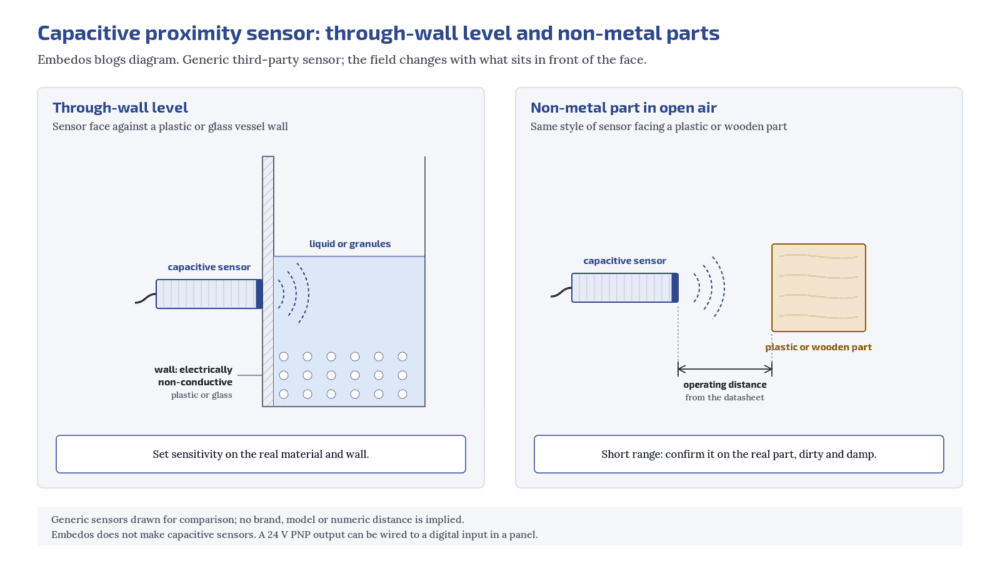
It can also look through a thin, electrically non-conductive wall (plastic or glass) to sense the contents of a vessel. It is a short-range presence sensor, not a long-range distance instrument.
Sensitivity must be set on the real material and then locked, because dust, moisture and nearby metal can look like a target and cause a false trip.
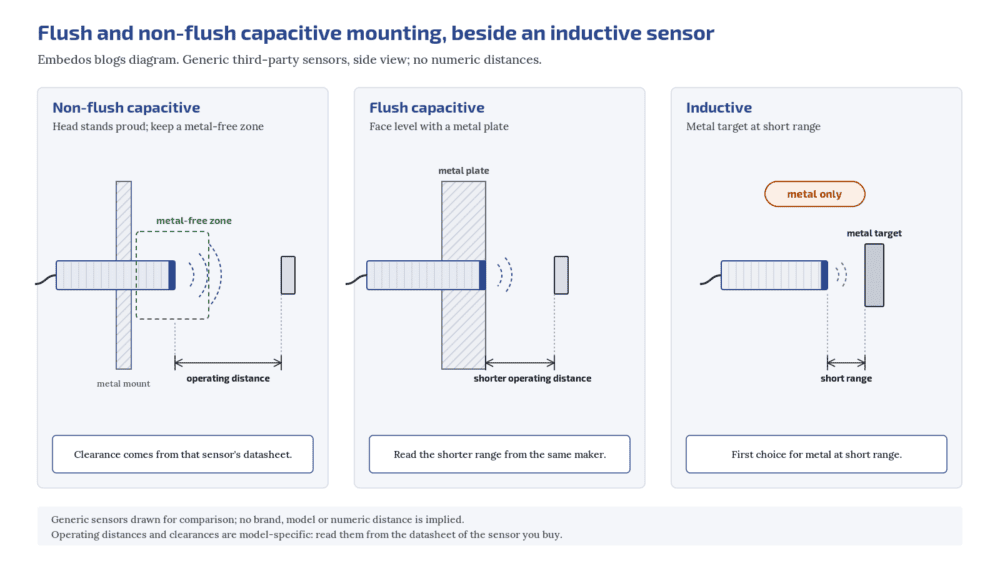
Non-flush (non-embeddable) bodies usually give the longer operating distance, provided you leave the metal-free zone the datasheet asks for around the barrel. A 24 V DC sensor with a PNP output can be wired to a digital input on Maxwell (EM) or Bose (EB).
Who this is for: instrumentation and electrical engineers specifying presence or point-level detection of bulk materials or non-metal parts, including non-flush 4-wire models, who need a checklist for sensitivity setting and for false trips from dust or moisture.
How a capacitive proximity sensor works?
A capacitive proximity sensor looks at a change in capacitance in front of its face. An electrode in the sensor forms an electric field with its surroundings.
When a target, conductive or not, enters that field, the capacitance changes and the output switches. Capacitive, inductive, ultrasonic and photoelectric proximity switches are all in the scope of IEC 60947-5-2 .
Two vendor documents are the primary sources for the application notes below.
Pepperl+Fuchs’ knowledge base on capacitive sensor installation describes flush and non-flush mounting, and why a non-flush sensor needs clearance around the sensing element so the side field is not damped by the mounting (Pepperl+Fuchs, capacitive sensors, installation conditions).
Balluff’s basics and installation guide covers through-wall level sensing on a non-conductive vessel, and the need to set sensitivity on the real material (Balluff, Capacitive sensors: basics and installation).
The rated operating distance is usually quoted against a grounded metal target of a stated size.
Other materials, and a different mounting, change that distance. That is why the sensitivity is adjustable, and why you set it on site, not only from the catalogue.
Where capacitive fits: level and non-metal parts
Capacitive is the better choice when:
- The target is not metal. Plastic parts, wooden pallets, paper, glass, and many films that would be awkward for an inductive sensor.
- You need a point level in a plastic or glass vessel, a hopper or a pipe. The sensor can be used as a through-wall sensor for a liquid or a granule, provided the wall is electrically non-conductive and thin; Balluff gives a maximum of 4 mm for its standard flush models. Balluff’s guide describes mounting the face tightly against a glass or plastic wall and setting the switch point with the real contents, not with an empty vessel.
- You want a simple presence bit, not a continuous level in metres. Most capacitive proximity sensors are digital switches. A 4-20 mA capacitive probe exists as a different product family; do not assume a proximity switch will give you an analog level.
Capacitive is usually a poor first choice when the target is metal at short range (use inductive), or when you need a longer distance, a transparent target in open air, or a dusty flight path that a photoelectric would struggle with (consider ultrasonic).
Flush or non-flush, and 4-wire
Non-flush (non-embeddable) capacitive sensors are the usual choice when you want the longer operating distance for a given diameter.
Pepperl+Fuchs’ installation note is the source for this: a non-flush sensor needs a clearance around the sensing element, defined in that sensor’s technical data, because some of the field leaves the side of the barrel.
If you bury a non-flush barrel in metal, you will damp it.
Flush (embeddable) models can sit in a metal plate with the face level with the surface.
That protects the barrel and reduces side interference. The same Pepperl+Fuchs note states that, for their flush-mountable capacitive sensors, this is done at the expense of detection range: those sensors achieve only about 60 percent of the operating distance of the non-flush versions.
That figure is Pepperl+Fuchs’, for their flush versus non-flush capacitive sensors. Do not copy it onto another maker’s range, and do not treat it as a universal ratio. If the tender asks for non-flush, confirm the metal-free zone on the datasheet of the model you are buying.
If the only space is a metal wall, use a flush model from that same maker and accept the shorter range that maker states.
4-wire DC in a tender often means a sensor with a supply pair and complementary outputs (normally open and normally closed); confirm the output arrangement on the datasheet, rather than assuming a 2-wire AC or DC switch. Confirm 24 V DC, and confirm a PNP output if the receiving input is a sinking input.
That is the combination this guide can take into EM or EB digital inputs.
Why do capacitive sensors false-trip in dusty or damp plants?
Dust, condensation and nearby metal change the capacitance in front of the face. Set sensitivity on the real material, lock it, and test a dirty or damp face before you accept the job.
Sensitivity, dust and moisture
False trips are the usual reason a capacitive sensor is pulled off a vessel.
Dust on the face, condensation, a wet hopper wall, or a metal guard in the side field can look like the target. Balluff’s installation guide is the source for setting the switch point on the real material, and for leaving margin, because temperature and other environmental factors can cause faulty switching near the limit. The practical steps are:
- Mount the sensor as it will be used (through-wall or in free air, flush or non-flush).
- Fill or present the real material, and set the sensitivity or the teach function at that condition, then lock it.
- Test a dirty or damp face, and a nearby metal guard, on purpose, before you accept the installation.
- For level through a wall, consider coating or condensation on the probe or on the wall, and whether a flush face sitting tight on the wall is cleaner than a gap that can fill with dust.
If the material has a low dielectric constant, the operating distance shrinks and the setting becomes tighter. If you cannot get a stable setting on the real material, capacitive may be the wrong type; do not turn the pot to maximum and hope.
When is a capacitive sensor better than an inductive one?
When the target is not metal, or when you need to sense a liquid or a bulk material, including through a plastic or glass wall. Inductive remains the first choice for metal at short range.
Flush or non-flush in a metal plate?
Use a flush model if the barrel must sit in metal, and read the shorter range from that maker’s datasheet. Pepperl+Fuchs states about 60 percent of the non-flush operating distance for their flush capacitive sensors; treat that as their figure, not a universal ratio.
Outputs into a gateway or PLC
A capacitive proximity sensor is, in the usual plant case, a 24 V DC digital presence bit. Wire a PNP (sourcing) output to a sinking digital input.
On Maxwell (EM) and Bose (EB), that is a 24 V PNP sensor into a digital input. Those are the input claims we can make. Other output styles need a matching input, which is outside the scope of this guide.
If you need a continuous level rather than a point, use a level transmitter with a 4-20 mA output into an analog input, not a proximity switch. The 4-20 mA current loop is defined in IEC 60381-1 (IEC webstore). Embedos Edge is the platform for that analog path, and the Edge device belongs in a panel, not on the hopper wall.
Also write down the IP rating, washdown, and whether you want a cable or a connector. Those are environmental choices, not detection choices, but they decide whether the sensor survives the first wet shift.
Why do tenders ask for non-flush 4-wire models?
Non-flush usually gives the longer operating distance, provided the metal-free zone is respected. 4-wire DC often means a 24 V sensor with complementary outputs; confirm the output arrangement on the datasheet, and confirm a PNP output if you are driving an EM or EB digital input.
Capacitive proximity sensor selection checklist
| Area | What to ask or check | Red flag |
|---|---|---|
| Target | Liquid, powder, granule or a non-metal solid recorded | Capacitive specified for a short-range metal target |
| Through-wall | Plastic or glass wall, thickness and a tight face recorded | Through-wall assumed on a metal vessel |
| Distance | Face-to-target or face-to-wall measured | Catalogue range used with no on-site check |
| Mount | Non-flush metal-free zone taken from that datasheet | A non-flush barrel buried in metal |
| Flush | Used only if the same maker’s flush range is acceptable | A 60 percent figure copied from another maker |
| Electrical | 24 V DC PNP into a matching digital input | Output style left as “DC sensor” |
| Setting | Sensitivity or teach set on the real material, then locked | Pot left at maximum |
| False trips | Dust, moisture and nearby metal guards tested on site | First trip discovered after handover |
| Level coating | Condensation or coating on the face or wall considered | Through-wall used on a wall that sweats, with no test |
| When not capacitive | Metal at short range: inductive first; longer range: consider ultrasonic | One sensor type specified for every target |
| Documents | Datasheet, mounting sketch, and a note from the false-trip test | Brochure only |
Where Embedos fits
We do not make capacitive proximity sensors. Choose the sensor from your preferred vendor using the checks above. A 24 V PNP capacitive sensor can be wired to a digital input on Maxwell (EM) or Bose (EB). Embedos Edge is the platform when a related analog signal (for example a 4-20 mA level probe) also needs to be logged. The Edge device goes in a panel.
Download the Free “Capacitive Proximity Sensor Selection Checklist”
Enter your email and the form emails you the copy link to the Google Sheet.
Can a capacitive sensor see through a tank wall?
Yes, if the wall is electrically non-conductive (plastic or glass) and the face sits tightly on it. Set the switch point with the real contents. It will not see through a metal wall.
Can I wire this into an Embedos device?
A 24 V PNP sensor can be wired to a digital input on EM or EB. That is the input path this guide covers. Do not assume other output styles on those inputs.
Next step! Send us a Mail
Send us the stroke, the resolution and speed you need, how the sensor will be mounted (in a cylinder, on a profile or with a wire), the conditions at the sensor head and the input your PLC accepts.
Help Us Help You Leverage The Power Of Industrial Automation & Industrial IoT - IIoT.