
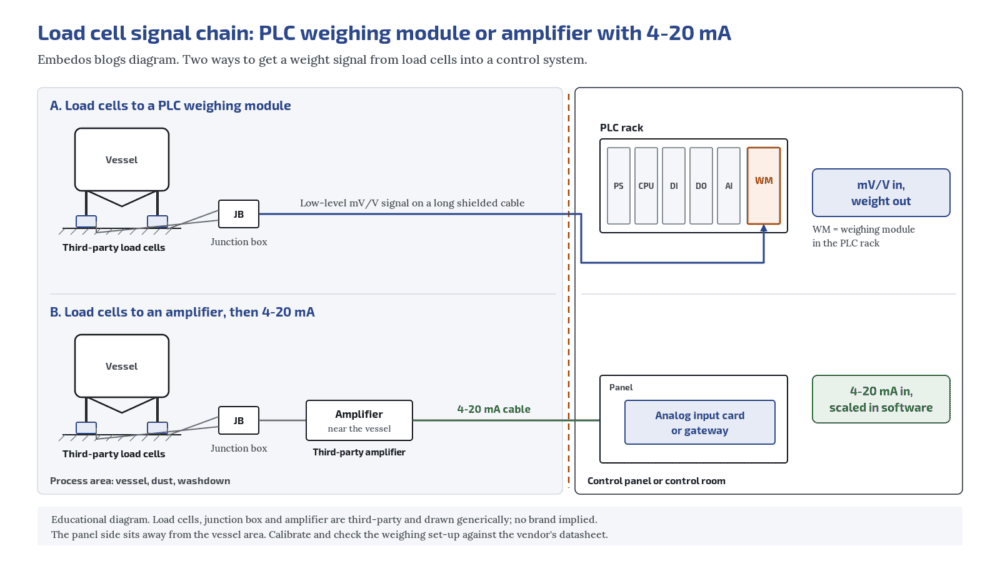
A strain gauge load cell gives a signal of a few millivolts, so it cannot be wired straight into a normal PLC analog input. You have two main ways to get weight into a PLC.
A load cell weighing module for the PLC connects the load cells directly, powers the bridge, reads the millivolt signal and gives the PLC a calibrated weight with tare, zero and filling functions.
A load cell amplifier or weighing transmitter sits near the load cells and converts the signal to 4-20 mA, 0-10 V or a fieldbus value that any analog input or gateway can read.
Choose the weighing module for fast batching, filling and dosing where the PLC acts on weight in real time, or where trade approval is involved (the approval covers the complete weighing instrument, so check that the module is part of an approved model).
Choose an amplifier for tank inventory, monitoring and long cable runs where a standard analog signal is easier to carry and log.
Automation, instrumentation and process engineers specifying tank, hopper or batch weighing in food, chemical, steel and building material plants.
How a load cell makes its signal
Most industrial load cells are strain gauge types: strain gauges bonded to a metal element, wired as a Wheatstone bridge. FUTEK’s primer covers the main load cell types and how the bridge output changes with load (what is a load cell).
The bridge needs a supply, called excitation, and gives a small output in proportion to it. That is why load cell sensitivity is quoted in mV/V: millivolts of output, at full rated load, per volt of excitation. HBK’s training notes work through it (HBK: pros and cons of amplified force sensors):
- A 2 mV/V load cell with 5 V excitation gives 10 mV at full load.
- The same cell with 10 V excitation gives 20 mV at full load.
Now compare that with a standard PLC analog input built for 0-10 V. A 10 mV full-scale signal is one thousandth of the input range. Tiny noise becomes a large weight error, and the input’s own resolution is spread over a range the signal never uses.
That is the whole reason weighing modules and amplifiers exist.
4-wire and 6-wire load cells
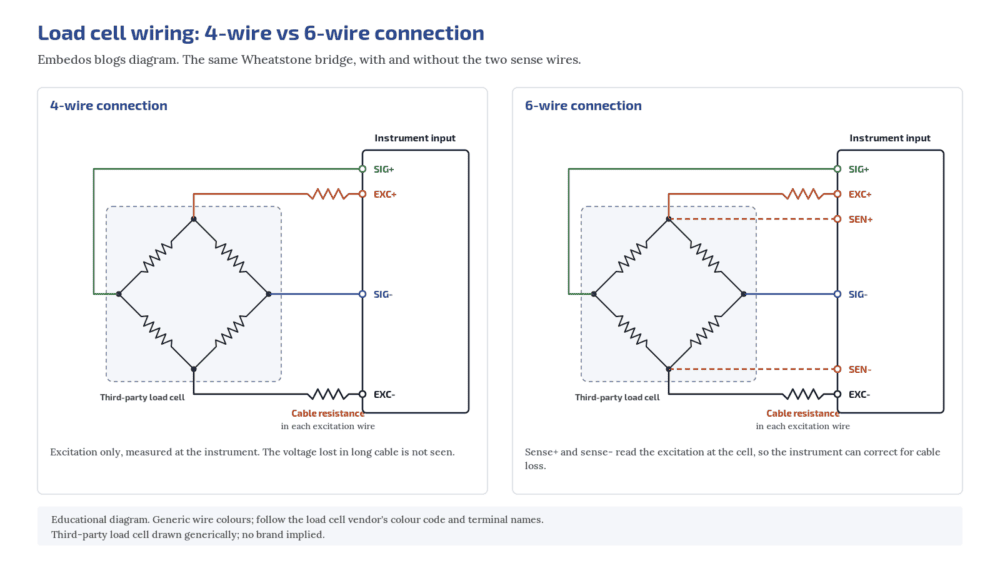
A 4-wire load cell has two excitation wires and two signal wires. The cable resistance drops part of the excitation voltage before it reaches the bridge, so the sensitivity changes with cable length and temperature. HBK’s notes show this effect for 4-wire circuits.
A 6-wire load cell adds two sense wires that measure the excitation at the bridge itself. The instrument uses that reading to correct for the cable, so sensitivity no longer depends on cable resistance. For a 4-wire cell, do not cut or extend the cable without checking the calibration; for long runs, prefer 6-wire cells and a 6-wire instrument.
Option A: a weighing module in the PLC
A weighing module is a PLC card built for strain gauge load cells. Siemens’ manual for its SIWAREX WP521/WP522 modules is a good public example of what such a module covers (SIWAREX WP521/WP522 manual):
- It supplies the load cells (4.85 V on this module) and reads cells rated 1 to 4 mV/V, in 4-wire or 6-wire connection.
- It requires a junction box when more than one load cell is connected, with the cells wired in parallel.
- It is calibrated with test weights or adjusted without them using the load cells’ characteristic values.
- It gives the PLC a weight value directly, with tare, zero and setpoint functions, plus its own digital inputs and outputs and Modbus interfaces.
- It monitors the load cell wiring for breaks.
When a module wins:
- Batching, filling and dosing, where the PLC must cut a feeder or valve at a target weight. The module’s own setpoints and digital outputs are built for this job.
- Multi-ingredient recipes on one vessel, where the weight drives each step.
- Trade or regulatory use, where an approved weighing chain is needed (see the OIML and Legal Metrology section below).
Trade-offs: you are tied to the PLC platform, the load cell cable must run to the PLC panel (or to an extension box), and commissioning needs someone who knows the module’s calibration procedure.
Option B: a load cell amplifier or weighing transmitter
An amplifier, also called a weighing transmitter or load cell transmitter, sits near the vessel, often next to the junction box. It powers the bridge, amplifies the millivolt signal and outputs 4-20 mA, 0-10 V or a fieldbus value.
When an amplifier wins:
- Tank and silo inventory, where you need a weight trend, a low-level alarm and a daily figure, not a cut-off in a fraction of a second.
- Long distances from vessel to panel. A 4-20 mA loop carries the signal much better than a millivolt pair, and the current loop is a standardised signal per IEC 60381-1 (IEC webstore).
- Mixed systems, where the same weight goes to a PLC, a SCADA and a remote dashboard.
- Retrofits, where the PLC has spare analog inputs but no slot or budget for a weighing card.
Trade-offs: calibration lives in two places, the span set in the amplifier and the scaling in the PLC, so record both. The analog chain adds its own noise and resolution limits, so check the amplifier datasheet against the smallest weight change you need to see. Tare and zero logic move into the PLC program.
If the amplifier’s analog output feeds channels in the same panel as other loops with different grounds, read our note on 4-20 mA signal isolators and ground loops.
Option C: amplifier plus edge logging
For monitoring only, such as silo stock across sites or a weight trend for maintenance, the 4-20 mA from an amplifier can go to an edge device or gateway that logs it and sends it to a dashboard. The weighing itself is still done by the load cells and amplifier; the gateway only records and transmits the analog value.
Calibration basics
Whichever option you choose, plan calibration from the start:
- Zero (dead load). With the vessel empty and all fixed attachments in place, set zero.
- Span with test weights. Add known weights, ideally close to the working range, and set the span. The Siemens manual above describes calibration points defined by calibration weights.
- Check linearity. Add and remove weights in steps and record the readings both ways.
- Theoretical adjustment using each load cell’s characteristic value (its certified mV/V) is possible on some instruments when test weights cannot be placed, for example on a large silo. Treat it as a starting point and verify with a known material quantity where you can.
Record the calibration date, the weights used and the readings. For the amplifier route, also record the amplifier span and the PLC scaling.
Noise and installation
Most weighing problems are mechanical or wiring, not electronic:
- Cable. Use shielded, twisted-pair load cell cable and earth the shield as the instrument manual specifies; the Siemens manual requires shielded twisted pairs for sense, signal and supply wires and grounds the shield close to the module. Keep load cell cables away from motor and VFD power cables.
- Junction box. Where several load cells are summed, use a proper junction box and keep it dry.
- Mechanical forces. Rigid pipes, cable trays or walkways attached to a weighed vessel carry part of the load and spoil the reading. Mettler Toledo’s vessel piping guide shows how to lay out pipes and flexible connections so they do not push or pull on the vessel (vessel piping design).
- Vibration and wind. Agitators, nearby machines and wind on outdoor silos add noise. Instrument filters help but slow the reading, which matters for fast filling.
OIML R76, R60 and Legal Metrology in India
If weight is used only to run the process, you are doing process weighing. If you sell, buy or charge by that weight, it is trade weighing and legal metrology rules apply.
- OIML R 76 covers non-automatic weighing instruments (OIML R 76:2006). It classifies instruments by the verification scale interval (e), which represents absolute accuracy, and the number of verification scale intervals (n = Max / e), which represents relative accuracy, into four accuracy classes: special (I), high (II), medium (III) and ordinary (IIII) (R 76-1 text).
- The verification scale interval is not the same as the display division (d). NIST explains the difference clearly (NIST: d versus e).
- OIML R 60 is the metrological regulation for load cells (OIML R 60:2017). Load cell datasheets often quote an OIML R 60 class; read it together with the instrument requirements, not on its own.
- India. Weighing instruments used for trade need model approval under the Legal Metrology Act, 2009 and the Legal Metrology (Approval of Models) Rules, 2011 (the Act and Rules are published by the Department of Consumer Affairs: Legal Metrology Act and rules). If your weight will appear on an invoice, involve your legal metrology contact before you choose hardware.
Load cell weighing module for PLC: buyer checklist
| Item | PLC weighing module | Amplifier / weighing transmitter |
|---|---|---|
| Purpose | Batching, filling, dosing, trade | Inventory, monitoring, long runs |
| Load cell input | mV/V range the module accepts; 4 or 6-wire | mV/V range the amplifier accepts; 4 or 6-wire |
| Number of cells | Junction box for more than one | Junction box for more than one |
| Output to PLC | Weight value over the backplane or Modbus | 4-20 mA, 0-10 V or fieldbus |
| Cable to panel | Load cell cable or extension box | 4-20 mA pair |
| Calibration | In the module: weights or characteristic values | In the amplifier, plus scaling in the PLC |
| Tare and zero | In the module | In the PLC program |
| Setpoints | Module setpoints for cut-off | PLC logic on the analog value |
| Trade use | Check the approved weighing chain | Usually process only |
| Installation | Shielded twisted pairs; flexible vessel connections | Same |
Where Embedos fits
We do not make a weighing module or a load cell amplifier.
Where weight is needed for monitoring, a third-party load cell amplifier or weighing transmitter can send its 4-20 mA or 0-10 V output into an analog input on an Embedos Edge device, an Embedos Maxwell (EM) card or an Embedos Bose (EB) HMI, which then logs and displays the value.
Download the Free “Load Cell Signal and Calibration Worksheet”
Enter your email and the form emails you the copy link to the Google Sheet.
Common questions
Can I connect a load cell directly to a PLC analog input?
No, not to a standard 4-20 mA or 0-10 V input. The load cell gives millivolts. Use a weighing module or an amplifier between them.
What does 2 mV/V mean?
At full rated load, the load cell outputs 2 mV for every volt of excitation. With 10 V excitation that is 20 mV at full load.
Weighing module or 4-20 mA amplifier for a silo?
For stock monitoring, an amplifier with 4-20 mA is usually simpler. For filling to a target weight, a weighing module reacts faster and keeps the logic in one place.
Why is my tank weight drifting?
Check mechanical connections first: rigid pipes, cable trays or walkways touching the vessel. Then check cable shielding, moisture in the junction box and temperature effects on 4-wire cables.
Do I need a legal-for-trade weighing system?
Only if the weight is used for trade, such as selling or charging by weight. In India, weighing instruments used for trade must be of a model approved under the Legal Metrology Act, 2009 and the Approval of Models Rules, 2011.
How many load cells does a tank need?
That depends on how the vessel is supported. Follow the load cell maker’s mounting guidance and use a junction box to sum the cells.
Next step! Send us a Mail
Send us the stroke, the resolution and speed you need, how the sensor will be mounted (in a cylinder, on a profile or with a wire), the conditions at the sensor head and the input your PLC accepts.
Help Us Help You Leverage The Power Of Industrial Automation & Industrial IoT - IIoT.