
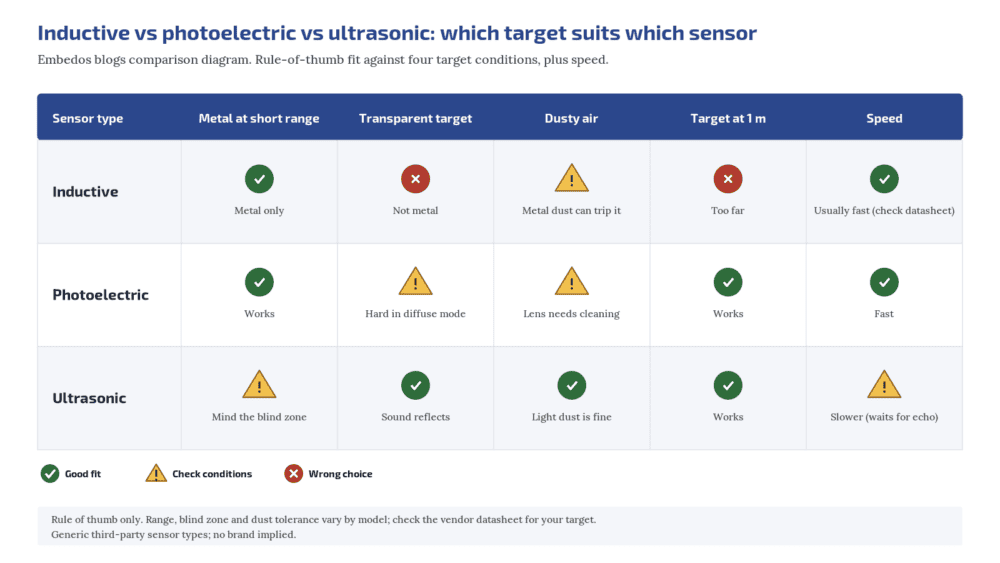
An ultrasonic proximity sensor beats an inductive sensor when the target is not metal, or is metal but too far away for an inductive field.
It beats a photoelectric sensor when the target is transparent, shiny or dark, or the air is dusty enough to blind a lens.
It measures distance from the echo time of a sound pulse, so colour, transparency and surface shine do not matter.
It has limits that matter in a steel plant: a blind zone just in front of the face, a beam that spreads with distance, a range that falls in heavy dust, hot air and humidity, and unreliable echoes from red-hot stock, where air turbulence scatters the sound.
Use inductive for metal targets close to the face (millimetres to a few tens of millimetres, per the datasheet), ultrasonic for non-metal, liquid, bulk or transparent targets at centimetres to metres, and a sensor built for hot targets near red-hot steel.
Who this is for: instrumentation and electrical engineers in steel, sinter, coke, cement and power plants writing a spec for presence, position or level detection where inductive and photoelectric sensors have already given trouble.
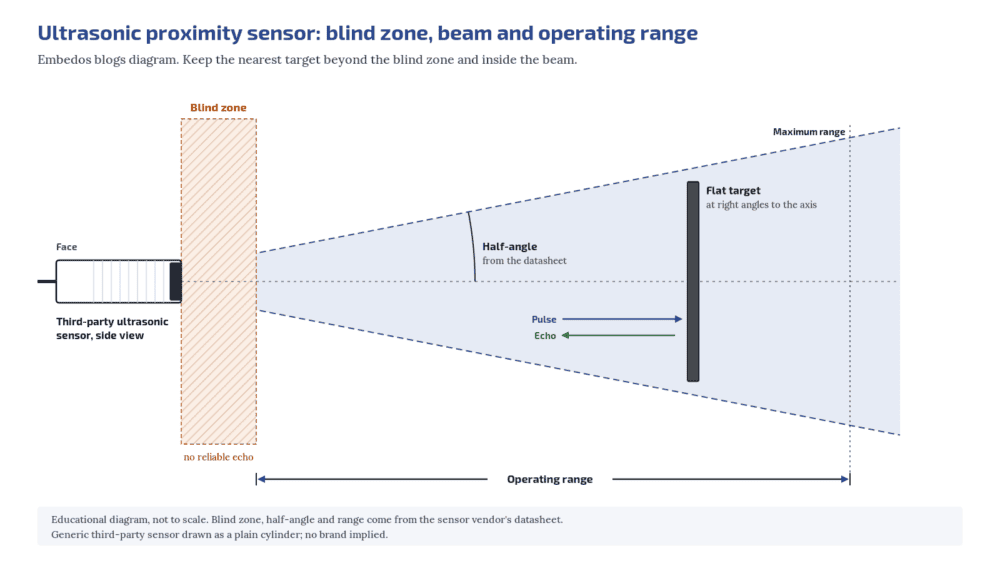
How an ultrasonic proximity sensor works
The sensor sends a short pulse of ultrasound and times the echo from the target. Knowing the speed of sound, it works out the distance and then either switches an output at a set distance or gives an analog value proportional to distance. Pepperl+Fuchs‘ technology guide is a clear primary reference on the principle and its limits
Ultrasonic proximity switches are covered, along with inductive, capacitive and photoelectric types, by IEC 60947-5-2.
Its scope describes ultrasonic types as sensing “the presence of sound reflecting objects”, and that phrase is the key to selection: if the target reflects sound towards the sensor, it can be detected, whatever its material or colour.
Can an ultrasonic sensor detect hot steel?
Not reliably near red-hot stock. Hot objects cause air turbulence that scatters the sound. Use a sensor designed for hot targets.
Where ultrasonic beats inductive
An inductive sensor detects metal only, and only within a short distance of its face. Ultrasonic is the better choice when:
- The target is not metal. Coal, sinter, limestone, refractory bricks, wooden pallets, rubber belts, plastic, glass and liquids all reflect sound.
- The gap is large. Ultrasonic sensors work from a few centimetres up to several metres depending on the model, which lets you mount the sensor out of the way of moving equipment and falling material.
- You need a distance, not just presence. With an analog output, the same sensor reports how far away the target is, for example the height of material in a chute or bin.
- Metal dust and scale would trigger an inductive sensor. Metallic fines or mill scale building up on an inductive face can cause false switching. Light dust on an ultrasonic transducer does not affect the measurement.
Does steam affect ultrasonic sensors?
Humidity reduces range, and water droplets or condensation on the face impair the sensor. Mount away from the steam path and keep the face dry.
Where ultrasonic beats photoelectric
Photoelectric sensors depend on light reaching the receiver. Ultrasonic wins when:
- The target is transparent or shiny. Glass, clear film, water and polished metal are hard for diffuse photoelectric sensors. To an ultrasonic sensor, colour is of no consequence and surfaces can be rough, smooth, glossy or transparent.
- The air carries dust or the lens gets dirty. Light dust and dirt deposits on an ultrasonic transducer do not influence the measurement. A photoelectric lens in a coal handling or sinter area needs air purge and cleaning to keep working.
- The target is dark or changes colour. Colour does not change the echo.
Is ultrasonic better than inductive in a dusty plant?
For non-metal or distant targets, yes. For a metal target close to the face, inductive is simpler, usually faster and unaffected by non-metal dust.
Where ultrasonic struggles: steel plant conditions
Ultrasonic is not a fix for every harsh area. Check each of these against your location.
Red-hot stock. Particularly hot objects such as red-hot metal create strong air turbulence, and the ultrasound can be scattered or deflected so that no usable echo returns.
Do not use a general ultrasonic sensor to detect hot billets, slabs or bars at a mill stand. Use a sensor designed for hot targets; laser distance sensors, for example, are sold for measuring hot steel slabs in steel mills (SICK Dx1000 overview).
Air temperature. The speed of sound changes by about 0.17% per degree Celsius. As an illustration, a 40°C rise in air temperature changes the speed of sound by roughly 7%, which on an uncompensated reading at 1 m is about 70 mm.
Most industrial ultrasonic sensors have a temperature probe and compensate for this, but the probe reads the air at the sensor, not along the whole path.
A path that crosses hot and cold air layers, as near furnaces and ladles, still adds error. Check the operating temperature on the datasheet; one vendor states a working range of about -25 to +70°C for most of its sensors, which rules out many spots in a melt shop.
Heavy dust, steam and humidity. Heavy dust, rain or snow reduces acoustic energy and shortens the maximum range, and range also falls with rising temperature and humidity. Water droplets or crust on the transducer face impair the sensor. In steam, condensation on the face is the bigger risk: mount the sensor away from the steam path, angled so water runs off, or use a protective enclosure as the maker suggests.
Sound-absorbing targets. Soft, fibrous or foamy targets (felt, wool, foam rubber) return weak echoes and shorten the range.
Slanted smooth surfaces. A smooth surface must face the sensor at close to 90 degrees, or the echo goes elsewhere. Rough surfaces, such as heaps of coarse material, tolerate much larger angles at reduced range.
Noise and neighbours. External noise at the same frequency as the sensor, such as stone being dumped into a silo, can mask the echo. Two ultrasonic sensors close together can hear each other’s pulses; use models with synchronisation or multiplex inputs and follow the maker’s minimum spacing.
Gas other than air. Ultrasonic sensors are designed for atmospheric air. In other gases, such as carbon dioxide, the speed of sound and attenuation change and measurement can fail.
What is the blind zone of an ultrasonic sensor?
The area just in front of the face where the sensor cannot detect a target because the transducer is still ringing from its own pulse. The datasheet gives its size.
Blind zone and beam angle: the two numbers to read first
Blind zone.
The transducer keeps vibrating for a moment after it sends a pulse, so it cannot receive an echo straight away. That creates a blind zone directly in front of the face where targets cannot be reliably detected (EGE ultrasonic sensors brochure).
Mount the sensor so the nearest possible target position is beyond the blind zone stated on the datasheet.
Thru-beam ultrasonic sensors, with separate emitter and receiver, have no blind zone.
Beam angle.
The sound leaves in a cone. Makers define the edge of that cone differently.
The beam angle is the angle at which the pulse energy is “reduced of 33% of its maximum value”, and a flat target should not be tilted by more than half the beam angle.
Pepperl+Fuchs instead publishes sound beam diagrams measured with a standard 100 × 100 mm plate and a 25 mm rod. Compare beam angles only within one maker’s definition, and read the diagram for a target like yours.
A wide beam picks up nearby structures such as chute walls, rails and brackets; a narrow beam needs careful aiming.
Draw the cone on your layout drawing, at the working distance, before you fix the mounting point.
Operating modes
- Diffuse (direct detection): one sensor head; the target itself reflects the pulse. Simplest to install. Has a blind zone.
- Retro-reflective: the sensor watches a fixed reference reflector, such as a plate or wall, and switches when a target disturbs that echo. Recommended for sound-absorbing or slanted targets, and has no blind zone in this mode.
- Thru-beam: separate emitter and receiver facing each other. Longest range, most resistant to disturbance and fastest switching; needs two heads and two cables.
Outputs and wiring
Ultrasonic sensors come with switching outputs (PNP or NPN, NO or NC), analog outputs (current or voltage, rising or falling with distance), or both.
Many can be taught their switching points or analog limits by a button, a teach input, a potentiometer or software.
For a switching output, match PNP or NPN to the input card as you would for an inductive sensor.
For an analog output, prefer 4-20 mA for cable runs from the field to the panel; the current loop is standardised in IEC 60381-1.
An ultrasonic sensor has to wait for each echo, so its switching frequency is usually below 10 Hz, or up to about 100 Hz for thru-beam types.
Standard inductive sensors are usually rated in the hundreds of hertz or more, though some long-range and weld-immune inductive types are much slower.
Ultrasonic is the wrong choice for counting gear teeth or fast slots on a shaft.
Can I mount two ultrasonic sensors side by side?
Only with enough spacing or with synchronisation, otherwise they hear each other. Follow the maker’s spacing guidance.
Ultrasonic proximity sensor selection checklist
| Check | Ultrasonic | Inductive | Photoelectric |
|---|---|---|---|
| Target material | Any sound-reflecting target | Metal only | Any, but colour and shine matter |
| Range | Centimetres to metres | Short: millimetres to tens of mm | Centimetres to metres |
| Transparent or shiny target | Good | Metal only | Difficult in diffuse mode |
| Dust on the face | Light dust not critical | Metal dust can false-trigger | Needs purge and cleaning |
| Heavy dust, steam | Range drops; keep face dry | Fine for non-metal dust | Range drops |
| Red-hot stock nearby | Avoid; use a hot-target sensor | Check temperature rating | Use a hot-target type |
| Near-face target | Blind zone applies | Fine | Mode dependent |
| Speed | Slower (waits for echo) | Usually fast (check datasheet) | Fast |
| Output | PNP / NPN, 4-20 mA / 0-10 V | PNP / NPN | PNP / NPN, some analog |
| Standard | IEC 60947-5-2 | IEC 60947-5-2 | IEC 60947-5-2 |
Where Embedos fits
Choose the sensor using the checks above.
If you want to log the distance or level, an ultrasonic sensor with a 4-20 mA or 0-10 V output can be wired to an analog input on an Embedos Edge device.
The Edge device is an IP20 unit, so it goes in a panel or control room away from the hot and dusty zone, with the sensor cable run back to it.
Download the Free “Ultrasonic vs Inductive vs Photoelectric Checklist”
Enter your email and the form emails you the copy link to the Google Sheet.
Can ultrasonic sensors see glass or clear film?
Yes. Transparency and colour do not affect an ultrasonic echo, which is why ultrasonic often replaces photoelectric for clear targets.
Next step! Send us a Mail
Send us the stroke, the resolution and speed you need, how the sensor will be mounted (in a cylinder, on a profile or with a wire), the conditions at the sensor head and the input your PLC accepts.
Help Us Help You Leverage The Power Of Industrial Automation & Industrial IoT - IIoT.