
Data center noise levels inside the white space commonly sit in the mid 80s to mid 90s dBA, close to where long shifts start to damage hearing. In Maharashtra, Schedule XXIV of the Maharashtra Factories Rules, 1963 sets 90 dBA for 8 hours with a 5 dB exchange rate; NIOSH recommends 85 dBA for 8 hours with a 3 dB exchange rate, which is stricter.
Measure the hall, measure the people, cut noise at source first, and issue hearing protection that is fitted and worn. Engineering guidance, not legal advice: whether Factories Act schedules cover your site depends on registration and state rules.
Who this is for: facility, EHS and operations engineers running data halls, and contractors who spend long shifts in them. Neighbours outside: health effects.
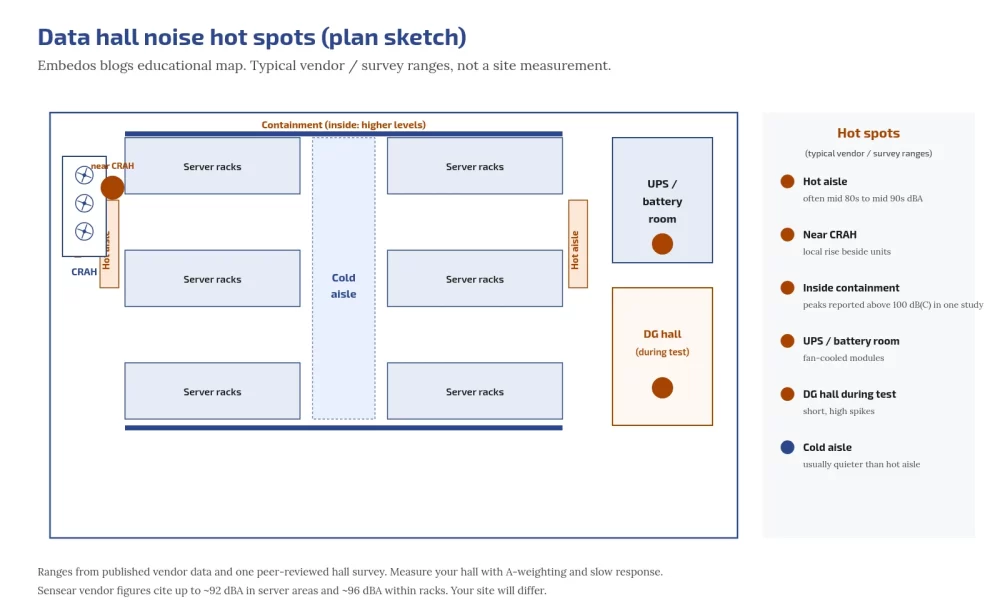
How loud inside, and where
Most indoor noise is fan noise: server fans plus CRAH/CRAC overview .
Published surveys are scarce. Vendor infographics (for example Sensear) put server areas up to about 92 dBA and within racks higher; treat as vendor data. A peer-reviewed field study of a large air-cooled hall (ISO 9612) found average exposure often above 85 dBA, with C-weighted peaks above 100 dB inside cold-aisle containment (Cho et al., Journal of the Architectural Institute of Korea, 2026, )
Hot spots: hot aisle behind dense racks, next to CRAH, inside containment, UPS/battery rooms, DG hall during tests. Compare declared IT noise via free ECMA-74 / ECMA-109.
How many decibels is a data center inside?
Vendor data and one peer-reviewed hall survey put many areas at or above 85 dBA. Your hall differs with density and containment; measure it.
Indian schedules vs NIOSH and OSHA
Factories Act 1948 has no noise table; states set Schedule XXIV. Maharashtra Factories Rules, 1963 Schedule XXIV (as on 1 Sep 2025 PDF): 90 dBA for 8 h, 5 dB exchange, no exposure above 115 dBA, impulse 140 dB peak (Maharashtra PDF )
Engineering/admin controls first; protectors; audiometry within 14 days of employment then at least yearly where the schedule applies.
NIOSH REL: 85 dBA 8-h TWA, 3 dB exchange. OSHA 29 CFR 1910.95 uses 90 dBA / 5 dB with 85 dBA action level (US reference only). Many operators adopt NIOSH internally even if Factories schedules apply differently. Maharashtra 2026 draft OSH rules proposing 85 dBA were draft when last checked; verify status before planning to them.
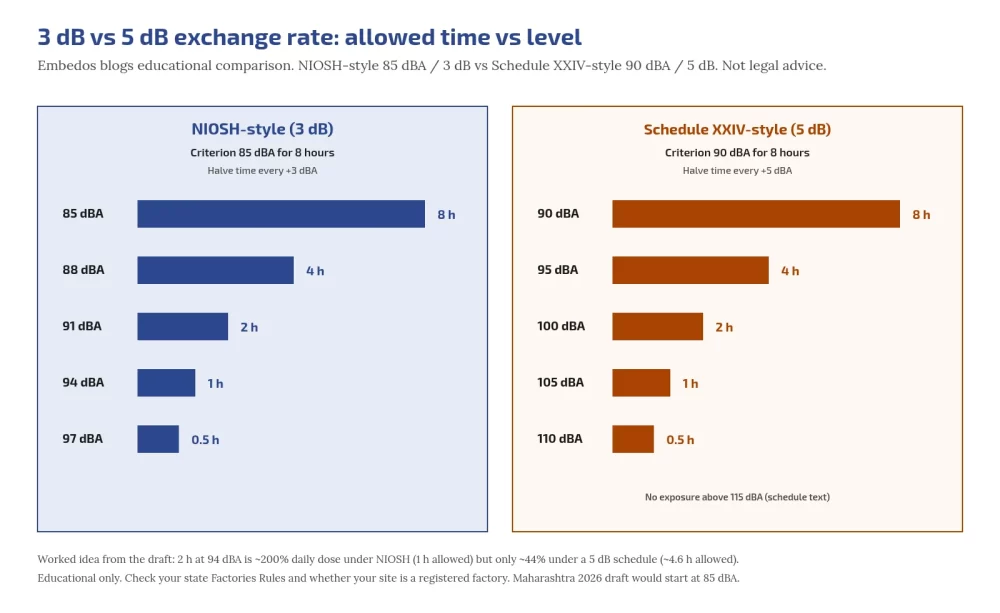
Why exchange rate changes the answer
3 dB is about equal energy (doubling). 5 dB allows more time at high levels. Illustrative: 2 h at 94 dBA is about 200% NIOSH daily dose (allowed 1 h) but under about 44% on a 5 dB schedule reading.
An 8 hr shift at 88 dBA is 200% NIOSH dose; Schedule XXIV text that ignores below 90 dBA can read as zero dose on a strict reading. Write your internal rule down.
Which occupational limit does NIOSH recommend?
85 dBA as an 8-hour TWA with a 3 dB exchange rate.
Area monitoring vs personal dosimetry
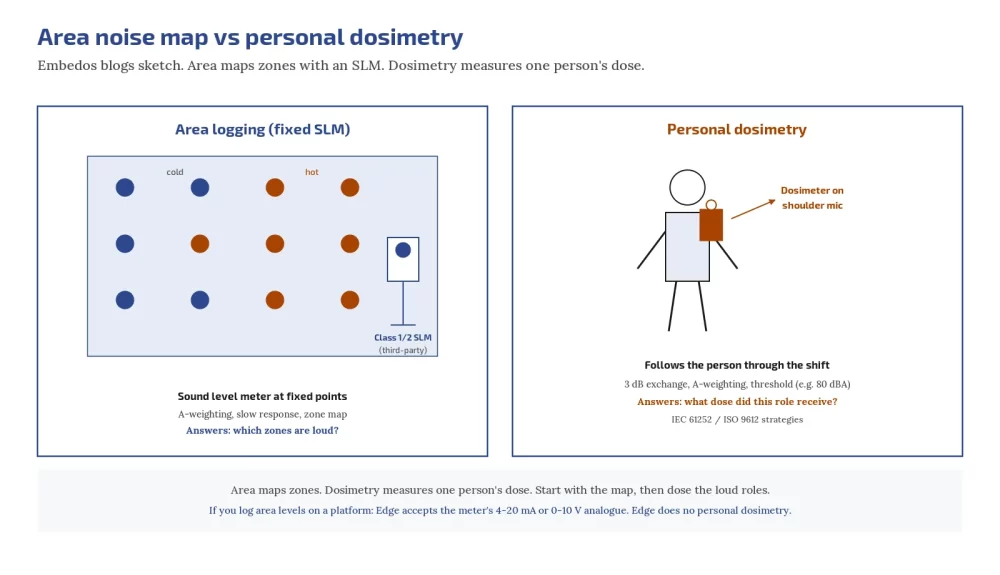
NIOSH: sound level meter maps an area; dosimeter measures one person. Map with A-weighting, slow response, equipment running. Type 1/2 meter; IEC 61672-1 for instruments (IEC).
Dosimetry strategies: ISO 9612 (paid); personal meters IEC 61252 (paid). Class labels apply to the third-party instruments, not to Edge.
Speech, alarms and controls order
If you raise your voice at arm’s length, noise is likely hazardous (NIOSH rule of thumb). Use hand signals/radio read-backs and visual beacons in loud zones.
Order: quieter equipment (ECMA-109), slower fans (fan acoustics), separate people from sources (passive),
limit time, then protectors. NIOSH: consumer ANC headphones are not hearing protection unless labelled with an NRR (NIOSH PPE)
See ANC post.
Hearing conservation checklist
- Write internal limit (Schedule / NIOSH / both).
- Map hall; mark zones above limit; post signs.
- Dosimetry on high-exposure roles.
- Fix sources first.
- Issue rated protectors; fit test; train.
- Baseline and periodic audiometry per applicable schedule / NIOSH advice.
- Re-measure after rack/cooling changes; keep records.
Area logging with Edge, not dosimetry
Embedos Edge is our platform. Edge can log readings from a third-party sound level meter, noise meter or recorder via 4-20 mA or 0-10 V analogue inputs.
Edge has no built-in microphone and does not do dosimetry; the meter measures. EmView monitoring/dashboard/SCADA can show those logged readings at https://emcommandview.embedos.io/; report exports HOLD. Class 1/2 under IEC 61672 refers only to the third-party meter.
Scaling: https://tools.embedos.io/4-20ma-loop-scaling-calculator/.
Edge monitors area levels from a wired third-party meter; it does not replace personal dosimeters.
Do you need hearing protection in a data center?
Where maps or dosimetry show exposure above your limit, yes, until controls bring it down.
Next step
Send your hall layout, any existing noise map and which limit you use internally, and we will help you plan fixed area meter logging (not personal dosimetry).
Email: team@embedos.io
Help Us Help You Leverage The Power Of Industrial Automation & Industrial IoT – IIoT.