
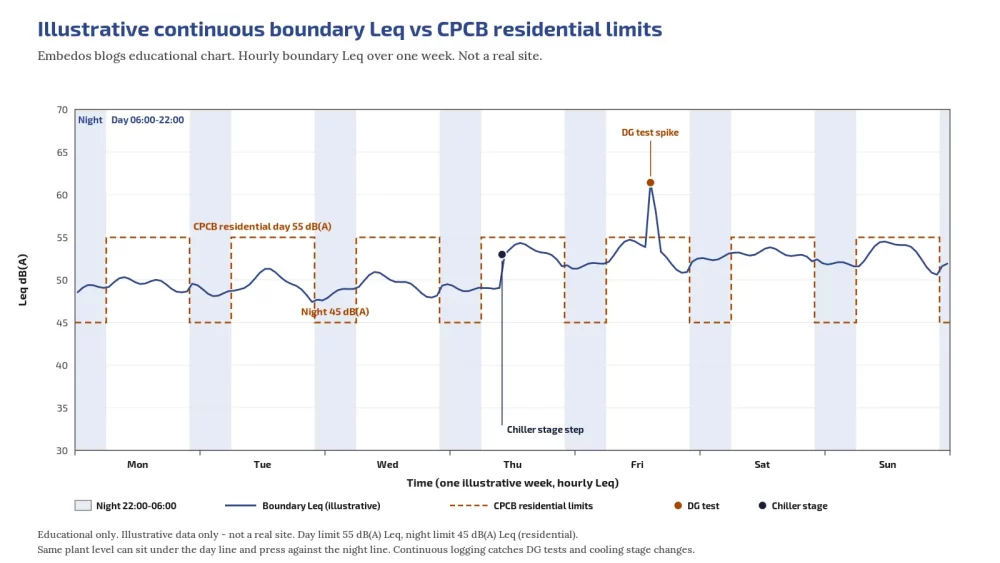
To keep proving compliance, an operating data center needs continuous boundary logging that compares day and night Leq with the CPCB zone limits (CPCB Noise Rules 2000) while chillers, dry coolers and DG tests change the plant from hour to hour.
Log at fixed property line points facing the nearest receptors, tag every record with plant state, and keep the raw data ready for a complaint.
Who this is for: facility managers, EHS leads, community liaison staff and consultants supporting an operating data center in India.
One survey vs continuous compliance: what each is for
A snapshot answers one question at one time. It is the right tool for an acceptance test after commissioning, an annual check, or an attended visit after a complaint. It is usually done with a Class 1 meter, an operator on site, and a written report.
A continuous program answers a different question: does the site stay inside its limits on every night of the year, including the nights when two chillers are on and the DG is under test? It uses permanent or long-term loggers, covers both the day and night windows, and raises alarms before neighbours notice.
You need both. The prediction work belongs in predicting night noise before you build, and meter class, Leq, L90 and spectra are covered in Class 1 vs Class 2 sound level meters. This post covers what happens after handover.
Is a post-construction noise study enough for compliance?
It is a necessary first step, not the end. A post-construction study proves the site met its limits on the days it was measured, with the plant state of those days. Cooling load, weather, equipment wear and DG test schedules all change later, so ongoing logs are what show the result still holds.
What changes after the data center is live
The plant you predicted is not the plant you run.
- Cooling stages with IT load and weather. More fans and compressors run on hot afternoons and as halls fill. See how cooling plant noise changes with load.
- DG testing is intermittent and loud. A monthly or weekly test can dominate a boundary reading for its duration.
- Failures shift load. When one fan fails, the others in the bank speed up, and the level and tone at the fence change.
- Night ambient drops. Road and city background falls after 10:00 p.m., so the same plant is easier to hear at night.
Outside India, some local authorities now write post-construction studies, recurring tests or permanent boundary monitors into data center approvals. One example is the Fairfax County data center noise study requirements ( foreign context only, not an Indian rule). In India the compliance frame is the CPCB ambient schedule plus any condition in your own consent.
Why do data centers need continuous noise monitoring?
Because the noise changes all the time. Cooling plant follows load and weather, DG tests come and go, and night background is lower. One reading cannot show all of those states. Continuous logs show trends, catch step changes early and give you a record when someone asks.
Which numbers the continuous log must compare against
The Noise Pollution (Regulation and Control) Rules, 2000 set ambient limits in dB(A) Leq by zone (CPCB C1, Delhi Noise Limit
| Zone | Day Leq dB(A) | Night Leq dB(A) | Night is lower by |
|---|---|---|---|
| Industrial | 75 | 70 | 5 dB |
| Commercial | 65 | 55 | 10 dB |
| Residential | 55 | 45 | 10 dB |
| Silence zone | 50 | 40 | 10 dB |
Day is 6:00 a.m. to 10:00 p.m. and night is 10:00 p.m. to 6:00 a.m. A silence zone covers not less than 100 m around hospitals, educational institutions and courts, as declared by the State Government. Rule 7(1) lets a person complain when the ambient standard is exceeded by 10 dB(A) or more, or when night restrictions are broken.
DG sets have a separate product limit. New sets up to 1000 kVA made on or after 1 January 2005 must not exceed 75 dB(A) at 1 m from the enclosure, and user-end enclosures and exhaust mufflers need at least 25 dB(A) insertion loss, or must meet the ambient standard, whichever is higher (CPCB DG noise limits C2 ; Delhi noise limit).
That limit sits at the set. Your boundary log is judged against the ambient table above. This is not legal advice; confirm the zone category and any consent condition with your consultant or SPCB.
What are the CPCB day and night ambient noise limits?
Industrial 75 day and 70 night, commercial 65 and 55, residential 55 and 45, silence zone 50 and 40, all in dB(A) Leq. Day runs 6:00 a.m. to 10:00 p.m. and night runs 10:00 p.m. to 6:00 a.m. Night is 5 dB lower in industrial areas and 10 dB lower in the other zones.
Post-construction check first, then the ongoing program
Start with one careful attended check once the site runs near its design load.
- Measure at the same boundary and receptor points used in the baseline, so results line up.
- Record plant state for every interval: chiller and dry cooler stages, DG on or off, IT load band.
- Cover both windows. A daytime pass alone tells you little about the 45 dB(A) residential night limit.
- Compare with the prediction from the impact assessment. Large gaps point to a source or path the model missed.
- Choose the permanent points for continuous logging from what you learned.
There is no Indian rule we can point to that makes a permanent boundary monitor mandatory for every data center. Some US ordinances ask for one; treat that as context, and check your own consent or SPCB conditions with your consultant. Many operators keep continuous logs anyway because they are the fastest way to answer questions.
How often should noise be checked after a data center starts up?
Do an attended check after startup at near design load, then keep continuous logs at the boundary. Add an attended Class 1 check after any major cooling or DG change, after a complaint, and on whatever schedule your consent or SPCB condition sets. US annual retest rules are context only.
Where to place permanent or long-term boundary monitors
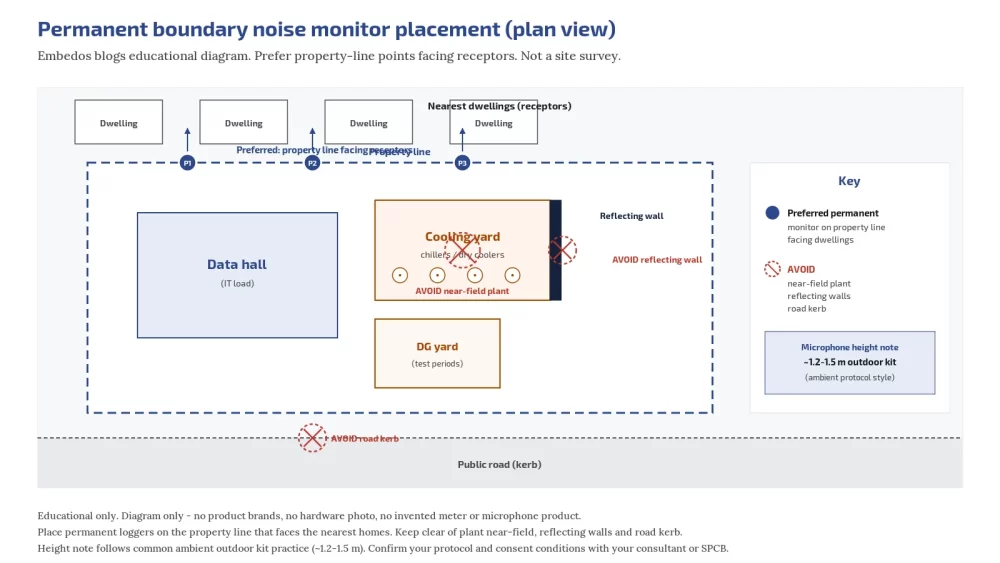
- Facing receptors. Put points on the property line facing the nearest dwellings, schools, hospitals or other silence zone receptors.
- Out of the near field. A monitor next to a dry cooler measures the dry cooler, not the community exposure.
- Height and weather. Follow the ambient protocol for microphone height and use an outdoor kit with windscreen and rain protection (CPCB Protocol for Ambient Level Noise Monitoring, MPCB host).
- Avoid reflections and roads. Keep away from hard walls and road kerbs that would dominate the reading.
- Power and access. A point you cannot service is a point that stops logging.
Where should permanent noise monitors sit at a data center?
On the property line facing the nearest receptors, away from the plant near field, at the height the ambient protocol sets, with outdoor weather protection and clear of reflecting walls and busy roads.
What a compliance-ready continuous log must capture
- Time-stamped Leq for each hour, rolled up to the day and night windows.
- L90 or a similar background descriptor, so you can separate plant from road.
- dB(A) plus dB(C) or octave bands when tonal hum is the complaint. See why dBA can miss low frequency hum.
- Meter make, serial number, class and calibration dates.
- Weather notes: wind, rain, temperature.
- Plant tags at the same timestamps: DG run, chiller or dry cooler stage, IT load band.
- Raw exportable records kept for as long as your consent or legal advisor recommends.
The CPCB ambient protocol describes supervised sessions with 1 second sampling and day or night coverage for routine and complaint work. A permanent station extends that idea across weeks and months, and attended sessions still matter when a result is disputed.
What should a data center boundary noise log include?
Hourly Leq rolled into day and night windows, a background descriptor such as L90, dB(C) or bands for tonal issues, meter serial and calibration, weather, and plant state tags at the same timestamps. Keep the raw records.
Alarms that help operations before neighbours call
Useful alarms are simple:
- Night margin. Rolling night Leq within a few dB of the zone limit.
- Step change. A jump at one point that matches a fan bank going to high speed or a failed unit.
- DG window. Flag test periods so readings are explained, and move tests into daytime where you can.
- Data gap. A logger that stops is its own alarm.
Alarms are operational aids. They are not a legal finding, and the thresholds are yours to set. We do not quote fine amounts here; any penalty question belongs with your legal advisor and the SPCB.
Answering a neighbour or authority complaint with the log
- Acknowledge the complaint and note the date, time and location described.
- Pull the boundary traces for that window, plus the nearest façade point if you have one.
- Show plant state at the same timestamps.
- Compare the night or day Leq with the CPCB zone limit.
- Check tonal content if the words were hum, drone or throb.
- Fix source or path: fans and controls first (cooling plant), then barriers and enclosures when the log shows a path problem.
- Re-measure with an attended Class 1 check and share the before and after.
For why night levels matter to people living nearby, see health framing for neighbours. Night guidance from WHO Europe sets 40 dB Lnight outside as a target and 55 dB as an interim target (WHO Night Noise Guidelines 2009).
We make no health claim for any Embedos product.
How do you answer a data center noise complaint with data?
Pull the boundary log for the complaint window, show plant state, compare with the CPCB zone limit, check for tones, fix the source or path, then confirm with an attended Class 1 measurement.
Checklist: continuous compliance program for an operating Indian site
| # | Item | Done |
|---|---|---|
| 1 | Zone category confirmed for each receptor (industrial, commercial, residential, silence) | ☐ |
| 2 | Post-startup attended check done at near design load, day and night | ☐ |
| 3 | Permanent boundary points chosen facing receptors, out of near field | ☐ |
| 4 | Meters: Class 1, or Class 2 stated as screening, with outdoor kit | ☐ |
| 5 | Day and night Leq plus L90 logged and retained | ☐ |
| 6 | Calibration schedule and field calibrator checks recorded | ☐ |
| 7 | Plant state tags (DG, cooling stages, IT load band) on the same timeline | ☐ |
| 8 | Alarm thresholds set for night margin, step change, data gap | ☐ |
| 9 | Complaint pack template ready | ☐ |
| 10 | Review after any major cooling or DG change | ☐ |
Writing noise limits into purchases helps too: see writing noise limits into equipment tenders so the plant starts quieter. Inside the hall is a separate exposure problem: staff hearing in the data hall.
Can continuous logging replace a Class 1 attended survey?
No. Continuous logging is best for trends, alarms and answering “what happened that night”. An attended Class 1 survey, with a calibrated meter and an operator who can note what is audible, is what you bring to a dispute or a formal report.
Automation angle: third-party meter into Embedos Edge
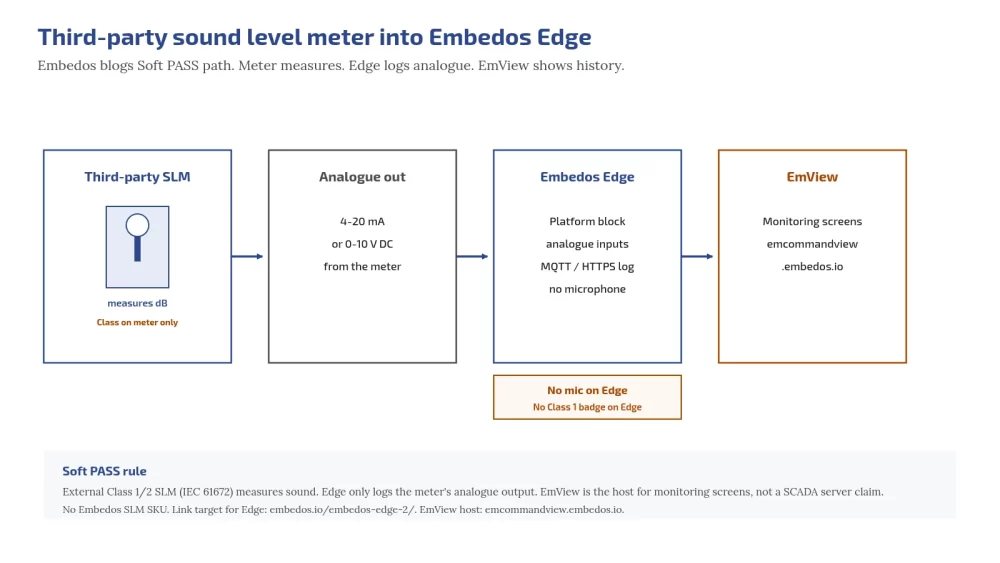
A Class 1 or Class 2 sound level meter or noise recorder (IEC 61672, a paid standard) with an analogue output can be wired to an analogue input on Embedos Edge, using 4-20 mA or 0-10 V.
The Embedos Edge is the platform that logs that signal day and night, next to DG run and cooling stage status, and can raise an alarm when the night margin is at risk.
The Embedos Edge has no microphone of its own and does not measure sound by itself; the class belongs to the meter. Edge makes no compliance or health judgement.
To check how a meter’s range maps onto a 4-20 mA loop, try the 4-20 mA loop scaling calculator.
If a hosted view is needed, monitoring screens sign in at EmCommandView.
Next step
Send us your site plan, receptor locations and meter model, and we will help you plan boundary logging points and the analogue wiring into Edge.
Email: team@embedos.io
Help Us Help You Leverage The Power Of Industrial Automation & Industrial IoT – IIoT.