

Data Center Noise Levels Inside: Protect Staff Hearing

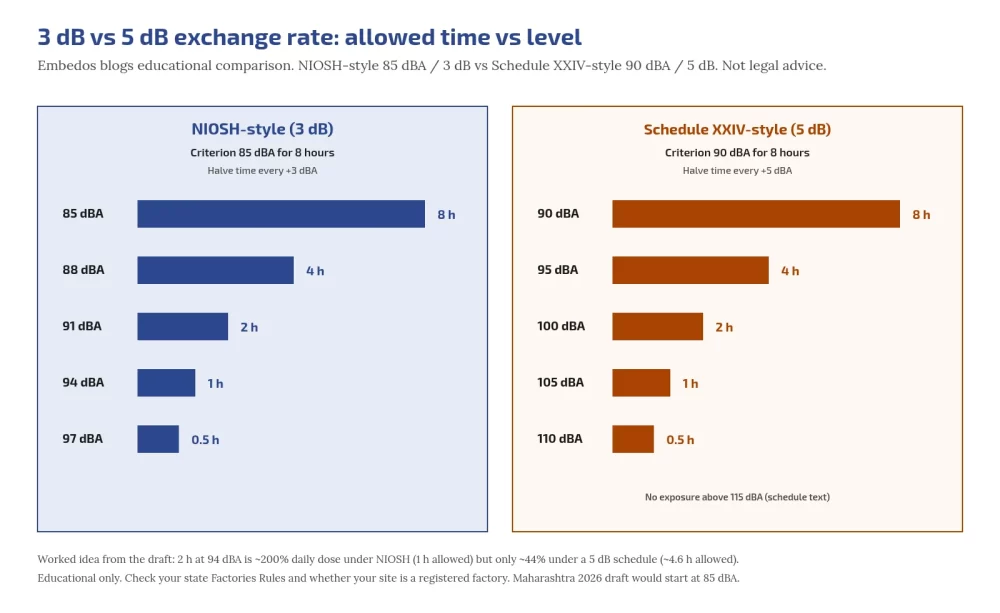
Data center noise levels inside the white space commonly sit in the mid 80s to mid 90s dBA, close to where long shifts start to damage hearing. In Maharashtra, Schedule XXIV of the Maharashtra Factories Rules, 1963 sets 90 dBA for 8 hours with a 5 dB exchange rate; NIOSH recommends 85 dBA for 8 hours with a 3 dB exchange rate, which is stricter.

Measure the hall, measure the people, cut noise at source first, and issue hearing protection that is fitted and worn. Engineering guidance, not legal advice: whether Factories Act schedules cover your site depends on registration and state rules.

Who this is for: facility, EHS and operations engineers running data halls, and contractors who spend long shifts in them. Neighbours outside: health effects.

Tell us what you need on site

Need this on your site? Tell us your requirement

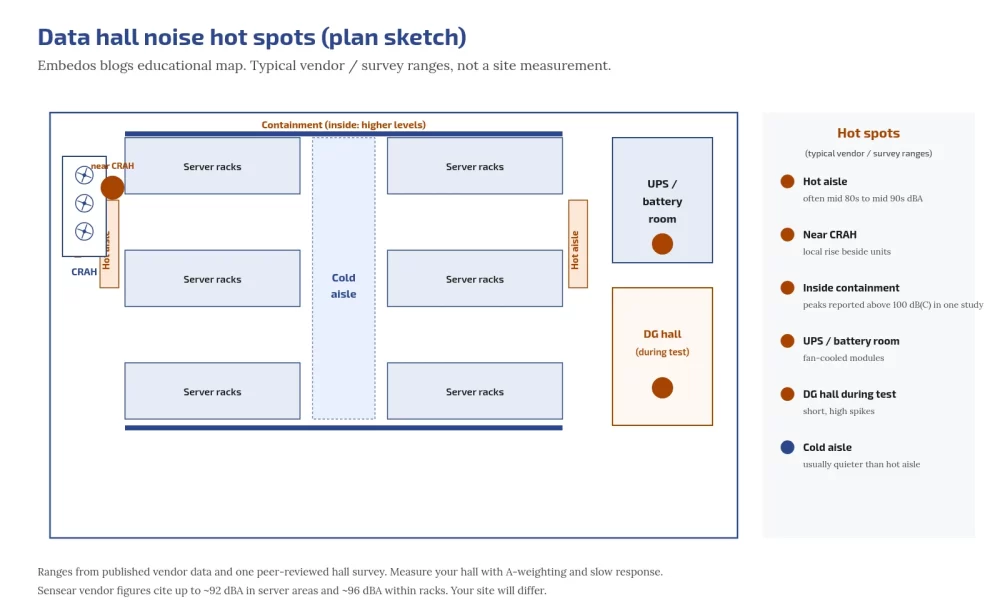
Embedos blogs embedos-blogs: data hall noise hotspots map

How loud inside, and where

Most indoor noise is fan noise: server fans plus CRAH/CRAC overview .

Published surveys are scarce. Vendor infographics (for example Sensear) put server areas up to about 92 dBA and within racks higher; treat as vendor data. A peer-reviewed field study of a large air-cooled hall (ISO 9612) found average exposure often above 85 dBA, with C-weighted peaks above 100 dB inside cold-aisle containment (Cho et al., Journal of the Architectural Institute of Korea, 2026, )

Hot spots: hot aisle behind dense racks, next to CRAH, inside containment, UPS/battery rooms, DG hall during tests. Compare declared IT noise via free ECMA-74 / ECMA-109.

How many decibels is a data center inside?

Vendor data and one peer-reviewed hall survey put many areas at or above 85 dBA. Your hall differs with density and containment; measure it.

Indian schedules vs NIOSH and OSHA

Factories Act 1948 has no noise table; states set Schedule XXIV. Maharashtra Factories Rules, 1963 Schedule XXIV (as on 1 Sep 2025 PDF): 90 dBA for 8 h, 5 dB exchange, no exposure above 115 dBA, impulse 140 dB peak (Maharashtra PDF ) 

Engineering/admin controls first; protectors; audiometry within 14 days of employment then at least yearly where the schedule applies.

NIOSH REL: 85 dBA 8-h TWA, 3 dB exchange. OSHA 29 CFR 1910.95 uses 90 dBA / 5 dB with 85 dBA action level (US reference only). Many operators adopt NIOSH internally even if Factories schedules apply differently. Maharashtra 2026 draft OSH rules proposing 85 dBA were draft when last checked; verify status before planning to them.

Embedos blogs embedos-blogs: 3 dB vs 5 dB exchange rate

Why exchange rate changes the answer

3 dB is about equal energy (doubling). 5 dB allows more time at high levels. Illustrative: 2 h at 94 dBA is about 200% NIOSH daily dose (allowed 1 h) but under about 44% on a 5 dB schedule reading.

An 8 hr shift at 88 dBA is 200% NIOSH dose; Schedule XXIV text that ignores below 90 dBA can read as zero dose on a strict reading. Write your internal rule down.

Which occupational limit does NIOSH recommend?

85 dBA as an 8-hour TWA with a 3 dB exchange rate.

Area monitoring vs personal dosimetry

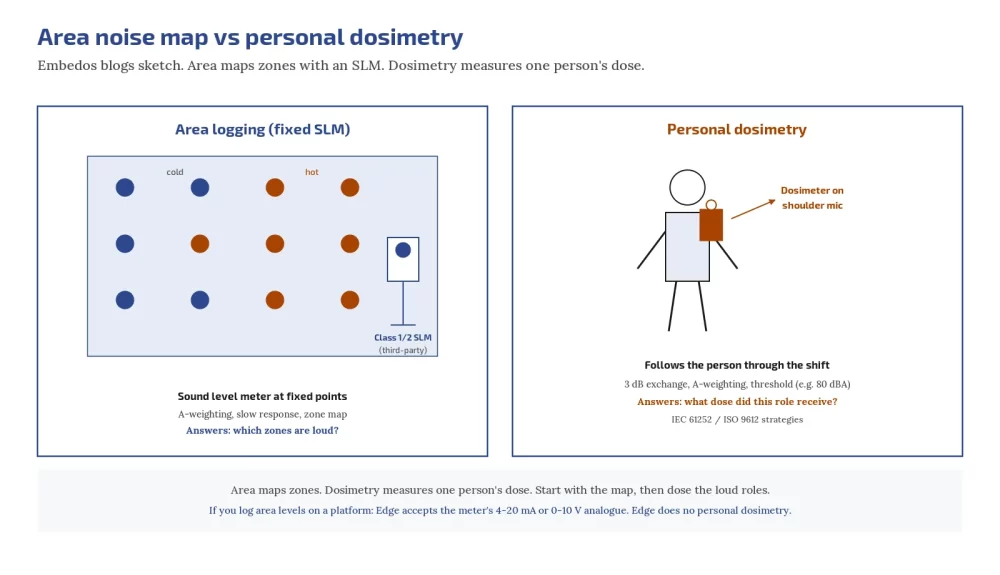
Embedos blogs embedos-blogs: area SLM vs personal dosimeter

NIOSH: sound level meter maps an area; dosimeter measures one person. Map with A-weighting, slow response, equipment running. Type 1/2 meter; IEC 61672-1 for instruments (IEC).

Dosimetry strategies: ISO 9612 (paid); personal meters IEC 61252 (paid). Class labels apply to the third-party instruments, not to Edge.

Speech, alarms and controls order

If you raise your voice at arm’s length, noise is likely hazardous (NIOSH rule of thumb). Use hand signals/radio read-backs and visual beacons in loud zones.

Order: quieter equipment (ECMA-109), slower fans (fan acoustics), separate people from sources (passive),

limit time, then protectors. NIOSH: consumer ANC headphones are not hearing protection unless labelled with an NRR (NIOSH PPE)

See ANC post.

Hearing conservation checklist

  1. Write internal limit (Schedule / NIOSH / both).
  2. Map hall; mark zones above limit; post signs.
  3. Dosimetry on high-exposure roles.
  4. Fix sources first.
  5. Issue rated protectors; fit test; train.
  6. Baseline and periodic audiometry per applicable schedule / NIOSH advice.
  7. Re-measure after rack/cooling changes; keep records.

Area logging with Edge, not dosimetry

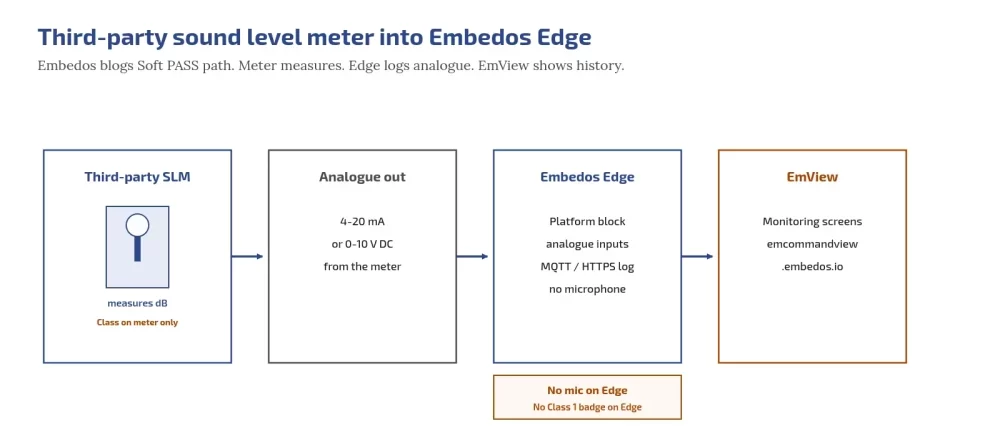
Embedos Edge is our platform. Edge can log readings from a third-party sound level meter, noise meter or recorder via 4-20 mA or 0-10 V analogue inputs.

Edge has no built-in microphone and does not do dosimetry; the meter measures. EmView monitoring/dashboard/SCADA can show those logged readings at https://emcommandview.embedos.io/; report exports HOLD. Class 1/2 under IEC 61672 refers only to the third-party meter.

Scaling: https://tools.embedos.io/4-20ma-loop-scaling-calculator/.

Edge monitors area levels from a wired third-party meter; it does not replace personal dosimeters.

Do you need hearing protection in a data center?

Where maps or dosimetry show exposure above your limit, yes, until controls bring it down.

Next step

Send your hall layout, any existing noise map and which limit you use internally, and we will help you plan fixed area meter logging (not personal dosimetry).

Email: team@embedos.io

Help Us Help You Leverage The Power Of Industrial Automation & Industrial IoT – IIoT.

EVs are great! But what of fraud risk at charging stations? Who keeps tabs on that?

Addressing fraud at charging points can be a complex task.

For commercial charging stations, fraud prevention measures may include implementing secure payment systems, conducting regular audits and inspections, and monitoring usage patterns to identify any unusual activity.

It will be helpful to have clear policies and procedures in place for billing and payment, and to establish partnerships with trusted EV maintenance companies to help ensure the integrity of the charging infrastructure.

For retail customers, fraud prevention measures may include using secure payment methods, such as credit or debit cards, and monitoring usage patterns to identify any unusual activity.

It may also be helpful to gather demographic and billing data to help identify any potential fraud risks, and to establish procedures for handling complaints or concerns about charging activity.

A combination of technological solutions, such as secure payment systems and smart charging stations, and proactive risk management practices, such as audits and monitoring, can help to mitigate the risk of fraud at EV charging points.

Integrating new charging infrastructure with existing systems can be a challenge for electricity providers. It is important to ensure that the new charging stations are securely connected to the grid and that the necessary safeguards are in place to protect against cyber threats.

There are a few measures in place to help mitigate fraud risk at charging stations for electric vehicles (EVs). One measure is the use of secure payment systems, such as credit or debit cards, to charge for the electricity.

These payment systems have fraud protection measures in place and can help to prevent unauthorized charging.

Another measure is the use of smart charging stations, which can be configured to only allow charging when a valid payment method is presented, such as a charging card or a mobile payment app. These smart charging stations may also have security measures in place to prevent tampering or unauthorized access.

In addition, many charging station networks have customer service teams that monitor charging activity and can identify and address any suspicious activity or fraud.

As the EV charging network grows and becomes more established, it is likely that additional measures will be put in place to further reduce the risk of fraud.

Embedos_EV Picture_2

One way to address this challenge is to use secure, standards-based communication protocols for the transmission of data between the charging stations and the energy provider’s systems. This can help to prevent unauthorized access to sensitive data and ensure the integrity of the charging process.

It may also be helpful for energy providers to conduct regular security assessments and implement appropriate security measures, such as firewalls and secure authentication protocols, to protect against cyber threats.

In addition, implementing robust incident response and recovery plans can help to minimize the impact of any successful attacks and ensure the continued operation of the charging infrastructure.

Compliance with regulatory policies and requirements is an important aspect of managing risk and ensuring the safe and secure operation of EV charging infrastructure.

Energy commissions and other regulatory authorities often set policies and guidelines for the deployment and operation of charging stations to ensure that they are safe and reliable, and to protect against potential risks such as cyber threats and unauthorized access.

Energy providers and charging station operators are typically required to comply with these policies and may be subject to inspections and audits to ensure compliance.

In addition to compliance with regulatory policies, it is also important for charging station operators to implement effective governance risk management practices to help identify and mitigate potential risks.

This may include conducting regular risk assessments, implementing appropriate cyber security measures, and establishing clear policies and procedures for access and control of the charging infrastructure.

Integrating and connecting anti-theft and fraud prevention programs and tools can be an effective way for energy providers to get a better understanding of fraudulent activities and to take steps to prevent losses. Some potential solutions that could be considered include:

  • Installing iot devices, at charging stations to gather data on activity and usage patterns. This data can then be analyzed to identify any unusual activity or potential fraud.
  • Implementing an automated #rule engine that can trigger alerts in near real-time when potential fraud is detected. This can help to quickly identify and address any issues.
  • Using secure payment systems, such as credit or debit cards, to charge for electricity at the charging stations. These payment systems often have fraud protection measures in place to help prevent unauthorized charging.
  • Implementing security measures, such as firewalls and secure authentication protocols, to protect against cyber threats.
  • Conducting regular risk assessments and audits to identify potential vulnerabilities and take steps to mitigate them.

A combination of technological solutions and proactive risk management practices can help energy providers reduce the risk of fraud and protect against losses.

Embedos_EV Picture_1

Using #predictiveanalytics can help to reduce false positives and refine controls on the fly in the fight against fraud at EV charging stations. #predictivemaintenance involves using advanced analytical techniques, such as machine learning and data mining, to analyze data and make recommendations for action based on the insights gained.

In the context of EV charging stations, predictive analytics could be used to analyze data on charging activity and usage patterns to identify any unusual or suspicious activity. This data could then be used to refine existing controls and identify new controls that could be put in place to help prevent fraud.

For example, predictive analytics could be used to identify patterns of activity that are commonly associated with fraud, such as the use of stolen credit cards or payment fraud. This information could then be used to develop new controls or refine existing ones to better detect and prevent these types of fraud.

Incorporating predictive analytics into fraud prevention efforts at EV charging stations can help to identify new and emerging frauds, reduce false positives, and improve the effectiveness of existing controls.

#monitoring the charging infrastructure end-to-end and analyzing usage data can be effective ways for energy providers to identify and mitigate risks at EV charging stations.

Monitoring the charging infrastructure end-to-end can help to identify any discrepancies or issues with the charging process, such as unauthorized access or tampering with equipment.

This can be achieved through the use of sensors and other iotdevices , as well as through regular inspections and audits of the charging infrastructure.

Analyzing usage data can also be helpful in identifying potential risks or vulnerabilities. For example, analyzing usage patterns and profiles can help to identify any unusual activity or potential fraud. This can be done through the use of data analytics tools and techniques, such as machine learning and data mining.

Thus, a combination of #end-to-end monitoring and usage analysis can help energy providers to identify and mitigate risks at #ev charging stations and protect against potential vulnerabilities.

Using technology to help prevent #fraud and protect against revenue losses can be an effective way for energy providers to ensure compliance and transparency in their revenue generation.

Implementing advanced technologies, such as smart meters and real-time monitoring systems, can help energy providers to accurately track and measure electricity usage and identify any unauthorized or fraudulent activity.

As the demand for electricity from EVs continues to grow, it is likely that energy providers will need to invest in technology to ensure the integrity of their charging infrastructure and protect against revenue losses.

In a competitive market, energy providers that are able to effectively manage the risks and vulnerabilities associated with EV charging may have a competitive advantage.

 Here are some steps that energy providers can take to help prevent fraud at EV charging stations:

  1. Use secure payment systems: Implementing secure payment systems, such as credit or debit cards, can help to prevent unauthorized charging and protect against fraud.
  2. Implement smart charging stations: Configuring charging stations to only allow charging when a valid payment method is presented can help to prevent unauthorized access and tampering.
  3. Monitor charging activity: Establishing customer service teams or other monitoring systems to identify and address any suspicious activity or fraud can be an effective way to prevent losses.
  4. Implement security measures: Protecting against cyber threats is important for the security of the charging infrastructure. Implementing measures such as firewalls and secure authentication protocols can help to prevent unauthorized access.
  5. Conduct regular risk assessments: Regularly assessing the charging infrastructure for vulnerabilities and taking steps to mitigate any identified risks can help to prevent fraud.
  6. Use data analytics: Analyzing data on charging activity and usage patterns can help to identify any unusual activity or potential fraud. Implementing data analytics tools and techniques, such as machine learning and data mining, can be an effective way to identify risks and take preventative action.
  7. Establish clear policies and procedures: Having clear policies and procedures in place for billing, payment, and access to the charging infrastructure can help to prevent fraud and protect against losses.

A few additional steps that energy providers can consider to help prevent fraud at EV charging stations:

  1. Partner with trusted EV maintenance companies: Establishing partnerships with trusted EV maintenance companies can help to ensure the integrity of the charging infrastructure and reduce the risk of fraud.
  2. Implement customer authentication systems: Implementing systems to authenticate customers, such as through the use of charging cards or mobile payment apps, can help to prevent unauthorized access to the charging stations.
  3. Educate customers: Providing customers with information on how to properly use the charging infrastructure and what to do if they suspect any fraudulent activity can help to prevent losses.
  4. Monitor third-party vendors: If the charging infrastructure includes third-party vendors, such as EV charging vendors or electric meter spoofing companies, it is important to monitor their activity to ensure compliance with policies and procedures and to identify any potential fraudulent activity.
  5. Use predictive analytics: Incorporating prescriptive analytics, which involves using advanced analytical techniques to identify patterns and make recommendations for action, can help to refine controls and reduce false positives in the fight against fraud.

There are a number of steps that energy providers can take to help prevent fraud and protect against losses at EV charging stations.

By implementing a combination of technological solutions, proactive risk management practices, and clear policies and procedures, energy providers can ensure the reliability and integrity of their charging infrastructure and reduce the risk of fraud.

Embedos Industrial Automation End to End Scope

Embedos is a full-stack IoT device platform that includes a device cloud platform, connectivity hardware, and varied automation & Interface Solutions. 

Are you looking for Industrial IoT solutions? Contact Embedos to know more!


Looking for End to End Industrial Automation & IoT Solutions? 


Our Experts Want to speak to You!

Read More

Embedos blogs embedos-blogs diagram: inductive sensor field detecting a steel target at short range versus photoelectric beam detecting an object at longer range

Inductive vs Photoelectric Sensor: Plant Selection Guide by Embedos Mumbai!

Inductive vs photoelectric Sensors. In proximity sensors for steel and power plants: Target, Flush vs Non-flush, 3-wire PNP/NPN, IP65 and dust checks. What to look for before purchasing?

When a timezone setting becomes a root shell: Four OT edge lessons in Cyber Security to learn in Industrial Automation

Four OT edge lessons from October 2026 CISA ICS advisories: timezone-to-shell, localhost bypass, Linux runtimes on controllers, and pollers without peer identity checks.

Embedos blogs embedos-blogs diagram: radar level transmitter on a small tank showing blocking distance, maximum level, minimum level and beam cone

Short-Range Radar Level Transmitter: Picking for 0.1-1.6 m

For a short range radar level transmitter on a vessel where the liquid sits 100 mm to 1600 mm below the flange, the spec that decides everything is the blocking distance (also called dead band or near-range limit).

Embedos embedos-blogs diagram of supermarket cold cabinets controlled by an internet-exposed refrigeration supervisor.

When the fridge became the attack surface: France and Germany supermarket cyber lessons (2021 to 2026)

France and Germany supermarket refrigeration OT attacks in 2026, plus CERT-FR and BSI steps operators can take. Cold-chain lessons for India.

embedos-blogs: photo of warehousing godown sheds in Uttar Pradesh, India, where temperature and humidity are monitored for stored commodities

Warehouse temperature and humidity monitoring system for agri commodities

A warehouse temperature and humidity monitoring system for agri commodities measures two different things.

Ambient relative humidity (RH) and temperature tell you about the air in the shed;

Grain moisture tells you about the stock.

Vibration Transmitter 4-20mA 0-25 mm/s: Buyer Guide

Choosing a 0-25 mm/s 4-20 mA vibration transmitter for motors and fans: range, RMS velocity, frequency band, mounting and alarm limits.

Flow Meter Pulse Output vs 4-20mA: Which to Use and When

Pulse output or 4-20mA for your flow meter? Compare totalising accuracy, cable length, noise and PLC input needs, with simple examples for Indian plants.

embedos-blogs-3-wire-pt100-to-4-20ma-transmitter-embedos-rtd: 3 wire PT100 sensor showing the three lead wires used for lead compensation

PT100 to 4-20mA Transmitter or Direct RTD Input?

PT100 for remote monitoring: wire it direct as 2, 3 or 4 wire RTD, or add a head mounted 4-20mA transmitter? Cable length, accuracy, noise and cost compared.

Embedos blogs featured image with the title Data Center Noise: Sources, Limits and How to Control It, beside a site plan with a data hall, cooling plant, transformers and DG sets, and dashed sound paths to nearby homes.

Data Center Noise: Sources, Limits and How to Control It

Why data centers are noisy, which sources reach neighbours, CPCB and WHO numbers, and how should engineers control and log boundary noise in India.

4G vs 5G Industrial Router: Which Suits Your Plant in India

4G or 5G industrial router for PLC and SCADA telemetry? Compare coverage, bandwidth, power, cost and dual SIM failover for Indian plants before you buy.

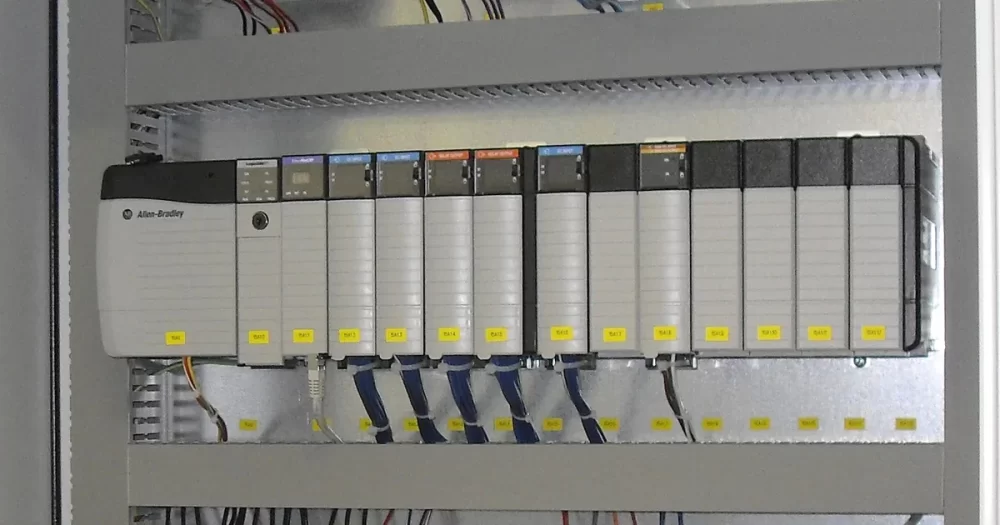
Embedos blogs embedos-blogs: PLC I/O rack wired in an industrial control panel, featured image for the Embedos guide to reading a Modbus register map

Modbus Register Map: How Do You Read It and Decode 32-bit Values (ABCD, CDAB, BADC, DCBA)?

How to read a Modbus register map: function codes, 40001 vs 0-based addresses, data types, scaling and a 32-bit float decoded. | Embedos Mumbai

embedos-blogs-din-rail-4-20ma-signal-isolator-ground-loop-embedos-panel: DIN rail clamp terminal block, the kind of panel where a 4-20mA signal isolator is fitted before a PLC or gateway

4-20mA Signal Isolator: When You Need One for Ground Loops

When does a 4-20mA or 0-10V loop need a signal isolator before a PLC or IoT gateway?

Ground loops, shared supplies, noise signs and isolator types.

Embedos blogs featured image with the title Modbus RTU vs Modbus TCP: Frames, Wiring, Speed and When to Use Each, beside two rows of byte cells with the shared PDU shaded.

Modbus RTU vs Modbus TCP: Frames, Wiring, Speed and When to Use Each

Modbus RTU vs Modbus TCP from the official specs: framing, CRC vs MBAP header, addressing, port 502, RTU over TCP and gateways, for plant engineers.

Embedos blogs featured image with the title How to Build an OEE Baseline in Indian Plants Before You Buy an MES, beside stacked bars that shrink from shift time to fully productive time.

How to Build an OEE Baseline in Indian Plants Before You Buy an MES

Set a defensible OEE baseline before you choose MES software: what to measure, for how long, and how Indian plants can start with the machines they have.

Embedos blogs embedos-blogs: third-party sound level meter analogue 4-20 mA or 0-10 V into Embedos Edge then EmView

How do you keep proving data center noise compliance after the site is built?

After a data center is built, one survey is not enough. How to run continuous boundary noise compliance logging against CPCB day and night limits in India.

OEE Monitoring System: What to Measure on Shop-Floor Machines

How to set up OEE monitoring on shop-floor machines: availability, performance and quality signals, legacy retrofit, and where an edge gateway fits.

Digitise a Bursting Strength Tester: Peak Hold to Wi-Fi Log

Upgrade a manual bursting strength tester with peak hold, auto bursting factor, RS-485 printer output and Wi-Fi data logging, without a new machine.

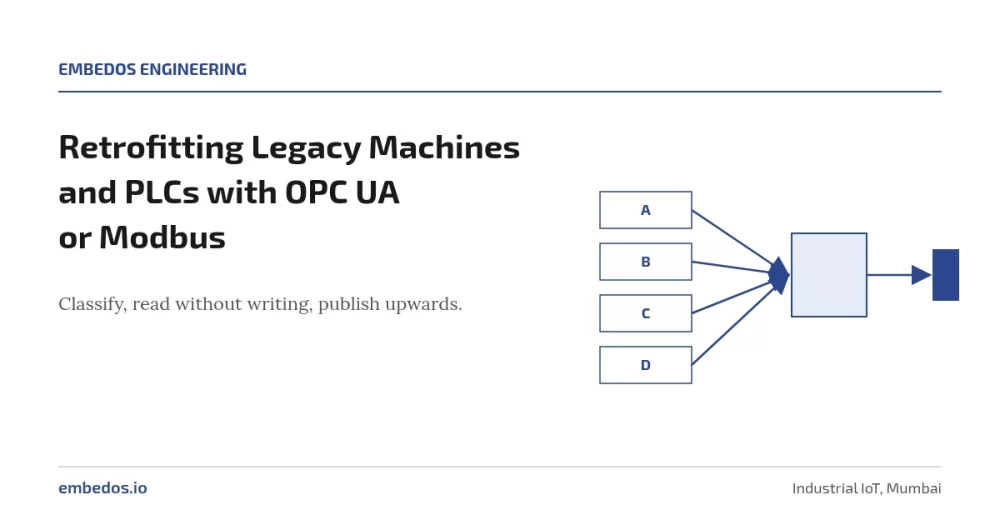
Embedos blogs featured image with the title Retrofitting Legacy Machines and PLCs with OPC UA or Modbus, beside four machine boxes A to D connected to an edge device and a plant system.

Retrofitting Legacy Machines and PLCs with OPC UA or Modbus

How to connect legacy machines and old PLCs without touching control logic: when Modbus is enough, when OPC UA pays off, and a read-only first retrofit.

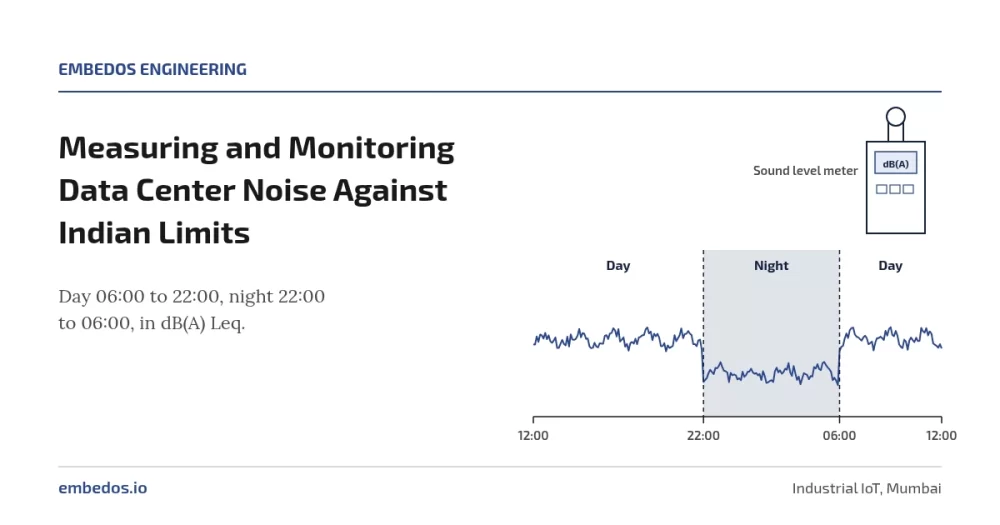
Embedos blogs featured image with the title Measuring and Monitoring Data Center Noise Against Indian Limits, beside a sound level meter icon and a 24 hour noise trace with the night band from 22:00 to 06:00.

Data Center Noise Monitoring: Measure Against Indian Limits

How to measure and continuously monitor data center noise against CPCB day and night limits, Class 1 meters, Leq/L90/spectra and logging via a third-party meter into Embedos Edge.

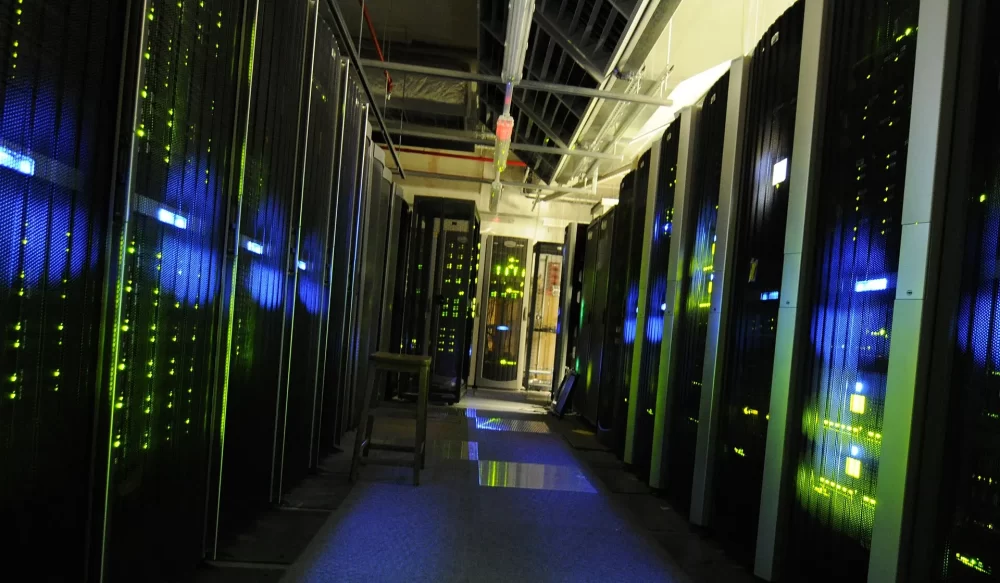
Embedos blogs photo of a narrow aisle between rows of server racks in a server room, where staff work beside continuous fan noise.

Data Center Noise Levels Inside: Protect Staff Hearing

Measure inside data center noise levels, compare them with Indian and NIOSH exposure limits, and protect data hall staff with a hearing plan that works.

What Airtel, Jio & Vodafone are doing, and how they can lead in the IoT Market!

What Airtel, Jio, Vodafone are doing, and how they can lead in the IoT Market!

As the telecos power ahead with new age internet technologies, like IoT, AR/VR, Blockchain and with the obvious use of AI, there is a large market that they can capture.

Internet of Things (IoT) services are becoming increasingly important as more and more devices are connected to the internet. Telcos, Telecommunications & Internet companies, have the opportunity to play a key role in the development and deployment of these services.

There are several ways that telcos can lead the future of IoT services:

  1. Connectivity: Telcos have the infrastructure and expertise to provide the connectivity that is necessary for IoT devices to communicate with each other and with the internet. This includes both wireless and wired connectivity options.
  2. Network management: Telcom Companies can manage the networks that IoT devices operate on, ensuring that they are secure and reliable. This includes managing data traffic, providing security measures such as encryption, and monitoring for potential issues.
  3. Data analytics: Telcos can collect and analyze data from IoT devices to gain insights and improve their services. This can include identifying patterns and trends, as well as predicting potential issues and developing solutions.
  4. Platforms: Can develop platforms that enable businesses and organizations to easily manage and control their IoT devices and systems. These platforms can provide features such as remote monitoring, automation, and device management.

Overall, telcos have the potential to be key players in the development and deployment of IoT services, helping to drive innovation and create new opportunities for businesses and individuals.

The B2B sector can be an important area of growth for telcos, and IoT is a key area for differentiation. IoT has the potential to transform various industries, including manufacturing, transportation, and healthcare, by enabling businesses to collect and analyze data from connected devices to improve efficiency and productivity.

Additionally, telcos that can develop and offer platform solutions that enable businesses to easily manage and control their IoT systems can also differentiate themselves in the market.

It’s important for telcos to stay up-to-date on the latest technologies and trends in the IoT space and to be able to adapt and offer new services as the market evolves. By offering innovative and differentiated IoT services, telcos can position themselves as leaders in the market and drive growth in the B2B sector.

Like what Jio is doing with Blockchain, AR/VR, IoT or even what Airtel is doing in the Industrial IoT Space is to watch out for.

5G networks are expected to play a significant role in the growth of the IoT, as they can provide faster, more reliable connectivity and support a greater number of connected devices. This can make it easier for businesses to deploy IoT solutions and realize the benefits of connected devices more quickly.

Telcos that have already upgraded to 5G networks can leverage this advantage to offer market-ready IoT solutions that are quick and simple to deploy. By bundling connectivity, network management, and device management into one package, telcos can make it easier for businesses to implement and scale their IoT systems.

In addition to 5G networks, telcos can also leverage other technologies, such as low-power wide-area networks (LPWAN) and edge computing, to enable the deployment of IoT solutions in a variety of environments and applications. By offering a range of IoT solutions that are tailored to different industries and use cases, telcos can further differentiate themselves and meet the needs of a diverse set of customers.

IoT offers telcos the opportunity to create new revenue streams and improve their business model by becoming service providers. By offering IoT services that enable businesses to collect and analyze data from connected devices, telcos can help their customers increase efficiency and productivity, leading to cost savings and improved profitability.

There are many B2B use cases for IoT technology, including smart hospitals, intelligent factories, fleet management, and autonomous vehicles, that require low latency, high bandwidth, and high reliability. Telcos can play a key role in enabling these use cases by providing the necessary connectivity and network management services.

Embedos_5g-min

In addition to helping businesses realize the value of IoT quickly, telcos can also differentiate themselves in the market by offering innovative solutions that meet the specific needs of their customers. For example, telcos can offer custom packages that include data analytics services, platform solutions, and consulting services to help businesses get the most out of their IoT systems.

Overall, IoT offers a significant opportunity for telcos to become service providers and drive growth through the development and deployment of innovative solutions that meet the needs of their customers.

Robust mobile network coverage is essential for the widespread adoption of #iot technology. Telcos can play a key role in enabling IoT adoption by providing reliable, secure connectivity that enables connected devices to communicate with each other and with the internet.

By offering core connectivity services that go beyond simply selling “the pipe,” telcos can differentiate themselves in the market and provide value to their customers by helping them achieve specific business outcomes.

The IoT market is expected to continue to grow in the coming years, and telcom companies that are able to offer innovative, value-added services will be well-positioned to take advantage of this growth. By helping businesses achieve their digital transformation goals and providing the necessary #network connectivity, telcos can showcase the true value of their services and push back against market commoditization.

IoT has the potential to transform various industries and aspects of our lives by enabling the collection and analysis of data from connected devices. IoT technology is based on a network of connected devices that can communicate with each other and with the internet, allowing for the exchange of real-time data and updates.

There are many potential applications for IoT technology, including smart homes, smart cities, agriculture, manufacturing, transportation, and healthcare. In each of these areas, IoT can help businesses and organizations improve efficiency, productivity, and decision-making by providing real-time data and insights.

In order to realize the full potential of IoT, it is important for the technology to be simple to deploy and use. Telcos and other service providers can play a key role in simplifying the delivery of IoT solutions by offering packages that include connectivity, network management, and device management services. By making it easy for businesses to get started with IoT, service providers can help drive widespread adoption of the technology.

Embedos_5G _ 1

Partner networks can be an effective way for telcos to accelerate the adoption of IoT technology in the B2B market. By working with other companies and organizations that have complementary skills and expertise, telcos can bring innovative solutions to market more quickly and efficiently.

Telcos have a unique advantage in the IoT space due to their expertise in connectivity and network management. By partnering with companies that have expertise in areas such as data analytics, device management, and industry-specific solutions, telcos can offer more comprehensive packages to their customers and help them achieve their digital transformation goals.

Partnering with other companies can also help telcos to address challenges such as time-to-market and cost, as they can share resources and expertise to develop and deploy solutions more efficiently. By building strong partner ecosystems, telcos can leverage the strengths of different organizations and create mutually beneficial relationships that drive growth and innovation in the IoT market.

Partnering with other companies in the supply chain can be an effective way for telcos to accelerate the adoption of IoT technology. By working with distributors and supply chain platform partners, telcos can streamline the process of bringing new products and services to market and make it easier for customers to access the IoT solutions they need.

Distributors can provide logistics, inventory, and contracting services, as well as expertise in building tech stacks for a variety of use cases, which can help telcos to add new products and services quickly and efficiently. Supply chain platform partners can offer automated subscription and billing workflows and a digital self-service experience that lets customers select their IoT solutions on demand, further simplifying the process of accessing the technology.

Overall, building strong partner ecosystems can help telcos to focus on their core competencies, such as connectivity, while leveraging the expertise of other companies to bring innovative solutions to market more quickly and efficiently. This can help telcos to drive growth and differentiate themselves in the IoT market.


Looking for End to End Industrial Automation & IoT Solutions? 


Our Experts Want to speak to You!

Read More

Embedos blogs embedos-blogs diagram: inductive sensor field detecting a steel target at short range versus photoelectric beam detecting an object at longer range

Inductive vs Photoelectric Sensor: Plant Selection Guide by Embedos Mumbai!

Inductive vs photoelectric Sensors. In proximity sensors for steel and power plants: Target, Flush vs Non-flush, 3-wire PNP/NPN, IP65 and dust checks. What to look for before purchasing?

When a timezone setting becomes a root shell: Four OT edge lessons in Cyber Security to learn in Industrial Automation

Four OT edge lessons from October 2026 CISA ICS advisories: timezone-to-shell, localhost bypass, Linux runtimes on controllers, and pollers without peer identity checks.

Embedos blogs embedos-blogs diagram: radar level transmitter on a small tank showing blocking distance, maximum level, minimum level and beam cone

Short-Range Radar Level Transmitter: Picking for 0.1-1.6 m

For a short range radar level transmitter on a vessel where the liquid sits 100 mm to 1600 mm below the flange, the spec that decides everything is the blocking distance (also called dead band or near-range limit).

Embedos embedos-blogs diagram of supermarket cold cabinets controlled by an internet-exposed refrigeration supervisor.

When the fridge became the attack surface: France and Germany supermarket cyber lessons (2021 to 2026)

France and Germany supermarket refrigeration OT attacks in 2026, plus CERT-FR and BSI steps operators can take. Cold-chain lessons for India.

embedos-blogs: photo of warehousing godown sheds in Uttar Pradesh, India, where temperature and humidity are monitored for stored commodities

Warehouse temperature and humidity monitoring system for agri commodities

A warehouse temperature and humidity monitoring system for agri commodities measures two different things.

Ambient relative humidity (RH) and temperature tell you about the air in the shed;

Grain moisture tells you about the stock.

Vibration Transmitter 4-20mA 0-25 mm/s: Buyer Guide

Choosing a 0-25 mm/s 4-20 mA vibration transmitter for motors and fans: range, RMS velocity, frequency band, mounting and alarm limits.

Flow Meter Pulse Output vs 4-20mA: Which to Use and When

Pulse output or 4-20mA for your flow meter? Compare totalising accuracy, cable length, noise and PLC input needs, with simple examples for Indian plants.

embedos-blogs-3-wire-pt100-to-4-20ma-transmitter-embedos-rtd: 3 wire PT100 sensor showing the three lead wires used for lead compensation

PT100 to 4-20mA Transmitter or Direct RTD Input?

PT100 for remote monitoring: wire it direct as 2, 3 or 4 wire RTD, or add a head mounted 4-20mA transmitter? Cable length, accuracy, noise and cost compared.

Embedos blogs featured image with the title Data Center Noise: Sources, Limits and How to Control It, beside a site plan with a data hall, cooling plant, transformers and DG sets, and dashed sound paths to nearby homes.

Data Center Noise: Sources, Limits and How to Control It

Why data centers are noisy, which sources reach neighbours, CPCB and WHO numbers, and how should engineers control and log boundary noise in India.

4G vs 5G Industrial Router: Which Suits Your Plant in India

4G or 5G industrial router for PLC and SCADA telemetry? Compare coverage, bandwidth, power, cost and dual SIM failover for Indian plants before you buy.

Embedos blogs embedos-blogs: PLC I/O rack wired in an industrial control panel, featured image for the Embedos guide to reading a Modbus register map

Modbus Register Map: How Do You Read It and Decode 32-bit Values (ABCD, CDAB, BADC, DCBA)?

How to read a Modbus register map: function codes, 40001 vs 0-based addresses, data types, scaling and a 32-bit float decoded. | Embedos Mumbai

embedos-blogs-din-rail-4-20ma-signal-isolator-ground-loop-embedos-panel: DIN rail clamp terminal block, the kind of panel where a 4-20mA signal isolator is fitted before a PLC or gateway

4-20mA Signal Isolator: When You Need One for Ground Loops

When does a 4-20mA or 0-10V loop need a signal isolator before a PLC or IoT gateway?

Ground loops, shared supplies, noise signs and isolator types.

Embedos blogs featured image with the title Modbus RTU vs Modbus TCP: Frames, Wiring, Speed and When to Use Each, beside two rows of byte cells with the shared PDU shaded.

Modbus RTU vs Modbus TCP: Frames, Wiring, Speed and When to Use Each

Modbus RTU vs Modbus TCP from the official specs: framing, CRC vs MBAP header, addressing, port 502, RTU over TCP and gateways, for plant engineers.

Embedos blogs featured image with the title How to Build an OEE Baseline in Indian Plants Before You Buy an MES, beside stacked bars that shrink from shift time to fully productive time.

How to Build an OEE Baseline in Indian Plants Before You Buy an MES

Set a defensible OEE baseline before you choose MES software: what to measure, for how long, and how Indian plants can start with the machines they have.

Embedos blogs embedos-blogs: third-party sound level meter analogue 4-20 mA or 0-10 V into Embedos Edge then EmView

How do you keep proving data center noise compliance after the site is built?

After a data center is built, one survey is not enough. How to run continuous boundary noise compliance logging against CPCB day and night limits in India.

OEE Monitoring System: What to Measure on Shop-Floor Machines

How to set up OEE monitoring on shop-floor machines: availability, performance and quality signals, legacy retrofit, and where an edge gateway fits.

Digitise a Bursting Strength Tester: Peak Hold to Wi-Fi Log

Upgrade a manual bursting strength tester with peak hold, auto bursting factor, RS-485 printer output and Wi-Fi data logging, without a new machine.

Embedos blogs featured image with the title Retrofitting Legacy Machines and PLCs with OPC UA or Modbus, beside four machine boxes A to D connected to an edge device and a plant system.

Retrofitting Legacy Machines and PLCs with OPC UA or Modbus

How to connect legacy machines and old PLCs without touching control logic: when Modbus is enough, when OPC UA pays off, and a read-only first retrofit.

Embedos blogs featured image with the title Measuring and Monitoring Data Center Noise Against Indian Limits, beside a sound level meter icon and a 24 hour noise trace with the night band from 22:00 to 06:00.

Data Center Noise Monitoring: Measure Against Indian Limits

How to measure and continuously monitor data center noise against CPCB day and night limits, Class 1 meters, Leq/L90/spectra and logging via a third-party meter into Embedos Edge.

Embedos blogs photo of a narrow aisle between rows of server racks in a server room, where staff work beside continuous fan noise.

Data Center Noise Levels Inside: Protect Staff Hearing

Measure inside data center noise levels, compare them with Indian and NIOSH exposure limits, and protect data hall staff with a hearing plan that works.

How to calculate the service life of an industrial asset using Industrial IoT (IIoT)?

How to calculate the service life of an industrial asset using Industrial IoT (IIoT)?

The service life of an industrial asset is the length of time that the asset can be expected to operate effectively and efficiently. There are several factors that can affect the service life of an industrial asset, including:

  1. The type of asset: Different types of assets have different expected service lives. For example, a piece of machinery may have a longer service life than a tool or a piece of equipment.
  2. The condition of the asset: The condition of the asset can have a significant impact on its service life. If an asset is well-maintained and operated correctly, it is likely to have a longer service life.
  3. The environment in which the asset is used: The environment in which an asset is used can also affect its service life. For example, an asset used in a harsh or corrosive environment may have a shorter service life than an asset used in a more benign environment.
  4. The level of use: The more an asset is used, the shorter its service life is likely to be.

To calculate the service life of an industrial asset, you will need to consider these factors and make an educated estimate based on your specific circumstances. You may also want to consult industry standards or guidelines for guidance on expected service life for different types of assets.

There are a few other factors that can impact the service life of an industrial asset:

  1. The quality of the asset: Higher quality assets are likely to have a longer service life than lower quality assets.
  2. The level of maintenance: Regular maintenance can help extend the service life of an asset by ensuring that it is operating correctly and efficiently.
  3. The design of the asset: The design of an asset can also impact its service life. For example, an asset designed with durability in mind is likely to have a longer service life than an asset designed for lower cost.
  4. The level of expertise of the operators: The level of expertise of the operators can also affect the service life of an asset. If operators are trained to operate the asset correctly and are familiar with best practices, it is likely to have a longer service life.
  5. The availability of replacement parts: The availability of replacement parts can also impact the service life of an asset. If it is difficult to obtain replacement parts, the service life of the asset may be shorter.

It is important to carefully consider these factors when calculating the service life of an industrial asset, as they can have a significant impact on the overall performance and reliability of the asset.

Embedos Blogs_worker-operating-industrial-machine-metal-workshop

How does industrial iot play a role in this ?

Industrial Internet of Things (IIoT) refers to the use of connected devices and sensors to gather and analyze data in industrial settings. In terms of calculating the service life of an industrial asset, IIoT can play a role in several ways:

  1. Monitoring asset performance: IIoT devices can be used to monitor the performance of an asset in real-time, allowing you to identify problems or issues before they become major issues. This can help extend the service life of the asset by allowing you to address problems as they arise.
  2. Improving maintenance practices: By gathering data on the performance and usage of an asset, IIoT can help identify when maintenance is needed and what type of maintenance is required. This can help ensure that the asset is properly maintained and extend its service life.
  3. Identifying patterns of failure: By analyzing data over time, IIoT can help identify patterns of failure that may indicate that an asset is reaching the end of its service life. This can allow you to plan for replacement before the asset fails completely.
  4. Predictive maintenance: IIoT can be used to predict when an asset is likely to fail or need maintenance, allowing you to schedule maintenance in advance and avoid unexpected downtime.
  5. Reduced downtime: By identifying problems before they become major issues, IIoT can help reduce downtime and improve the overall efficiency of an industrial operation.

Overall, IIoT can play a significant role in helping to extend the service life of industrial assets by providing the data and insights needed to optimize asset performance and maintenance.


However, there are also some potential cons to using IIoT for asset maintenance:

Cons:

  1. Cost: Implementing IIoT can be expensive, as it requires the purchase and installation of sensors and other equipment.
  2. Complexity: Managing and analyzing data from IIoT devices can be complex and time-consuming, requiring specialized skills and expertise.
  3. Security risks: IIoT devices can be vulnerable to hacking and other security threats, which can potentially compromise the security and integrity of an industrial operation.

Overall, the decision to use IIoT for asset maintenance will depend on the specific needs and goals of an industrial operation, as well as the available resources and budget. It may be worth considering the potential pros and cons carefully before implementing IIoT in order to ensure that it is the right fit for your operation.

How can we implement industrial iot in a cost effective manner for better asset health and calculate service life

There are several steps you can take to implement Industrial Internet of Things (IIoT) in a cost-effective manner in order to improve asset health and calculate the service life of industrial assets:

  1. Identify the assets that will benefit most from IIoT: Not all assets will benefit equally from IIoT, so it is important to identify the assets that are most critical to your operation and will benefit most from IIoT monitoring and analysis.
  2. Determine what data is most important to collect: Collecting data can be expensive, so it is important to determine what data is most important to collect in order to optimize asset performance and maintenance.
  3. Use existing infrastructure: If possible, try to use existing infrastructure, such as network and data storage systems, to reduce the cost of implementing IIoT.
  4. Use open-source or low-cost hardware and software: There are many open-source and low-cost options available for IIoT hardware and software, which can help reduce the overall cost of implementing IIoT.
  5. Use a phased approach: Instead of trying to implement IIoT across an entire operation all at once, consider a phased approach that allows you to gradually roll out IIoT and test its effectiveness before expanding it further.
  6. Utilize existing expertise: If you have staff with relevant skills and expertise, consider leveraging their knowledge to help implement and manage IIoT.

By following these steps, you can help ensure that you are implementing IIoT in a cost-effective manner that helps optimize asset performance and maintenance, and improve the accuracy of service life calculations.


Looking for End to End Industrial Automation & IoT Solutions? 


Our Experts Want to speak to You!

Read More

Embedos blogs embedos-blogs diagram: inductive sensor field detecting a steel target at short range versus photoelectric beam detecting an object at longer range

Inductive vs Photoelectric Sensor: Plant Selection Guide by Embedos Mumbai!

Inductive vs photoelectric Sensors. In proximity sensors for steel and power plants: Target, Flush vs Non-flush, 3-wire PNP/NPN, IP65 and dust checks. What to look for before purchasing?

When a timezone setting becomes a root shell: Four OT edge lessons in Cyber Security to learn in Industrial Automation

Four OT edge lessons from October 2026 CISA ICS advisories: timezone-to-shell, localhost bypass, Linux runtimes on controllers, and pollers without peer identity checks.

Embedos blogs embedos-blogs diagram: radar level transmitter on a small tank showing blocking distance, maximum level, minimum level and beam cone

Short-Range Radar Level Transmitter: Picking for 0.1-1.6 m

For a short range radar level transmitter on a vessel where the liquid sits 100 mm to 1600 mm below the flange, the spec that decides everything is the blocking distance (also called dead band or near-range limit).

Embedos embedos-blogs diagram of supermarket cold cabinets controlled by an internet-exposed refrigeration supervisor.

When the fridge became the attack surface: France and Germany supermarket cyber lessons (2021 to 2026)

France and Germany supermarket refrigeration OT attacks in 2026, plus CERT-FR and BSI steps operators can take. Cold-chain lessons for India.

embedos-blogs: photo of warehousing godown sheds in Uttar Pradesh, India, where temperature and humidity are monitored for stored commodities

Warehouse temperature and humidity monitoring system for agri commodities

A warehouse temperature and humidity monitoring system for agri commodities measures two different things.

Ambient relative humidity (RH) and temperature tell you about the air in the shed;

Grain moisture tells you about the stock.

Vibration Transmitter 4-20mA 0-25 mm/s: Buyer Guide

Choosing a 0-25 mm/s 4-20 mA vibration transmitter for motors and fans: range, RMS velocity, frequency band, mounting and alarm limits.

Flow Meter Pulse Output vs 4-20mA: Which to Use and When

Pulse output or 4-20mA for your flow meter? Compare totalising accuracy, cable length, noise and PLC input needs, with simple examples for Indian plants.

embedos-blogs-3-wire-pt100-to-4-20ma-transmitter-embedos-rtd: 3 wire PT100 sensor showing the three lead wires used for lead compensation

PT100 to 4-20mA Transmitter or Direct RTD Input?

PT100 for remote monitoring: wire it direct as 2, 3 or 4 wire RTD, or add a head mounted 4-20mA transmitter? Cable length, accuracy, noise and cost compared.

Embedos blogs featured image with the title Data Center Noise: Sources, Limits and How to Control It, beside a site plan with a data hall, cooling plant, transformers and DG sets, and dashed sound paths to nearby homes.

Data Center Noise: Sources, Limits and How to Control It

Why data centers are noisy, which sources reach neighbours, CPCB and WHO numbers, and how should engineers control and log boundary noise in India.

4G vs 5G Industrial Router: Which Suits Your Plant in India

4G or 5G industrial router for PLC and SCADA telemetry? Compare coverage, bandwidth, power, cost and dual SIM failover for Indian plants before you buy.

Embedos blogs embedos-blogs: PLC I/O rack wired in an industrial control panel, featured image for the Embedos guide to reading a Modbus register map

Modbus Register Map: How Do You Read It and Decode 32-bit Values (ABCD, CDAB, BADC, DCBA)?

How to read a Modbus register map: function codes, 40001 vs 0-based addresses, data types, scaling and a 32-bit float decoded. | Embedos Mumbai

embedos-blogs-din-rail-4-20ma-signal-isolator-ground-loop-embedos-panel: DIN rail clamp terminal block, the kind of panel where a 4-20mA signal isolator is fitted before a PLC or gateway

4-20mA Signal Isolator: When You Need One for Ground Loops

When does a 4-20mA or 0-10V loop need a signal isolator before a PLC or IoT gateway?

Ground loops, shared supplies, noise signs and isolator types.

Embedos blogs featured image with the title Modbus RTU vs Modbus TCP: Frames, Wiring, Speed and When to Use Each, beside two rows of byte cells with the shared PDU shaded.

Modbus RTU vs Modbus TCP: Frames, Wiring, Speed and When to Use Each

Modbus RTU vs Modbus TCP from the official specs: framing, CRC vs MBAP header, addressing, port 502, RTU over TCP and gateways, for plant engineers.

Embedos blogs featured image with the title How to Build an OEE Baseline in Indian Plants Before You Buy an MES, beside stacked bars that shrink from shift time to fully productive time.

How to Build an OEE Baseline in Indian Plants Before You Buy an MES

Set a defensible OEE baseline before you choose MES software: what to measure, for how long, and how Indian plants can start with the machines they have.

Embedos blogs embedos-blogs: third-party sound level meter analogue 4-20 mA or 0-10 V into Embedos Edge then EmView

How do you keep proving data center noise compliance after the site is built?

After a data center is built, one survey is not enough. How to run continuous boundary noise compliance logging against CPCB day and night limits in India.

OEE Monitoring System: What to Measure on Shop-Floor Machines

How to set up OEE monitoring on shop-floor machines: availability, performance and quality signals, legacy retrofit, and where an edge gateway fits.

Digitise a Bursting Strength Tester: Peak Hold to Wi-Fi Log

Upgrade a manual bursting strength tester with peak hold, auto bursting factor, RS-485 printer output and Wi-Fi data logging, without a new machine.

Embedos blogs featured image with the title Retrofitting Legacy Machines and PLCs with OPC UA or Modbus, beside four machine boxes A to D connected to an edge device and a plant system.

Retrofitting Legacy Machines and PLCs with OPC UA or Modbus

How to connect legacy machines and old PLCs without touching control logic: when Modbus is enough, when OPC UA pays off, and a read-only first retrofit.

Embedos blogs featured image with the title Measuring and Monitoring Data Center Noise Against Indian Limits, beside a sound level meter icon and a 24 hour noise trace with the night band from 22:00 to 06:00.

Data Center Noise Monitoring: Measure Against Indian Limits

How to measure and continuously monitor data center noise against CPCB day and night limits, Class 1 meters, Leq/L90/spectra and logging via a third-party meter into Embedos Edge.

Embedos blogs photo of a narrow aisle between rows of server racks in a server room, where staff work beside continuous fan noise.

Data Center Noise Levels Inside: Protect Staff Hearing

Measure inside data center noise levels, compare them with Indian and NIOSH exposure limits, and protect data hall staff with a hearing plan that works.