How Industrial IoT Helps Manufacturing Companies Become Service Providers

How Industrial IoT Helps Companies Become Service Providers

Imagine you are trying to print your presentation for an important meeting, but your printer’s ink runs out during the process. You are not only losing precious time but your image as well.


Now imagine if your printer could inform you in advance of the left ink status and arrange for a refill much in advance? Convenient, isn’t it! That’s how some of the leading printer brands across the globe are now functioning, turning equipment manufacturers into service providers of products.


The changing economies across the globe; increased B2B and B2C expectations from companies, and increasing market competition – not just from existing counterparts but growing D2C and rental players – are pushing businesses to interact with consumers much beyond the sales cycle.


Through servitisation, the biggest trend to hit manufacturing since the internet, businesses are now associated with patrons throughout the life of the product, providing aftercare, tips, and even upgrades. And Industrial IoT (IIoT) is the key that is helping such companies by moving them closer to their customers.


Why must all companies be service providers?  

Modern business models are designed to give consumers more power and control over their experiences and finances. Moreover, people are getting into the sharing economy, renting products rather than buying – right from home appliances and furniture, to automobiles.


Therefore, for manufacturers to stay in business and grow, it is all the more important than ever to offer consumers an experience beyond sales. Turning into service providers helps companies to do just that.


Sales is easier and customer acquisition costs become negligible if companies sell more services to their existing set of consumers, rather than pitching for new customers.


Keeping on touch with your user base is the goal.


Making a strong community out of your customers, solving pain points and creating product experiences where customers get to feel involved with the development of a product are a few points why companies pivot from Sales to building a brand and marketing.


If you are in the business of manufacturing Wind Turbines. Once you sell a Wind Turbine to an Energy company, your role in the sale is practically over, unless there are needs for repairs. Assumed depreciation of an asset over the years means your role as a product manufacturer is renewed only and after the existing product is deemed unusable or damaged beyond repair.


With the onset of the Fourth Industrial Revolution, we are exposed to more data on how our machines behave than we ever have been. We also have the right tools to analyze data, monitor situations, create a system of Alarms & Security and enable strategies that allow businesses to offer Just in Time services.

How Embedos can help you become a Service Provider - IIoT

Understanding IIoT and its role in companies


IIoT or Industrial Internet of Things refers to the extension and use of the internet of things (IoT) in industrial sectors and applications. It has a big focus on machine-to-machine (M2M) communication, big data, and machine learning (ML) to enable industries and enterprises to have better efficiency and reliability in their operations.


IIoT stands at the distinct intersection of information technology (IT) and operational technology (OT) – referring to the networking of operational processes and industrial control systems (ICSs), including human machine interfaces (HMIs), supervisory control and data acquisition (SCADA) systems, distributed control systems (DCSs), and programmable logic controllers (PLCs).


IIoT goes beyond the normal consumer devices and internetworking of physical devices usually associated with Industrial Internet of Things and encompasses several industrial applications including the likes of robotics, medical devices, and several software-defined production and servicing entities.

How Industrial IoT Helps Manufacturing Companies Become Service Providers

How IIoT Can Help Your Company Become A Service Provider


IIoT can serve multiple functions for companies in both manufacturing and servicing space. But its most important aspect for the latter is its use in data storage and assessment technology. The true value of the IIoT depends on how much quality data you can collect, analyze, and use.


IIoT is used to collect data via a network of sensors on systems or component parts. The data tracked gives the manufacturers relevant details on how a machine or product is operating, if there are any problems in its performance, and what is the user feedback and expectation.


As stated in the printer experience, the printer knows that it is running low on Ink. Cloud connected smart printers are frequent and can make decisions of directly purchasing ink from a listed vendor, there by reducing a customers hassle of manually buying an ink cartridge.


In essence, the concept of Industrial IoT or smart devices is creating a service that stretches through the product’s entire lifespan by collecting and analyzing data. It can be leveraged to inform your decisions at a tactical and strategic level. It improves the overall consumer experience by increasing operational efficiency by efficient scheduling, revealing bottlenecks for workflow optimization, and saving time in consumer communication.


Most importantly, data collected on the usage of a machine gives business’s valuable insights on how their products work, what are the points for wear and tear, and what are the customers pain points. Analyzing this data gives information on how we can better our products both in operational efficiency and improve a feeling of satisfaction of the customer.


Finding the right Industrial IoT Partner.

Finding the right partner to help you in your digitization journey is crucial. As a manufacturer, you are splendid at what you do, and your core competency is around the products that you manufacture. Diving into an area of digitization by yourself, and integrating systems with a connected network infrastructure might not be your best bet.


Embedos can be the one-stop solution for all these data collation and analysing needs for a company to turn into a service provider by providing hardware, software and cloud solutions based on your company’s targeted needs.


Its remote device configuration and firmware upgrade services can enhance the consumer experience and cloud visualization and analytics help manufacturers to keep a tab on product performance.


IIoT can change the way you do business and build long lasting relationships with your consumers in an efficient, cost effective and targetted manner.


Looking for End to End Industrial Automation & IoT Solutions? 


Our Experts Want to speak to You!

Read More
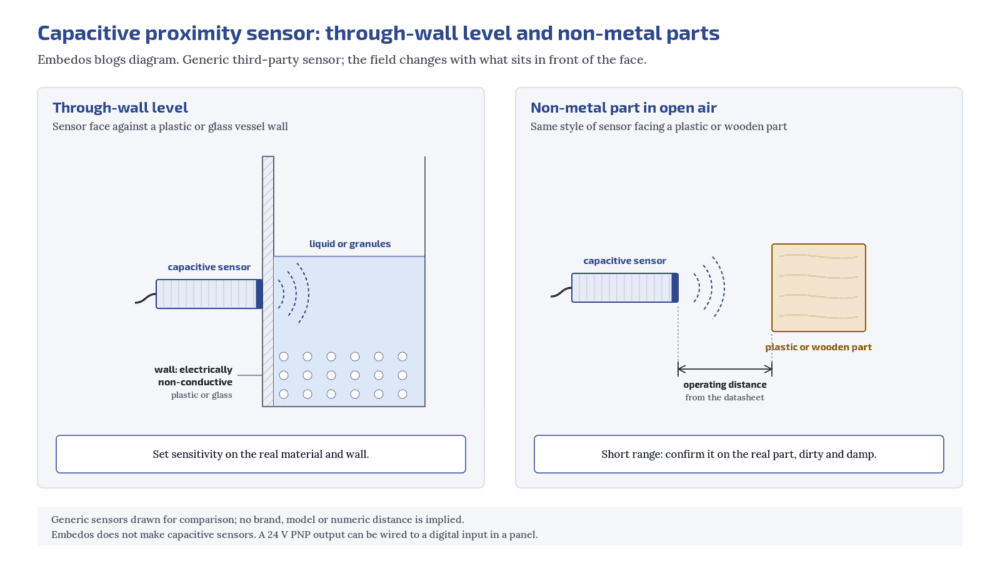
embedos-blogs-capacitive-embedos-level-non-metal: Embedos blogs diagram of a capacitive proximity sensor used for through-wall level and for a non-metal part in open air

Capacitive Proximity Sensor: Level and Non-Metal Distinction | Flush vs Non Flush | Guide

A capacitive proximity sensor is the right choice when the target is not a job for an inductive sensor: a liquid, a powder, a granule, or a non-metal solid such as plastic, wood or glass.

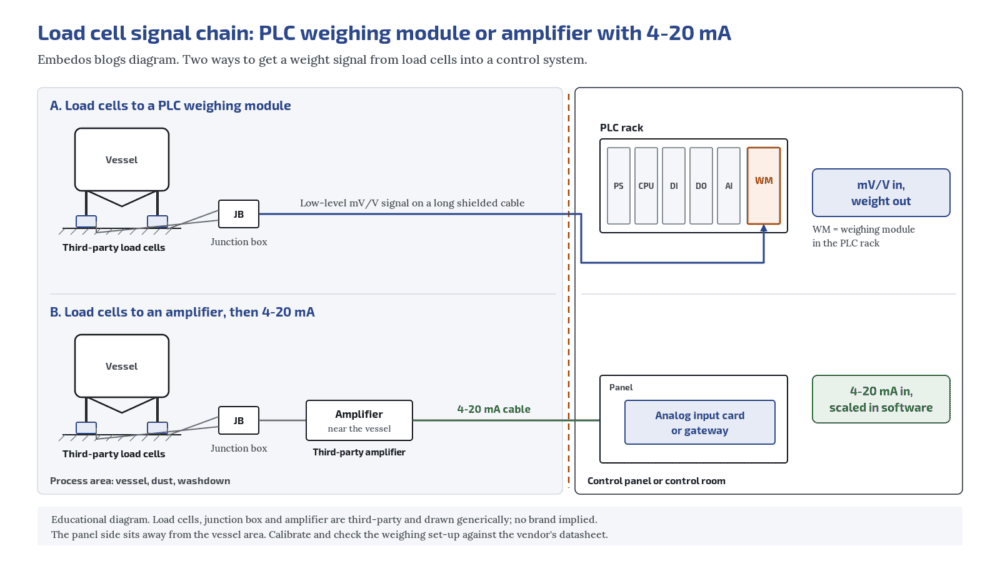
embedos-blogs-load-cell-embedos-signal-chain: Embedos blogs diagram comparing a load cell wired to a PLC weighing module with a load cell wired to an amplifier that sends 4-20 mA to a standard analog input

Load Cell Weighing Module for PLC: Buyer Guide

Load Cell Weighing Module for PLC: with Embedos.
PLC weighing module vs load cell amplifier with 4-20 mA vs edge logging: calibration, noise, excitation and how to choose for tank or batch weighing.

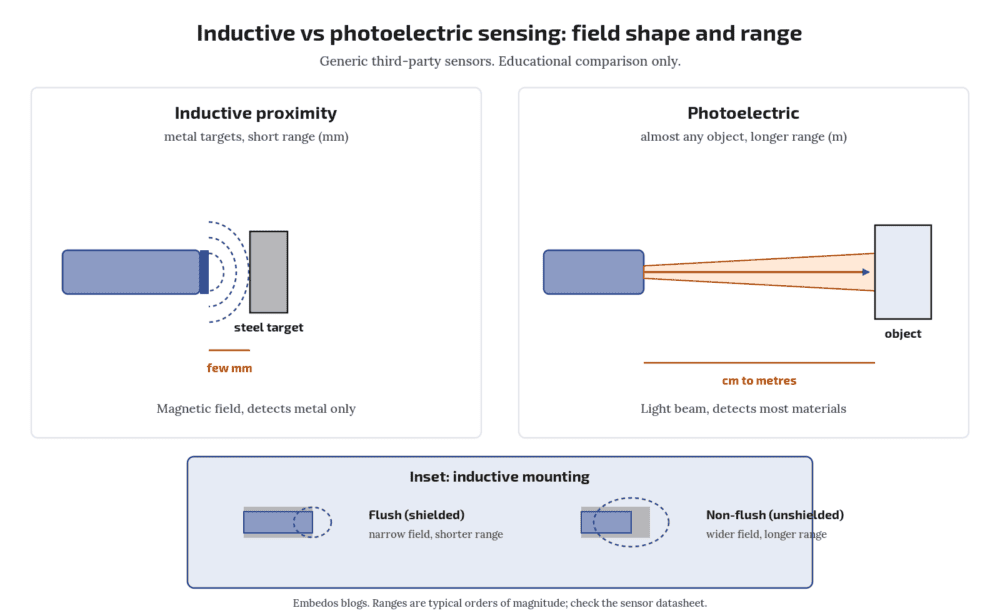
Embedos blogs embedos-blogs diagram: inductive sensor field detecting a steel target at short range versus photoelectric beam detecting an object at longer range

Inductive vs Photoelectric Sensor: Plant Selection Guide by Embedos Mumbai!

Inductive vs photoelectric Sensors. In proximity sensors for steel and power plants: Target, Flush vs Non-flush, 3-wire PNP/NPN, IP65 and dust checks. What to look for before purchasing?

When a timezone setting becomes a root shell: Four OT edge lessons in Cyber Security to learn in Industrial Automation

Four OT edge lessons from October 2026 CISA ICS advisories: timezone-to-shell, localhost bypass, Linux runtimes on controllers, and pollers without peer identity checks.

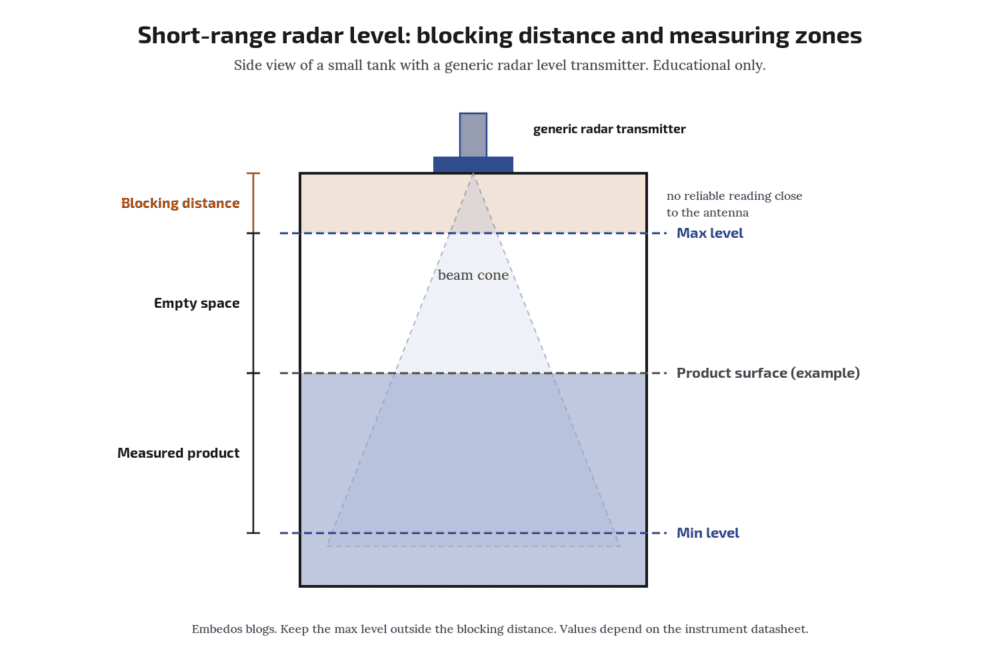
Embedos blogs embedos-blogs diagram: radar level transmitter on a small tank showing blocking distance, maximum level, minimum level and beam cone

Short-Range Radar Level Transmitter: Picking for 0.1-1.6 m

For a short range radar level transmitter on a vessel where the liquid sits 100 mm to 1600 mm below the flange, the spec that decides everything is the blocking distance (also called dead band or near-range limit).

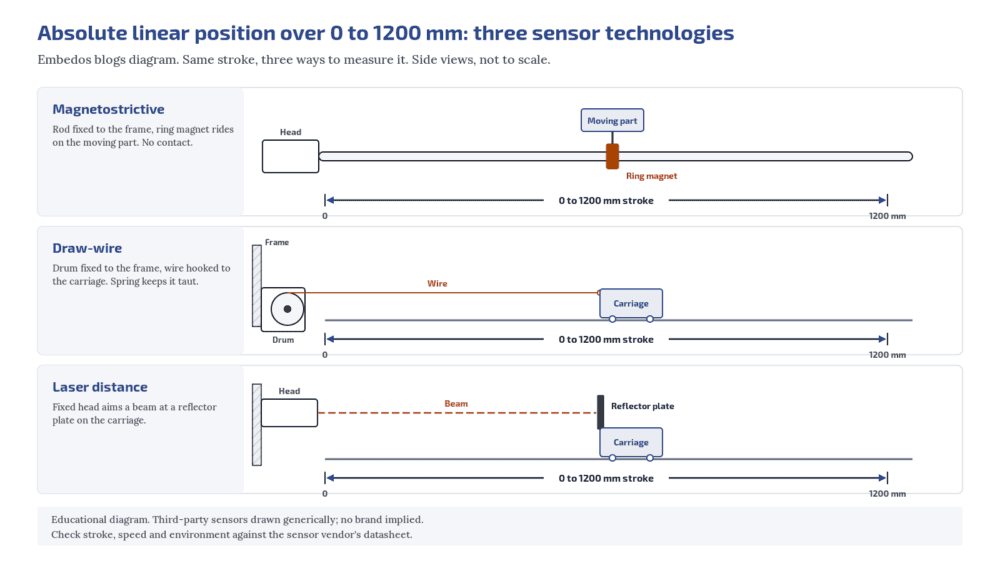
embedos-blogs-linear-position-embedos-technologies: Embedos blogs diagram comparing magnetostrictive, draw-wire and laser distance sensors measuring a 0 to 1200 mm stroke

Absolute Linear Position Sensor: 0-1200 mm | magnetostrictive vs laser vs lvdt vs draw wire |Guide

Choosing an absolute linear position sensor for 0-1200 mm: magnetostrictive vs draw-wire vs laser, SSI or digital vs 4-20 mA, stroke and mounting.

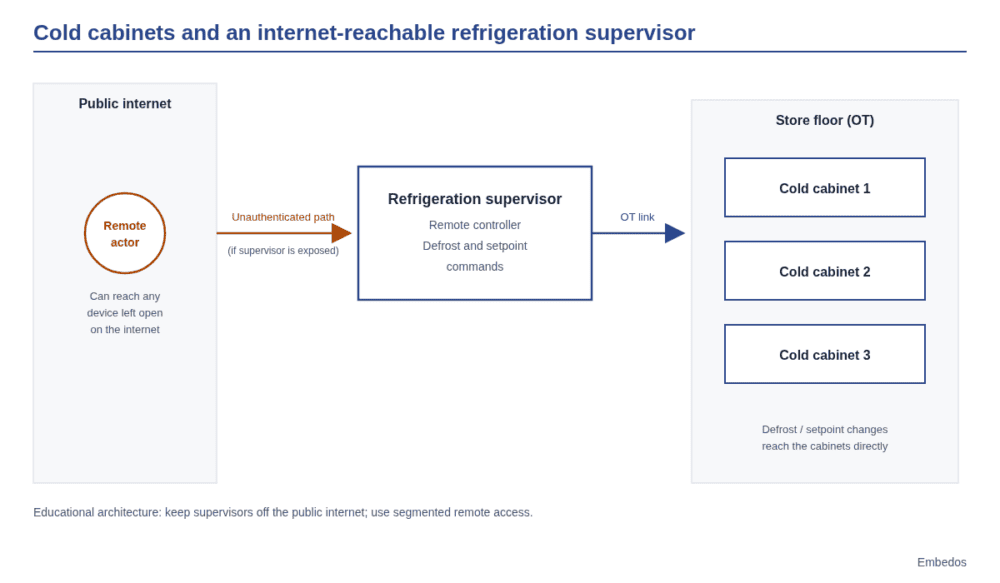
Embedos embedos-blogs diagram of supermarket cold cabinets controlled by an internet-exposed refrigeration supervisor.

When the fridge became the attack surface: France and Germany supermarket cyber lessons (2021 to 2026)

France and Germany supermarket refrigeration OT attacks in 2026, plus CERT-FR and BSI steps operators can take. Cold-chain lessons for India.

embedos-blogs: photo of warehousing godown sheds in Uttar Pradesh, India, where temperature and humidity are monitored for stored commodities

Warehouse temperature and humidity monitoring system for agri commodities

A warehouse temperature and humidity monitoring system for agri commodities measures two different things.

Ambient relative humidity (RH) and temperature tell you about the air in the shed;

Grain moisture tells you about the stock.

Vibration Transmitter 4-20mA 0-25 mm/s: Buyer Guide

Choosing a 0-25 mm/s 4-20 mA vibration transmitter for motors and fans: range, RMS velocity, frequency band, mounting and alarm limits.

Flow Meter Pulse Output vs 4-20mA: Which to Use and When

Pulse output or 4-20mA for your flow meter? Compare totalising accuracy, cable length, noise and PLC input needs, with simple examples for Indian plants.

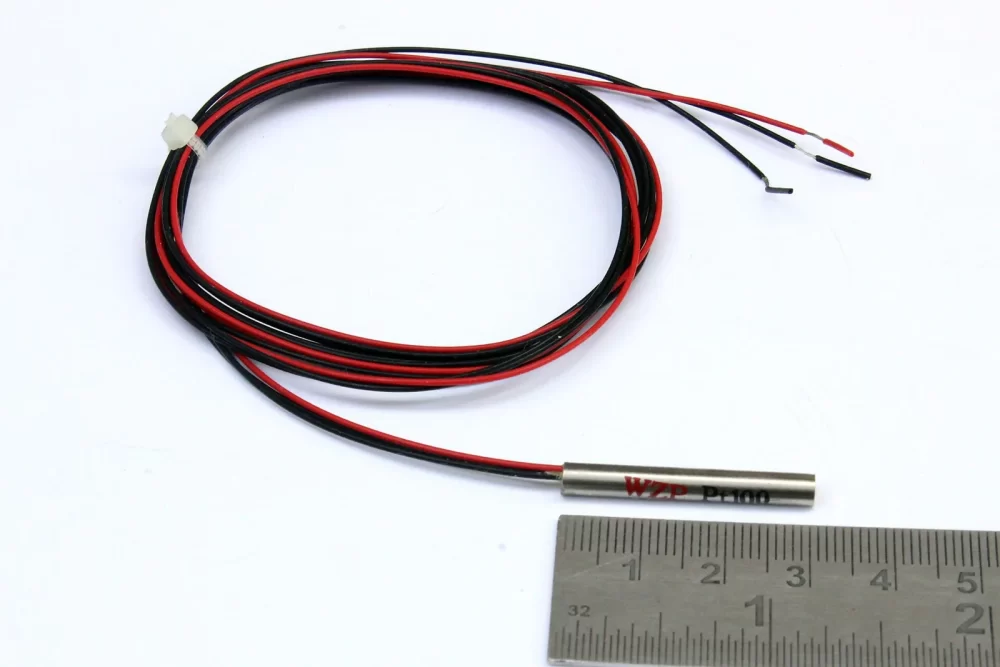
embedos-blogs-3-wire-pt100-to-4-20ma-transmitter-embedos-rtd: 3 wire PT100 sensor showing the three lead wires used for lead compensation

PT100 to 4-20mA Transmitter or Direct RTD Input?

PT100 for remote monitoring: wire it direct as 2, 3 or 4 wire RTD, or add a head mounted 4-20mA transmitter? Cable length, accuracy, noise and cost compared.

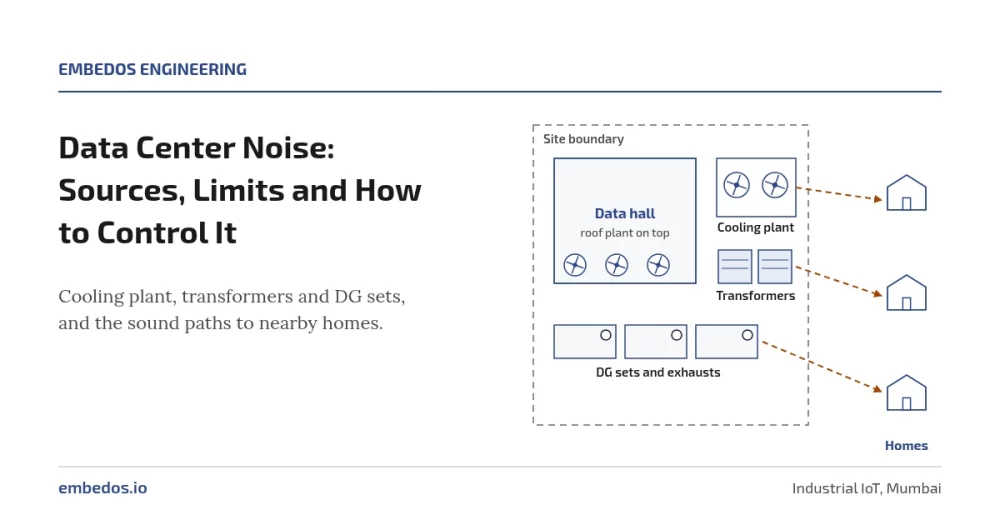
Embedos blogs featured image with the title Data Center Noise: Sources, Limits and How to Control It, beside a site plan with a data hall, cooling plant, transformers and DG sets, and dashed sound paths to nearby homes.

Data Center Noise: Sources, Limits and How to Control It

Why data centers are noisy, which sources reach neighbours, CPCB and WHO numbers, and how should engineers control and log boundary noise in India.

4G vs 5G Industrial Router: Which Suits Your Plant in India

4G or 5G industrial router for PLC and SCADA telemetry? Compare coverage, bandwidth, power, cost and dual SIM failover for Indian plants before you buy.

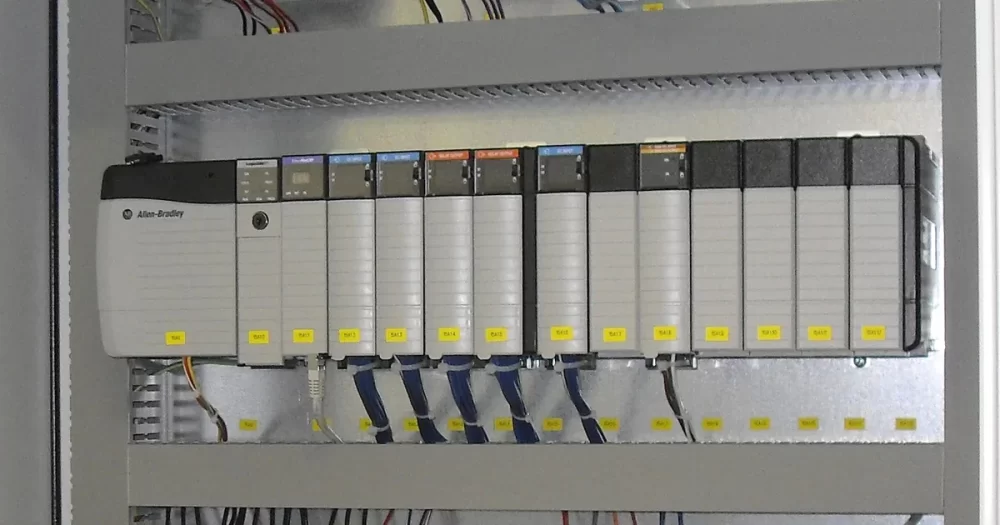
Embedos blogs embedos-blogs: PLC I/O rack wired in an industrial control panel, featured image for the Embedos guide to reading a Modbus register map

Modbus Register Map: How Do You Read It and Decode 32-bit Values (ABCD, CDAB, BADC, DCBA)?

How to read a Modbus register map: function codes, 40001 vs 0-based addresses, data types, scaling and a 32-bit float decoded. | Embedos Mumbai

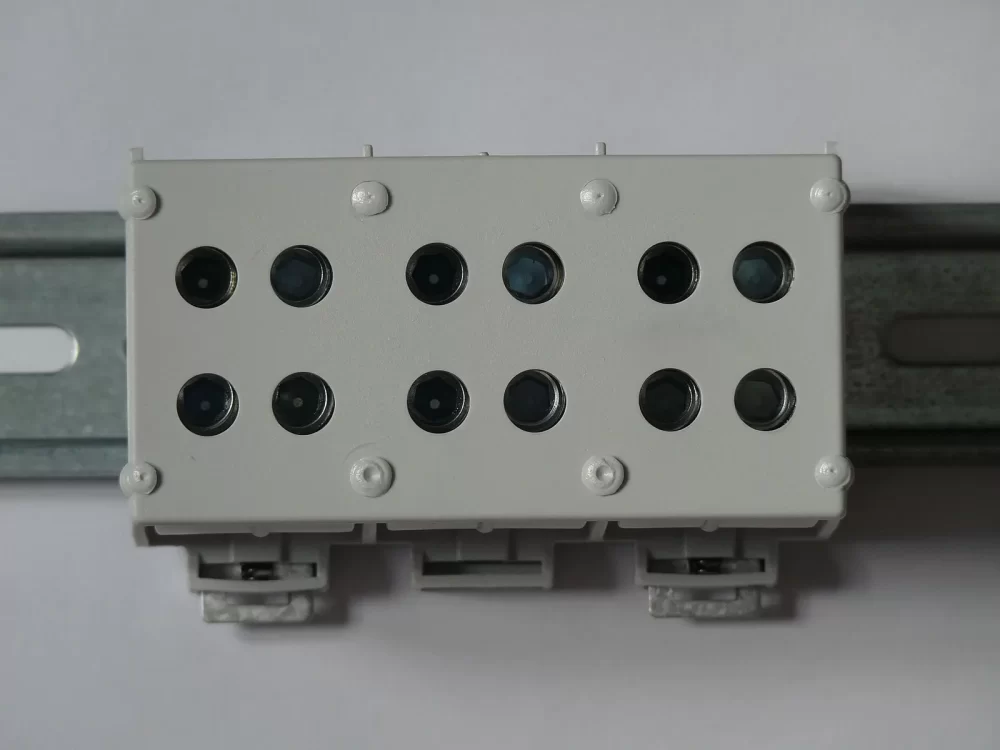
embedos-blogs-din-rail-4-20ma-signal-isolator-ground-loop-embedos-panel: DIN rail clamp terminal block, the kind of panel where a 4-20mA signal isolator is fitted before a PLC or gateway

4-20mA Signal Isolator: When You Need One for Ground Loops

When does a 4-20mA or 0-10V loop need a signal isolator before a PLC or IoT gateway?

Ground loops, shared supplies, noise signs and isolator types.

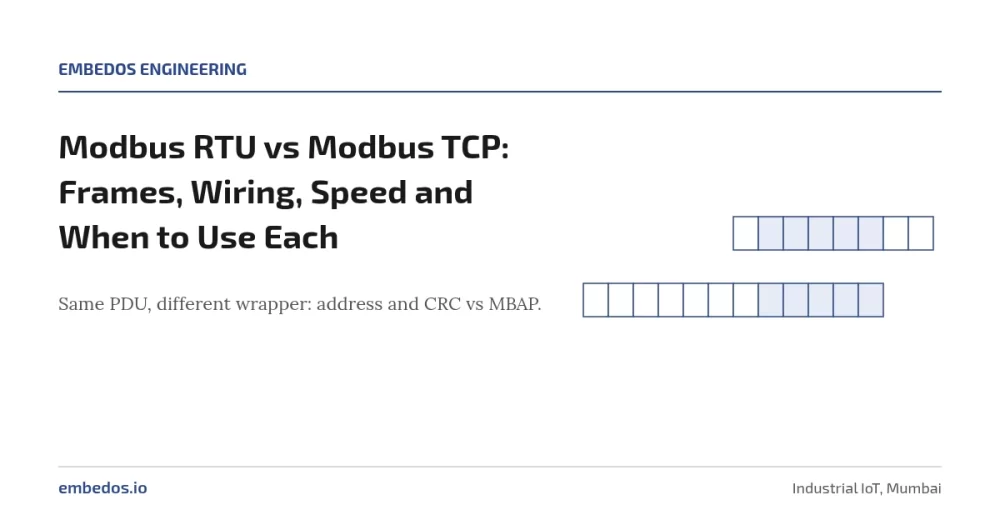
Embedos blogs featured image with the title Modbus RTU vs Modbus TCP: Frames, Wiring, Speed and When to Use Each, beside two rows of byte cells with the shared PDU shaded.

Modbus RTU vs Modbus TCP: Frames, Wiring, Speed and When to Use Each

Modbus RTU vs Modbus TCP from the official specs: framing, CRC vs MBAP header, addressing, port 502, RTU over TCP and gateways, for plant engineers.

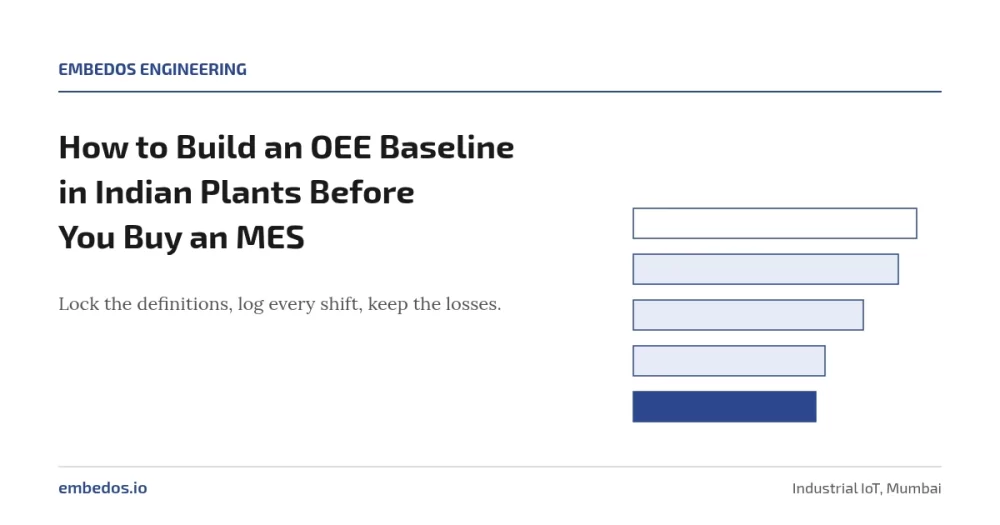
Embedos blogs featured image with the title How to Build an OEE Baseline in Indian Plants Before You Buy an MES, beside stacked bars that shrink from shift time to fully productive time.

How to Build an OEE Baseline in Indian Plants Before You Buy an MES

Set a defensible OEE baseline before you choose MES software: what to measure, for how long, and how Indian plants can start with the machines they have.

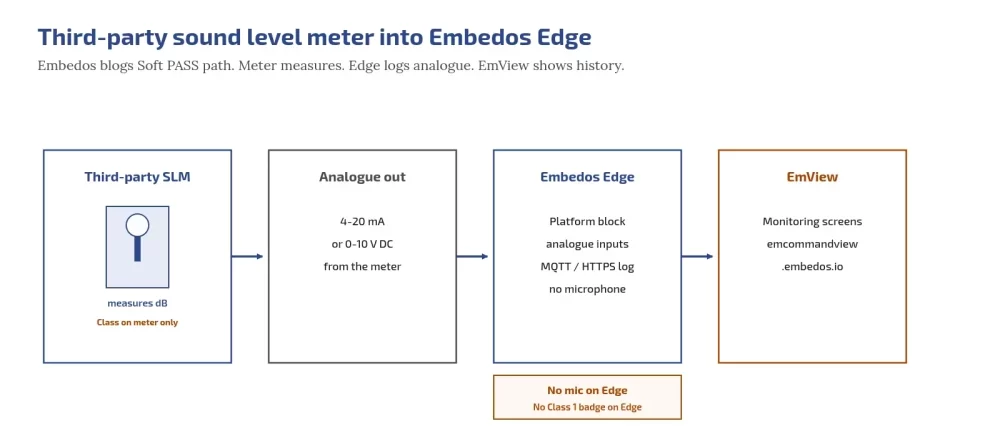
Embedos blogs embedos-blogs: third-party sound level meter analogue 4-20 mA or 0-10 V into Embedos Edge then EmView

How do you keep proving data center noise compliance after the site is built?

After a data center is built, one survey is not enough. How to run continuous boundary noise compliance logging against CPCB day and night limits in India.

OEE Monitoring System: What to Measure on Shop-Floor Machines

How to set up OEE monitoring on shop-floor machines: availability, performance and quality signals, legacy retrofit, and where an edge gateway fits.

Digitise a Bursting Strength Tester: Peak Hold to Wi-Fi Log

Upgrade a manual bursting strength tester with peak hold, auto bursting factor, RS-485 printer output and Wi-Fi data logging, without a new machine.

How IoT can improve safety and efficiency on a construction site?

IoT is a blanket term that encompasses a vast array of web enabled smart devices.

Sensors are sensing environmental pressures or temperatures or even bio-metric changes in our bodies.

IoT devices connected to the internet not only capture a whole bunch of data from these sensors, but they can talk to each other and they give us insights about what to do next.

IoT and construction sites are identifying risks before they happen.

It could be anything from poor air quality on a floor to a worker getting too close to a piece of equipment. It could potentially increase safety.

Embedos-Engineering-blog-for-construction-2

One way is by using presence detection or detect an entity’s location to understand and indicate exactly where individual workers are or materials are or where equipment is and the belief here is that we could increase individual environmental awareness.

The Interest for Industrial IoT at construction sites is growing. There has been an increased enthusiasm just to get more data onto the site but data alone isn’t enough. What we need is real time actionable information.

In order to get actionable information more sensors and IoT devices on the site need to be deployed so that they can be embedded in materials.

Intelligent tools tell us how a drill is performing, or how a welding machine is exactly executing & what problem is occurring, to reduce cut practices through manual labor & optimize on efficiency.

Not only intelligent devices at a construction site, but throughout building operations to give us continued insights on how that building as a whole is performing.

If the site supervisor logs in for the start of his work day by turning on the ignition in his company truck.

The construction company can see him in his truck en-route to his current project.

His truck’s performance metrics, such as mileage and stops are recorded automatically for better fuel management.

Arriving at the job site, he is checked in automatically. His crew and sub-trades are notified that he is on site, so they can begin reporting to him.

The supervisor has access to the location of employees and heavy equipment at all time, further ensuring the safety of workers and preventing loss of valuable assets.

Tasks can be automated using digital forms connected to the back office of the supervisor’s construction company.

Workflows for deliveries, change orders, invoicing, scheduling, inspections and quality control are all optimized to keep the project on schedule and on budget.

This streamlines his admin work and daily record keeping.

Predictive analysis helps minimize downtime by tracking operating hours and analyzing usage of equipment notifying him and head office, of maintenance needs.

As his shift ends, a temporary portable security system around the perimeter of the site switches on.

It will alert him and his team to any motion after hours.

All ideas in this blog are to provide a visualisation scenario of the various and vast array of things that can be done with IoT, with intelligent edge devices connected to sensors.

Embeodos had an application to work on for embedding location monitoring devices in helmets, safety jackets & safety belts of on field site crew & engineers.
The application was to identify at a given point of time, the location of any person logged into the system.

Remote enable & disable of certain access areas was also asked for, during application design to ensure Role Based access to certain areas based on physical parameters.
The Site Dashboard would log this data and create a virtual map of entities that contain these intelligent devices.

It was an efficient application on safety & management geared towards construction facilities.

This application can be ported to any large scale industrial area, where worker visibility, safety and security is concerned. This application can also be extended to track & trace equipments as well.

The cost of acquiring data from 100 – 200 people on a construction site, + plus monitoring their movements in real time is high.

But comes with huge amounts of data with the sole purpose of generating actionable insights into optimizing operations & processes on the shop floor.

Companies should have an appetite of investing into data acquiring projects & solutions that will enable them to produce insights and solve problems a lot quicker than intuition & experience!


Looking for End to End Industrial Automation & IoT Solutions? 


Our Experts Want to speak to You!

Capacitive Proximity Sensor: Level and Non-Metal Distinction | Flush vs Non Flush | Guide

A capacitive proximity sensor is the right choice when the target is not a job for an inductive sensor: a liquid, a powder, a granule, or a non-metal solid such as plastic, wood or glass.

Load Cell Weighing Module for PLC: Buyer Guide

Load Cell Weighing Module for PLC: with Embedos.
PLC weighing module vs load cell amplifier with 4-20 mA vs edge logging: calibration, noise, excitation and how to choose for tank or batch weighing.

Inductive vs Photoelectric Sensor: Plant Selection Guide by Embedos Mumbai!

Inductive vs photoelectric Sensors. In proximity sensors for steel and power plants: Target, Flush vs Non-flush, 3-wire PNP/NPN, IP65 and dust checks. What to look for before purchasing?

When a timezone setting becomes a root shell: Four OT edge lessons in Cyber Security to learn in Industrial Automation

Four OT edge lessons from October 2026 CISA ICS advisories: timezone-to-shell, localhost bypass, Linux runtimes on controllers, and pollers without peer identity checks.

Short-Range Radar Level Transmitter: Picking for 0.1-1.6 m

For a short range radar level transmitter on a vessel where the liquid sits 100 mm to 1600 mm below the flange, the spec that decides everything is the blocking distance (also called dead band or near-range limit).

Absolute Linear Position Sensor: 0-1200 mm | magnetostrictive vs laser vs lvdt vs draw wire |Guide

Choosing an absolute linear position sensor for 0-1200 mm: magnetostrictive vs draw-wire vs laser, SSI or digital vs 4-20 mA, stroke and mounting.

When the fridge became the attack surface: France and Germany supermarket cyber lessons (2021 to 2026)

France and Germany supermarket refrigeration OT attacks in 2026, plus CERT-FR and BSI steps operators can take. Cold-chain lessons for India.

Warehouse temperature and humidity monitoring system for agri commodities

A warehouse temperature and humidity monitoring system for agri commodities measures two different things.

Ambient relative humidity (RH) and temperature tell you about the air in the shed;

Grain moisture tells you about the stock.

Vibration Transmitter 4-20mA 0-25 mm/s: Buyer Guide

Choosing a 0-25 mm/s 4-20 mA vibration transmitter for motors and fans: range, RMS velocity, frequency band, mounting and alarm limits.

Flow Meter Pulse Output vs 4-20mA: Which to Use and When

Pulse output or 4-20mA for your flow meter? Compare totalising accuracy, cable length, noise and PLC input needs, with simple examples for Indian plants.

Predictive Maintenance & Industry 4.0


Maintenance is a demanding and taxing process. Not knowing when to schedule a maintenance run or send the maintenance team is even more menacing. With the advent of the fourth Industrial revolution, connected devices makes information about machines more available than before.

Your machines have a lot to tell you about when they need to be maintained, if you’re listening that is. Thus, the best way to optimize your machine health is by monitoring it.

A huge advantage of monitoring your systems is knowing when to accurately plan a maintenance run for your machines.

The internet in the last decade has proved to be a pivotal enabler of functionalities which would have been deemed impossible by its previous generations.

Industry 4.0 partly deals with interpreting machine data and figuring out patterns from raw data to convert into an algorithm.

Once these machines become Artificially Intelligent, they can learn from these algorithms to find out when it is going to need maintenance or when the machine is going to have a breakdown and take appropriate actions of fixing its machine cycles on its own.


We have not reached that level of technology or trust, where humans program machines and allow them to take decisions on their own. But, we have certainly dawned upon the concept of predicting the period when maintenance could be needed for a particular machine.

By installing automation controllers on machines, we receive data on the functioning of that instrument. Using this data, we can create a pattern of when the appliance is working in pristine condition and when it is not. Using this pattern, an algorithm is created to accurately detect when the machine could need its next maintenance run. Thus we reduce the requirement of a preventive maintenance run by accurately predicting when the machine needs maintenance the most.

Predictive Maintenance will also deliver on reporting the condition of the machine at all times, thus keeping track of its health.


Why is Predictive Maintenance so crucial?

Well for humans, not knowing what the future lies for you is considered to be a good thing. Significantly, it is quite the opposite for machines. For instance:

  • Early maintenance / Preventive Maintenance could risk loss of revenue for the machine needs to stop functioning for the maintenance run to be carried out, only to find out that the machine did not need maintenance in the first place.
  • Late maintenance would cause greater loss of revenue as not only the appliance has to be stopped, but some machine parts could also need replacement due to excessive use, corrosion or wear and tear.
  • In some industries & factories, condition reporting is a manual task. Staff members have a habit of submitting hand written reports of machine health after each shift. This irregular information format makes it difficult to assess issues and condition trends.
  • Accurately planning a maintenance run will lower machine downtime.Thus, assets will be able to deliver with greater efficiency at a reduced maintenance cost.


IOT is nothing but transferring machine data from one platform to another(normally a cloud platform) using the internet. Predictive maintenance is a huge application of what the Internet of Things can do with machine data.


Embedos being an Industrial IOT company is a big believer in predictive maintenance. We design our devices generally based on customer requirements with a default option of reporting when machine health deteriorates.

Machine cycle time, duration, output, idle times etc is what is reported about to predict when maintenance is needed the most.

With IOT, condition reporting can be automated with access to loads of data, thus allowing system generated reports to help in more accurate decision making. By collecting and displaying data on a consolidated dashboard, maintenance runs can be evaluated and scheduled before the condition becomes severe.


Maintenance is a calculated and a tactical process for manufacturers and product developers alike. Almost 30 percent of planned maintenance schedules are ineffective with regard to its timing. Preventive maintenance is too costly and is deemed futile by consuming essential resources needlessly.

As Machine to Machine(M2M)  technology progresses, human intervention for asset upkeep will not be required, thus defining the true power of predictive maintenance.


Looking for End to End Industrial Automation & IoT Solutions? 


Our Experts Want to speak to You!

Capacitive Proximity Sensor: Level and Non-Metal Distinction | Flush vs Non Flush | Guide

A capacitive proximity sensor is the right choice when the target is not a job for an inductive sensor: a liquid, a powder, a granule, or a non-metal solid such as plastic, wood or glass.

Load Cell Weighing Module for PLC: Buyer Guide

Load Cell Weighing Module for PLC: with Embedos.
PLC weighing module vs load cell amplifier with 4-20 mA vs edge logging: calibration, noise, excitation and how to choose for tank or batch weighing.

Inductive vs Photoelectric Sensor: Plant Selection Guide by Embedos Mumbai!

Inductive vs photoelectric Sensors. In proximity sensors for steel and power plants: Target, Flush vs Non-flush, 3-wire PNP/NPN, IP65 and dust checks. What to look for before purchasing?

When a timezone setting becomes a root shell: Four OT edge lessons in Cyber Security to learn in Industrial Automation

Four OT edge lessons from October 2026 CISA ICS advisories: timezone-to-shell, localhost bypass, Linux runtimes on controllers, and pollers without peer identity checks.

Short-Range Radar Level Transmitter: Picking for 0.1-1.6 m

For a short range radar level transmitter on a vessel where the liquid sits 100 mm to 1600 mm below the flange, the spec that decides everything is the blocking distance (also called dead band or near-range limit).

Absolute Linear Position Sensor: 0-1200 mm | magnetostrictive vs laser vs lvdt vs draw wire |Guide

Choosing an absolute linear position sensor for 0-1200 mm: magnetostrictive vs draw-wire vs laser, SSI or digital vs 4-20 mA, stroke and mounting.

When the fridge became the attack surface: France and Germany supermarket cyber lessons (2021 to 2026)

France and Germany supermarket refrigeration OT attacks in 2026, plus CERT-FR and BSI steps operators can take. Cold-chain lessons for India.

Warehouse temperature and humidity monitoring system for agri commodities

A warehouse temperature and humidity monitoring system for agri commodities measures two different things.

Ambient relative humidity (RH) and temperature tell you about the air in the shed;

Grain moisture tells you about the stock.

Vibration Transmitter 4-20mA 0-25 mm/s: Buyer Guide

Choosing a 0-25 mm/s 4-20 mA vibration transmitter for motors and fans: range, RMS velocity, frequency band, mounting and alarm limits.

Flow Meter Pulse Output vs 4-20mA: Which to Use and When

Pulse output or 4-20mA for your flow meter? Compare totalising accuracy, cable length, noise and PLC input needs, with simple examples for Indian plants.

How to Close the IoT Skills Gap?

 As technology evolves, the demand for advanced skills will only increase — unless we find ways to catch up.

It has been predicted that IoT will be a part of the most fundamental functionalities of each business area by the year 2020. Set up by different industry specialists, utilization of IoT will lead to improved business proficiency, productivity and quality work hours. There is no doubt that IoT will revolutionize the way we do our daily things, but we might have a terrible skills gap to match the demand of such a technology.

How to close the IoT skills Gap_Embedos

The concept of IoT is very clear which describes a pure interconnected world. It’s a world where every device of every shape and size are developed with smart capabilities so that they can connect, interact and exchange the data. It’s a world with technology that will make life easier, simpler and better.

IoT is a vast mixture of hardware, software, firmware and networking. To implement this, a core IoT team will require an electrical engineer, embedded systems designer, an embedded software developer, a back-end developer, a front-end developer and a product manager. For IoT startups like Embedos, these 7 positions are filled in by 3 people for want of people having relevant industry skills.

Skills needed for IoT projects to succeed:

With IoT, we need to bridge the gap between the data coming from your IoT infrastructure into your ERP application. You can have a better opportunity to increase your sales, build out new applications, new services and discover new lines of revenue for your business.

1) Security and data analysis- Millions of devices are connected to the IoT. So the amount of data needs to be encrypted, analyses and protected. Skilled engineers, architects, and analysts will be needed to gather and process the information.

2) Networking-As the IoT is all about connectivity, network engineers should focus on the skills like common protocols and keep track of a range of devices.

3) Business intelligence-All of the data collected through the IoT should be turned into actionable intelligence for businesses. They should focus on skills like sensor data analysis, data center management, programming on Hadoop.

4) Cyber-Security-The data attacks in IoT have become a serious problem. Therefore, there is a growing demand for professionals who know about cryptography, managing keys and sealing the networks. IoT security engineers will form an integral part of this field.

Challenges faced by IoT-

The IoT digitizes physical assets, sensors, devices, machines, gateways, and the network. It connects people to things and things to things in real-time. A typical IoT network can grow rapidly resulting in an exponential increase in the variety, velocity and the overall volume of the data. This data opens opportunities for significant data creation and revenue generation but the real challenge for IoT environments is how to analyze the large volume of information from all sources and take action from all in real-time.

What does this mean?

The IT environment has made the need for new analytics, approaches, and technology more urgent. Achieving desired business objectives requires the ability to act in real-time, to take advantage of opportunities and to address the problem quickly. In the pre-internet of things era, an issue in a typical supply of chain scenario could be addressed in a 2 to 3 days cycle for satisfactory results but in IoT time to action is in minutes, seconds, or microseconds. This could limit the utilization of its true potential benefits. The configuration process tends to get lengthy and complex while managing a large number of IoT devices. To simplify the process the systems should be built with a thoughtful design, standardized configuration tools, methods, and interface.

Bridging the IoT skills gap!

How can organizations plan to bridge the IoT related skills gaps?

It’s essential to plan for the IoT related skills gap that is currently present. An Organisation’s IoT implementation will not be successful if its focus is only on the technology. If it does not include its workforce in transitioning their skills gap, they will not be able to take advantage of this technology or even invent using this technology.

A Company has to invest in its workspace and change the mindset of its workers, that they will have to continuously evolve their skill sets. Think about the pace of technology and think about how we can invent new ways of technology. We must continue to reinvent ourselves and continue to evolve our skills. It’s a different contract between the employer and employee now. It’s not “I am hiring you to do this job”. It’s more like “I am hiring you to the job and I want you to continue to learn and evolve with the requirements of this job”

Are advancements in technology causing the growing IoT skills gap?

Technology is ever-evolving since the start of the 21st century. We have seen huge advancements. In 2002 iRobot Corporation released the first version of its Roomba vacuum cleaning robot. In 2004, Facebook was founded. In 2007, Apple introduced a touch screen phone with the iPhone. In 2010, 3D TV started to become more widely available. In 2013, Elon Musk announced “Hyperloop”, a giant tube transport system. In 2017, Quantum computing showed signs of becoming a practical technology and in 2018, Google announced Cloud AutoML, a suite of pre-trained systems that could make AI simpler to use. These advancements are showing no signs of slowing down which is leaving businesses falling short of employees with relevant IT skills.

In 2016, 20% of organizations were experiencing visible disruptions due to the IT skills gap. It’s now 75%. Employers are desperately searching for qualified candidates. In an increasingly growing market, employers are willing to pay higher salaries for applicants with up to date knowledge and who can bring new skills to their business.

How Augmentation reality is solving the Industrial skills gap?

Manufacturing and the service value chain jobs are most affected but the skills gap is more than just a retirement problem. There aren’t systems in place to train new generations of skilled workers. There is increasing competition from other job types. Meanwhile, physical assets are becoming more complex. Companies need to slow down the skills, drain maximize current skills and refill the skills. The answer lies in industrial augmented reality. It gives users a way to overlay digital data on top of the physical assets and environment which is a game-changer when it comes to closing the skills gap. Industrial AR provides a more efficient way to train workers using interactive digital ways of physical assets so workers learn faster and retain more by overlaying instructions, equipment status or performance data, complex or frequently changing assets. Inexperienced workers can also virtually connect with experts.

Outsourcing IoT security

IoT represents a technological revolution. There will be 24 billion connected devices by 2020. By 2020, 95% of cloud service failures will be the customer’s fault. At present, there is no standard for device-level security. The primary challenge to secure IoT implementation is that every device becomes a point of potential incursion. Outsourcing your IoT security requires you to make a detailed risk assessment of your operations. You need to determine the type of provider you need, what they will be responsible for and what you will maintain internally.

Digitization & IoT-

The magic word is digitization. It presents huge challenges to companies but it also means great business opportunities because the trend at the moment is the IoT. Deutsche Telekom has developed a solution that allows us to remotely operate our rapid action roller shutter doors in cases of maintenance and service. It helps the person directly via telephone, by service without a technician. He provides the m2m cards for communications with the IoT. It provides a reliable, high-speed network and data security.

Below is a list of skills that are in high demand in the field of IoT. A full-fledged all-round IoT experience will need expertise in at least 5 of them.

PROGRAMMING SKILLS

For IoT devices to perform useful functions, their microcontrollers need to be programmed. The most popular programming languages in use today in IoT are:

  • C
  • C++
  • Java
  • Python

Likewise note that the Arduino prototyping stage gives a library of C/C++ capacities for engineer use, and is broadly utilized in the IoT space, so creating mastery in this would be a generally excellent thought.

HARDWARE ENGINEERING

The accomplishment of IoT gadgets relies as much on its equipment structure, as on its product. Some skills to master include:

  • AutoCAD drafting
  • Computer-aided design (CAD)
  • An understanding of electronics, mechanical and network communication.
  • Sensor technology
  • PCB Designing
  • Soldering & Quality Testing
  • Embedded software Development

Data Analytics

IoT isn’t just about items being associated with the Internet. Its genuine worth originates from the data that is extracted from these keen gadgets.

IoT organizations need information wizards to gather, store, and break down the information from their devices with the goal that they can utilize them for brilliant actionable intelligence.

Abilities in Hadoop, SAS, R and NoSQL, just as business intelligence and networking are what IoT enrollment specialists are searching for.

Front End Development

For IoT devices to end up prevalent they have to have viable, easy to understand and attractive interfaces. IoT products will come in a wide range of shapes and measures and the individuals who can help plan them need to have elevated amounts of client experience, without weakening its viability will be profoundly employable.

Mobile App Development:

A part of the front end UI is the ease of access to information. Mobile Phones being used by every one of us is be a source of visualization of the data that is sent by our smart devices. Mobile Phones will be able to show data interactively gathered by IoT devices, thereby increasing opportunities for Mobile App developers in the IoT domain.

Cloud Computing:

Cloud computing unlocks a new dimension in software development. The cloud allows programmers to create, host, and execute applications that can scale up much faster.

We have viewed the potential of ‘The Cloud’, and seen it explode. Essentially because it is less expensive and quicker than customary server farms. Today organizations and IT firms are utilizing cloud and cloud applications like never before.

Skills like database management and coding are fundamental for Cloud Computing.

NETWORKING

The way to IoT is the gadgets’ capacity to speak with different devices. IoT organizations will need individuals who have mastery in current systems administration models and innovations, remote associations who can enable machine to machine communication with ease.

Top barriers to IT transformation include:

1) Technology silo

2) Outdated infrastructure

3) New skills/Expertise needed.

IT organizations are getting older which means that people are getting closer to retirement. There’s not as much new talent coming into IT organizations and most people worry about this. Many organizations look to new technology to transform their companies. Yet 94% of HR leaders say that they have difficulties accessing the skills required for transformation initiatives. And 29% say that they are being held back by a lack of digital skills amongst their workspace. So by bringing 800 technical resources who live in this environment every day, by bringing the partnerships with leading technology and understanding those technologies, understanding those dependencies can close the skills gaps.

Embedos is a full-stack IoT device platform that includes a device cloud platform, connectivity hardware, and varied automation & Interface Solutions.


Looking for End to End Industrial Automation & IoT Solutions? 


Our Experts Want to speak to You!

Capacitive Proximity Sensor: Level and Non-Metal Distinction | Flush vs Non Flush | Guide

A capacitive proximity sensor is the right choice when the target is not a job for an inductive sensor: a liquid, a powder, a granule, or a non-metal solid such as plastic, wood or glass.

Load Cell Weighing Module for PLC: Buyer Guide

Load Cell Weighing Module for PLC: with Embedos.
PLC weighing module vs load cell amplifier with 4-20 mA vs edge logging: calibration, noise, excitation and how to choose for tank or batch weighing.

Inductive vs Photoelectric Sensor: Plant Selection Guide by Embedos Mumbai!

Inductive vs photoelectric Sensors. In proximity sensors for steel and power plants: Target, Flush vs Non-flush, 3-wire PNP/NPN, IP65 and dust checks. What to look for before purchasing?

When a timezone setting becomes a root shell: Four OT edge lessons in Cyber Security to learn in Industrial Automation

Four OT edge lessons from October 2026 CISA ICS advisories: timezone-to-shell, localhost bypass, Linux runtimes on controllers, and pollers without peer identity checks.

Short-Range Radar Level Transmitter: Picking for 0.1-1.6 m

For a short range radar level transmitter on a vessel where the liquid sits 100 mm to 1600 mm below the flange, the spec that decides everything is the blocking distance (also called dead band or near-range limit).

Absolute Linear Position Sensor: 0-1200 mm | magnetostrictive vs laser vs lvdt vs draw wire |Guide

Choosing an absolute linear position sensor for 0-1200 mm: magnetostrictive vs draw-wire vs laser, SSI or digital vs 4-20 mA, stroke and mounting.

When the fridge became the attack surface: France and Germany supermarket cyber lessons (2021 to 2026)

France and Germany supermarket refrigeration OT attacks in 2026, plus CERT-FR and BSI steps operators can take. Cold-chain lessons for India.

Warehouse temperature and humidity monitoring system for agri commodities

A warehouse temperature and humidity monitoring system for agri commodities measures two different things.

Ambient relative humidity (RH) and temperature tell you about the air in the shed;

Grain moisture tells you about the stock.

Vibration Transmitter 4-20mA 0-25 mm/s: Buyer Guide

Choosing a 0-25 mm/s 4-20 mA vibration transmitter for motors and fans: range, RMS velocity, frequency band, mounting and alarm limits.

Flow Meter Pulse Output vs 4-20mA: Which to Use and When

Pulse output or 4-20mA for your flow meter? Compare totalising accuracy, cable length, noise and PLC input needs, with simple examples for Indian plants.

How To Mobilize Traffic Using IoT?


Traffic signal management is one major issue. What causes traffic jams? If you are unlucky enough to commute in your city you could end up spending the equivalent of 3 weeks per year stuck in traffic. Drivers know that accidents, construction, vehicles and just the sheer number of the people and vehicles on the road ,all contributes to traffic.

The Actual Problem:

The real culprit however is speed or rather sudden, random fluctuations in speed. When drivers travel at a constant rate traffic flows freely but even a single driver hits the brakes the flow is interrupted causing a chain reaction among the vehicles. What can be done to avoid this? Traffic signals can be better synchronized. Driverless cars can be made that can travel at more constant speeds.

IoT Will Solve Traffic Problems:

The average speed in urban environment is dropping everywhere. The question is that what speed are you right now? Traffic gets worse everywhere every year. Urbanization is a huge trend. 50 years ago about 40% of the world’s population lived in an urban area. Now it’s getting close to 80%. So we are going to see more concentration of people in cities. And that’s one of the reasons the entire things are important because cities need to operate even more efficiently.

Self-driving cars will actually solve traffic problems completely. One of the reasons traffic is frustrating is because there’s a lot of things you can’t do when you are driving. If the car is driving you then you can do your office work, you can take a nap or you can watch TV. So the car increasingly becomes a living room on wheels. Those cars can go faster. If all the cars are self-driving it will go 150 miles an hour. Human being can’t process information faster, they can’t operate at those speeds but machines can. There will be a lot of things that will change to relieve traffic burden.

Traffic Control Using IoT:

Consider a number of metal loops which acts as a sensor and are connected or embedded on the road. These sensors will act as data points. If there is an accident on the road or a very bad traffic jam, these data points will sense them and generate reports. Now the operation center will analyze the data. According to that the decisions will be taken. All the vehicles routing towards that road will be informed that traffic jam is nearby. And the alternate paths will be reduced.

Connected vehicles have become very popular in the recent years. There is a lot of research that is going on for building vehicles for good reasons. Stand alone vehicles embedded with different sensors has been there since several years. These vehicles have different embedded sensors and embedded systems.

How Can We Make Cars Manufactured By Different Companies, Connected To Each Other A Possibility?


Connected vehicles provide drivers with 360 degree awareness of similarly equipped vehicles within a range of 300 meters. This secure system keeps personal information private does not track your vehicles. Drivers will receive warnings that informs them of potential hazards through a virtual display or through seat vibrations.

These warnings can help drivers respond quickly to avoid potential crashes.

For example: “The intersection movements assist” application warns drivers when it is unsafe to enter an intersection. The “Do not pass warning” application warns drivers when it is not safe to pass a slower moving vehicle.

Connected vehicle technology can help pedestrians too.

For example: “The mobile accessible pedestrian signal system” application sends an automated pedestrian call from the Smartphones of a pedestrian with disabilities to the traffic controller holding the walk signal until the pedestrian has cleared the crosswalk. The potential benefits of a connected transportation system will able to enhance safety and mobility of not only vehicles on the road, but pedestrians as well and at the same time address environmental impacts.

Traffic Congestion Could Be Eased By IoT.

Solution:

One way could be to use maps. Google maps indicate how much traffic is going to be present on the road for your journey. Traffic Signals could be interfaced with such maps, that could tell it how much traffic does each lane have, how many vehicles at a given signal, and could calculate on its own, on an average how much green time should each lane be given.

Another way could be devices deployed on the roads which can be capable of measuring the condition levels. This could be done in various ways. There could be sensors deployed on the roads to pick up congestion data. This data can be transmitted to a cloud system, which analyzes it and decides which roads are truly congested and how much time should a traffic signal on that path give to vehicles.

It could figure out the optimal signal times to be sent to each signal. So that highly congested road would not have a longer waiting time.

Benefits Of Implementation Real Time Traffic Management Using IoT:

  • Signal times can be optimized in real time over a network of roads.
  • As this data is fed to the cloud, external systems can perform data analytics on the stream to identify traffic trends and patterns.
  • Emergency situations can be addressed efficiently. This may include plotting routes for ambulances and fire brigades.


Looking for End to End Industrial Automation & IoT Solutions? 


Our Experts Want to speak to You!

Capacitive Proximity Sensor: Level and Non-Metal Distinction | Flush vs Non Flush | Guide

A capacitive proximity sensor is the right choice when the target is not a job for an inductive sensor: a liquid, a powder, a granule, or a non-metal solid such as plastic, wood or glass.

Load Cell Weighing Module for PLC: Buyer Guide

Load Cell Weighing Module for PLC: with Embedos.
PLC weighing module vs load cell amplifier with 4-20 mA vs edge logging: calibration, noise, excitation and how to choose for tank or batch weighing.

Inductive vs Photoelectric Sensor: Plant Selection Guide by Embedos Mumbai!

Inductive vs photoelectric Sensors. In proximity sensors for steel and power plants: Target, Flush vs Non-flush, 3-wire PNP/NPN, IP65 and dust checks. What to look for before purchasing?

When a timezone setting becomes a root shell: Four OT edge lessons in Cyber Security to learn in Industrial Automation

Four OT edge lessons from October 2026 CISA ICS advisories: timezone-to-shell, localhost bypass, Linux runtimes on controllers, and pollers without peer identity checks.

Short-Range Radar Level Transmitter: Picking for 0.1-1.6 m

For a short range radar level transmitter on a vessel where the liquid sits 100 mm to 1600 mm below the flange, the spec that decides everything is the blocking distance (also called dead band or near-range limit).

Absolute Linear Position Sensor: 0-1200 mm | magnetostrictive vs laser vs lvdt vs draw wire |Guide

Choosing an absolute linear position sensor for 0-1200 mm: magnetostrictive vs draw-wire vs laser, SSI or digital vs 4-20 mA, stroke and mounting.

When the fridge became the attack surface: France and Germany supermarket cyber lessons (2021 to 2026)

France and Germany supermarket refrigeration OT attacks in 2026, plus CERT-FR and BSI steps operators can take. Cold-chain lessons for India.

Warehouse temperature and humidity monitoring system for agri commodities

A warehouse temperature and humidity monitoring system for agri commodities measures two different things.

Ambient relative humidity (RH) and temperature tell you about the air in the shed;

Grain moisture tells you about the stock.

Vibration Transmitter 4-20mA 0-25 mm/s: Buyer Guide

Choosing a 0-25 mm/s 4-20 mA vibration transmitter for motors and fans: range, RMS velocity, frequency band, mounting and alarm limits.

Flow Meter Pulse Output vs 4-20mA: Which to Use and When

Pulse output or 4-20mA for your flow meter? Compare totalising accuracy, cable length, noise and PLC input needs, with simple examples for Indian plants.

What is Edge Computing?


Soon the Internet of Things is going to give physical devices like doors, chairs, coffee makers, refrigerators, their own Internet Connection. Edge Computing will allow processing of data gathered from these devices locally and with the help of Artificial Intelligence and Machine Learning, will be able to make sense of this data. These things will become important decision makers.

So what is the Edge Device?

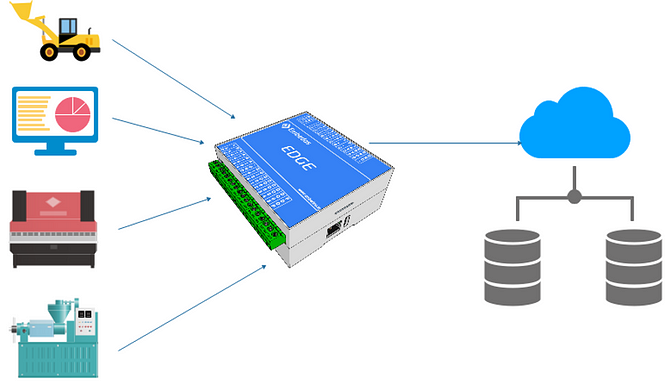
Edge in literal sense means the end or a boundary of a particular area. In the IoT world, Edge stands for the same thing. An Edge device stands at the boundary between a Field Device and a Cloud Storage. It is a logical controller for data to be acquired, processed and then transmitted from the field to the cloud.

What is the Difference between Edge Computing & Cloud Computing?

Cloud Computing is a Computing on demand service. When some one says their application is a cloud based one, it means that it is hosted on a distant Computer server, which is owned by IBM, Google or Amazon. Instead of having everything locally on a computer hard drive, everything is available on the Cloud. A cloud interface offers flexibility of not having to own expensive computing hardware to host an application.

Since its revenue structure is a “Pay as you use” one, running an application on a cloud storage is very profitable as it only charges you for the space and the computing power that you use. The most well known examples of Cloud usage is Google Drive and Apple ICloud.

The idea of Edge Computing is to push these cloud services closer to the network, to the devices themselves. Thus Edge Computing enables the captured data to be processed at the same location. With the help of Algorithms and AI, these machines can make decisions locally without the need of the internet or the cloud. It can be seen as a decentralized cloud.

But

What is the point of Edge Computing if Cloud Computing is so sought after?

Wasn’t Cloud Computing brought forward to give up hardware and only make use of the software when needed?

The answer to this is that in today’s fast moving world, avoiding latency is key. If data is processed at the time of acquisition itself, only already processed data is transferred to the cloud for a data visualization. This increases the speed of data that is transferred as processed data occupies less storage than raw acquired data.

As the Internet of Things approaches us, the size of the data that is collected is going to grow exponentially. Sending this data to the cloud for further computation is going to increase the bandwidth required and burden the network.

The benefit that Edge brings is to compute and transfer this raw data at the source itself, so as to reduce the size of the data to be transmitted and increase the speed of data transfer. Since data computation happens closer to the source of data generation, real time monitoring and analysis can take place bringing the machine closer to the operator.

Looking at the vast amounts of data that machines generate, sending all this data for computation to the cloud, is not only going to increase the processing power of the cloud, but also increase its cost of usage. With cost of usage going up and Computational speed of the Cloud decreasing, it is certain that Edge Computing only benefits the IoT to Cloud Architecture.

To give an example of Edge devices in the consumer domain, if our refrigerator were enabled with an internet connection and some data processing power, we could have our fridge know the type of food that it contains. It could also know when milk is going to run out based on consumption patterns and with its enabled internet connection and an inbuilt AI system, order a litre of milk by itself using this internet.

Speaking of Edge devices in the manufacturing and industrial sector, shop floor machines and PLC’s could be directly interfaced with edge devices. These Edge devices are critical for industries that use vast amounts of data and require immediate reaction times. The IoT to Cloud architecture is very inefficient and slow. It allows for latency in the transfer of data to the cloud due to the sheer size of data that is collected at the source.

Like Edge Computing, there is a term called “Fog Computing”.

Coined by Cisco, Fog Computing is similar to Edge Computing. Fog Computing believes in the processing, storage and networking of data between the Data Source and the Cloud. Thus Edge computing essentially is a sub division of fog computing.

For the industry, the main purpose of an Edge Gateway is to provide connectivity options to data gatherers like Sensors & Actuators. There are many industrial protocols followed like Bluetooth, Modbus, Bacnet, Profinet, OPC UA, etc.

To fulfill the need of a decision maker, the Edge gateway needs to be a programmable one, thus the term Programmable Automation Gateway Controller. In addition to running local processing and diagnostic applications, monitoring systems and custom softwares, the Edge device should store data by itself.

This allows it to be completely autonomous from the network. By running local applications and storing the data at the same time, the Edge device can operate independently, in a disconnected manner.

Thus If no internet connection is required, the processed data can be viewed locally as well. The Cloud only features as a Software to enable further analytics and poses as a customized GUI platform to view the data.

The Embedos Edge

The Flagship device of Embedos Engineering LLP is its own Edge device. It has a plethora of options and applications and is developed as a programmable automation gateway controller. The Emedos Edge device can replace the traditional PLC to perform as a Logical Controller.

The same device can be used to process the acquired data and behave like a gateway to transmit this computed data to a Cloud storage for further visualization and analytics. Solutions & Applications including Industrial Automation Controller, Data Logger, IO Expander & Controller , Display Systems , Temperature Dataloggers are some of the options offered by the Embedos Edge.

If you are interested in learning more about Edge Computing, and how to implement it on your shop floor, our team at Embedos can surely help you!


Looking for End to End Industrial Automation & IoT Solutions? 


Our Experts Want to speak to You!

Capacitive Proximity Sensor: Level and Non-Metal Distinction | Flush vs Non Flush | Guide

A capacitive proximity sensor is the right choice when the target is not a job for an inductive sensor: a liquid, a powder, a granule, or a non-metal solid such as plastic, wood or glass.

Load Cell Weighing Module for PLC: Buyer Guide

Load Cell Weighing Module for PLC: with Embedos.
PLC weighing module vs load cell amplifier with 4-20 mA vs edge logging: calibration, noise, excitation and how to choose for tank or batch weighing.

Inductive vs Photoelectric Sensor: Plant Selection Guide by Embedos Mumbai!

Inductive vs photoelectric Sensors. In proximity sensors for steel and power plants: Target, Flush vs Non-flush, 3-wire PNP/NPN, IP65 and dust checks. What to look for before purchasing?

When a timezone setting becomes a root shell: Four OT edge lessons in Cyber Security to learn in Industrial Automation

Four OT edge lessons from October 2026 CISA ICS advisories: timezone-to-shell, localhost bypass, Linux runtimes on controllers, and pollers without peer identity checks.

Short-Range Radar Level Transmitter: Picking for 0.1-1.6 m

For a short range radar level transmitter on a vessel where the liquid sits 100 mm to 1600 mm below the flange, the spec that decides everything is the blocking distance (also called dead band or near-range limit).

Absolute Linear Position Sensor: 0-1200 mm | magnetostrictive vs laser vs lvdt vs draw wire |Guide

Choosing an absolute linear position sensor for 0-1200 mm: magnetostrictive vs draw-wire vs laser, SSI or digital vs 4-20 mA, stroke and mounting.

When the fridge became the attack surface: France and Germany supermarket cyber lessons (2021 to 2026)

France and Germany supermarket refrigeration OT attacks in 2026, plus CERT-FR and BSI steps operators can take. Cold-chain lessons for India.

Warehouse temperature and humidity monitoring system for agri commodities

A warehouse temperature and humidity monitoring system for agri commodities measures two different things.

Ambient relative humidity (RH) and temperature tell you about the air in the shed;

Grain moisture tells you about the stock.

Vibration Transmitter 4-20mA 0-25 mm/s: Buyer Guide

Choosing a 0-25 mm/s 4-20 mA vibration transmitter for motors and fans: range, RMS velocity, frequency band, mounting and alarm limits.

Flow Meter Pulse Output vs 4-20mA: Which to Use and When

Pulse output or 4-20mA for your flow meter? Compare totalising accuracy, cable length, noise and PLC input needs, with simple examples for Indian plants.