Wireless IoT Water Tank Level: Sensor and Indicator | Gateway and Data | Guides

Does a hydrostatic sensor work if the water density changes?

Only if you correct for the new density. Height is pressure divided by density and gravity, so a density change with no correction looks like a level change.

A wireless IoT water tank level monitoring setup is four choices written down before anyone buys a kit: the sensor (hydrostatic pressure, ultrasonic or radar), the power at the tank (mains, battery or solar), the link (LoRa, 4G or Wi-Fi), and how high and low alerts reach a person.

Here we discuss for Water as the liquid. Special Relative Density Algorithms can always be developed for Dairy / Juice / Oil / Other Liquids with different Viscosities, different Densities. Can check that out here. 

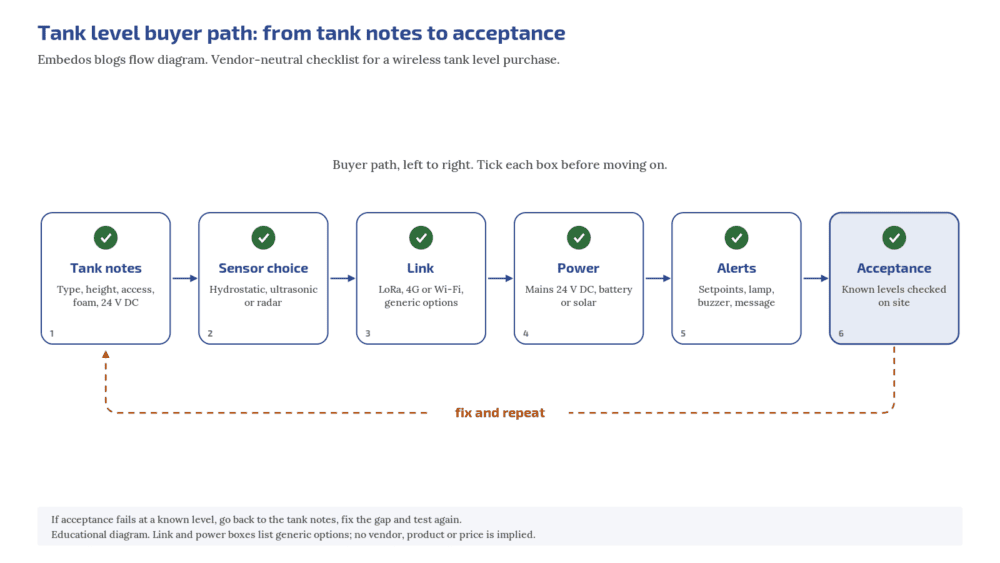
Start with the tank:

  1. height, access, foam or silt, and whether 24 V DC already exists there.
  2. Pick the sensor from that list, then pick a link you can support on site.
  3. A third-party level sensor with a 4-20 mA or 0-10 V output can then feed a gateway analog input.

Who this is for: facilities and plant engineers specifying level monitoring for overhead, underground, sump or process water tanks.
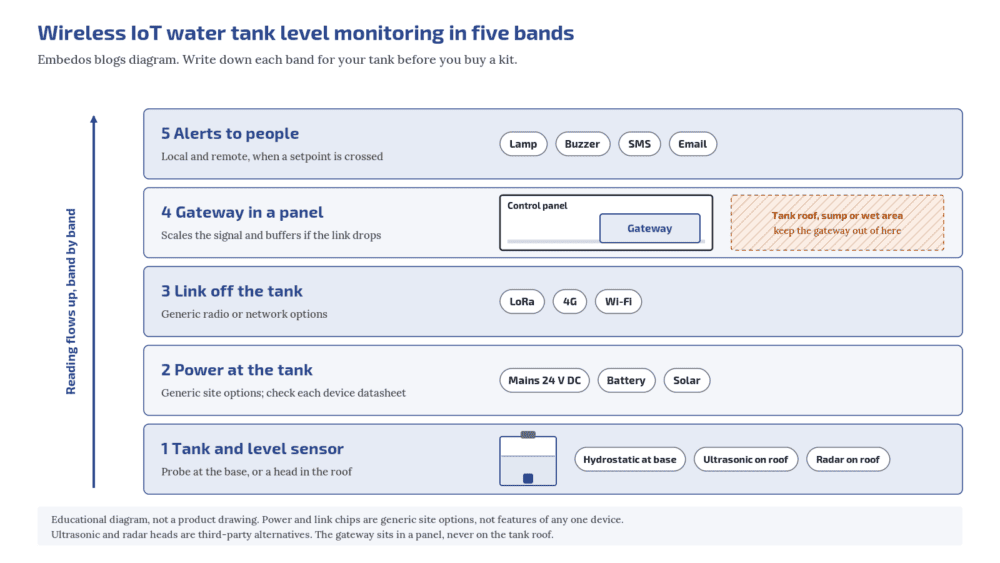
embedos-blogs-tank-level-embedos-layers: Embedos blogs diagram of a wireless IoT water tank level system from sensor and power to link, gateway and alerts

Tell us what you need on site

Need this on your plant? Tell us your requirement

What the setup actually is

Every wireless tank level system has the same chain: A level sensor on or in the tank; power at that location; a link that carries the reading off the tank; a receiving device that scales the signal; and people, reached by a local lamp or buzzer and by a message when a setpoint is crossed.

LoRa, 4G and Wi-Fi are vendor-neutral link choices. Where LoRa is used, it is a third-party node talking to a third-party LoRaWAN gateway, not a feed into our hardware.

The first three items are site choices. Write them down before you compare dashboards.

Walk the tank and record the type and material, the height or usable range, whether anyone can enter for service, foam or silt, weather, and whether 24 V DC already exists there.

That list decides the sensor more than any catalogue page does.

Ultrasonic, hydrostatic or radar for a building water tank?

Hydrostatic when you can mount a probe and the density is known; ultrasonic on a calm surface if the blind zone is clear; radar when condensation or foam makes ultrasonic unreliable. In all three cases, take the output as 4-20 mA or 0-10 V into a gateway.

Choose hydrostatic when you can mount at the bottom and the density is known; ultrasonic on a calm surface when the blind zone is clear; radar when condensation or foam rules ultrasonic out.
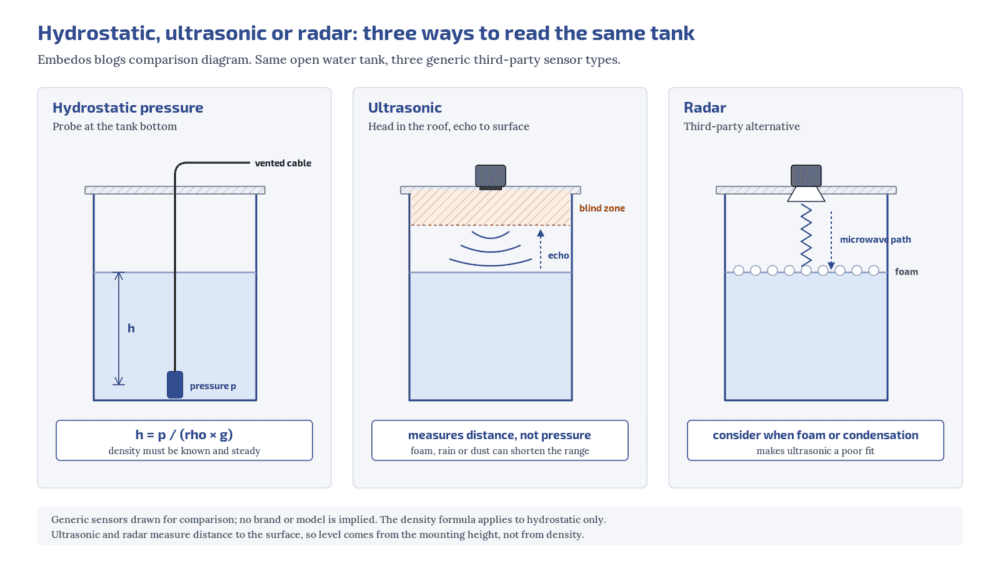
embedos-blogs-tank-sensor-embedos-choice: Embedos blogs comparison of hydrostatic, ultrasonic and radar tank level sensors on an open water tank

Hydrostatic, ultrasonic or radar

All three are third-party instruments. None of this assumes an Embedos sensor SKU.

The output you want, in most plants, is a 4-20 mA or 0-10 V signal into a gateway analog input. The 4-20 mA current loop is defined in IEC 60381-1 .

Its live zero is useful on a tank: a reading near 0 mA is a broken wire or a dead transmitter, not an empty tank. NAMUR NE 43 sets failure signal levels that let a system tell a sensor fault from a real level. 

Ask whether the gateway flags those levels as faults instead of plotting them as data. Either could be true, depending on how you want to read this. 

Hydrostatic pressure.

A pressure sensor at the tank bottom, or a submersible probe hung from the roof, measures the weight of the liquid column above it.

WIKA states the relationship for an open or vented tank as h = p / (ρ * g): height equals pressure divided by density and gravity.

A relative (gauge) sensor, often with a vented cable, cancels atmospheric pressure so the reading is only the liquid column.

Density must be known and reasonably steady; if it changes and you do not correct for it, the reported height moves even when the true level does not.

VEGA describes the same density dependence. WIKA’s rule of thumb, for a density of about 1,000 kg/m³, is that 1 bar relative corresponds to about 10 m of height. Treat that as a sizing check, not a calibration. Watch silt at the base. A sealed, pressurised tank needs a differential measurement (WIKA, sealed-vessel section).

 Ultrasonic.

An ultrasonic level sensor sits in the roof and times the echo from the liquid surface.

Pepperl+Fuchs‘ ultrasonic technology guide mentions that colour and shine do not matter.

The same guide is the source for the limits that matter on a water tank:

A blind zone immediately in front of the face (the highest expected level must sit below it), a beam that spreads with distance, and a shorter range in heavy dust, rain or snow, and as air temperature and humidity rise.

It also notes that porous targets, such as foam rubber, reduce the operating range; surface foam on a liquid can absorb the echo in the same way, so trial it.

Ultrasonic proximity switches are covered by IEC 60947-5-2; for a continuous ultrasonic level transmitter.

If foam is common, or the air at the sensor swings widely in temperature, ultrasonic is often a poor first choice; Pepperl+Fuchs names air temperature as the biggest influence on accuracy.

Radar.

A radar level sensor also sits in the roof, but it times a microwave reflection rather than a sound pulse. Use it when condensation, foam or a busy surface makes ultrasonic a poor fit.

A VEGA for a liquid radar sensor describes measurement that is largely unaffected by product deposits and condensation on the sensor, and virtually unaffected by foam and condensate.

Those statements are VEGA’s, for that family. Do not copy a beam angle from one maker and treat it as a universal figure; read the blocking distance from the datasheet of the model you are buying. The hydrostatic density calculation does not apply, because radar measures distance, not pressure.

Choose hydrostatic when you can mount at the bottom and the density is known; ultrasonic on a calm surface when the blind zone is clear; radar when condensation or foam rules ultrasonic out.

embedos-blogs-tank-sensor-embedos-choice: Embedos blogs comparison of hydrostatic, ultrasonic and radar tank level sensors on an open water tank

The link, kept vendor-neutral

LoRa, 4G and Wi-Fi are three ways to get a reading off the tank. This comparison is general engineering guidance. It does not add a long-range radio, or a battery-life figure, to any product in our catalogue.

LoRa is a long-range, low-power radio physical layer, described by Semtech, which developed it. On plant and building sites it is often used with LoRaWAN, the network protocol whose specifications are published by the LoRa Alliance.

A typical pattern is a third-party node at the tank talking to a third-party LoRaWAN gateway.

Check distance and line of sight to that third-party gateway before you commit, and write down who maintains it. Do not treat that radio path as a feed into our hardware.

4G or LTE is a cellular wide-area link.

It needs a SIM, a data plan, and actual coverage at the tank. It is often the right choice when the tank sits away from the building network.

Write down who pays for the SIM and what happens when the plan expires.

Wi-Fi is the IEEE 802.11 family of wireless local-area networks, maintained by the IEEE 802.11 working group (IEEE 802.11 Working Group).

It is the simplest option when a reliable SSID already reaches the tank and IT will approve the device, and the wrong option when the tank is in a basement, behind concrete, or outside the building’s wireless plan.

Bring IT in before the purchase order.

Whichever link you choose, ask what happens when it drops. The gateway should keep the last good values and, if it supports it, buffer readings and send them when the link returns.

Power at the tank, also vendor-neutral

Power is a site fact, not a product slogan.

Three patterns are common, and this list does not attribute battery, solar or low-power operation to any Embedos device.

Mains or 24 V DC at the tank is the cleanest option if a supply already exists, or if you can run a cable once.

Battery is used on many stand-alone tank nodes; write down how the pack is changed, who does it, and how you are told that the voltage is low.

Solar with a chargeable pack is used on remote or rooftop tanks with no mains; check shade through the day and a way to know that the pack is not charging.

In both cases the node is a site choice, not a feed into our hardware. If you already have 24 V at the tank, use it.

Specifying wireless level monitoring for a water tank?

Tell us the tank type, height, preferred sensor and the link you can support on site, and we will help you check the architecture.

Setpoints, local indication and alerts

For each tank, write a high and a low setpoint, and what should happen at each. A local lamp and buzzer still matter when the radio is down. The Bose (EB) tank level application is described under Where Embedos fits, including the local relay lamp and buzzer.

If an ultrasonic or radar distance sensor is used instead of a hydrostatic probe, the relative-density calculation does not apply, because density is derived from pressure.

SMS and email alerts can be raised through EmView or from specific Embedos Hardware devices directly from teh shop floor, when a threshold is crossed.

Call alerts are also available. Add a delay or a deadband, and name who acts and who is next if nobody acknowledges. ISA-18.2 covers alarm management in process plants; every alarm needs a defined response, or it should not exist.

If the sensor is 4-20 mA, write the scaling: level in metres = (mA – 4) / 16 x span.

Our 4-20 mA loop scaling calculator will do the arithmetic. Agree that acceptance is one fill or empty cycle checked against a dip tape or a sight glass, and write down who owns the data.

What if the tank has no power?

A battery or solar pack can power a third-party node at the tank, provided you can reach it for service. That node is a stand-alone site arrangement, not a feed into our hardware. If you can run 24 V DC once, that is usually the more maintainable path.

Wireless IoT water tank level checklist

Area What to ask or check Red flag
Tank Type, height, access, liquid, foam or silt recorded Kit quoted with no sketch
Hydrostatic Density known; vented or gauge type agreed; silt considered Density assumed, never checked
Ultrasonic Blind zone shorter than the highest level; foam and air temperature checked No blind-zone figure from the datasheet
Radar Used when foam or condensation rules ultrasonic out; blocking distance from that model’s datasheet A beam angle copied from another maker
Output 4-20 mA or 0-10 V into a gateway analog input; NE 43 faults flagged 0 mA plotted as an empty tank
Link LoRa, 4G or Wi-Fi chosen with a written reason; coverage checked on site Radio chosen before the tank is walked
Power Mains 24 V, battery or solar recorded; pack-change access agreed Battery specified with no access path
Buffering Local log if the link drops History that only exists while the radio is up
Alerts High and low setpoints; local lamp or buzzer; who is notified next Every ripple sends a message
Acceptance One fill or empty cycle checked against a dip or sight glass Dashboard screenshot as the only proof
Ownership Plant or society owns the data; export path in the order Silent contract on exit
embedos-blogs-tank-level-embedos-checklist-flow: Embedos blogs flow diagram of the buyer path from tank notes to sensor, link, power, alerts and acceptance
Can I use LoRa, 4G and Wi-Fi on the same project?

You can mix them across tanks, but each tank should have one primary link and a written reason. Check line of sight for LoRa, SIM coverage for 4G, and SSID reach plus IT approval for Wi-Fi, at the tank itself.

Where Embedos fits

Embedos Edge is our platform for the gateway layer. A third-party hydrostatic, ultrasonic or radar level sensor with a 4-20 mA or 0-10 V output can be wired to an analog input on an Edge device.

The Bose (EB) tank level application uses a ultrasonic sensor at the tank bottom to display level and volume for a liquid of any density, drives a local relay lamp and buzzer on a setpoint, and uses Wi-Fi with OTA updates.

If the tank is away from the building Wi-Fi, 4G is available as an option on Maxwell (EM). SMS, email and call alerts can be raised through EmView.

Download the Free “Wireless IoT Water Tank Level Checklist”

Enter your email and the form emails you the copy link to the Google Sheet.


How should high and low alerts be raised?

Set the two levels in writing. Use a local lamp and buzzer, and send SMS or email (and a call, if you use that path) to a named person, with a delay so a ripple does not become a flood of messages.

Next step! Send us a Mail

Send us the stroke, the resolution and speed you need, how the sensor will be mounted (in a cylinder, on a profile or with a wire), the conditions at the sensor head and the input your PLC accepts.

Email: team@embedos.io

Help Us Help You Leverage The Power Of Industrial Automation & Industrial IoT - IIoT.

What is the CAN Bus? – The Ultimate Beginner’s Guide

The Language of Machines: A CAN Bus Journey

The Silent Symphony

Dawn broke over the city as Maya stepped out of her apartment building. The streets were quiet, save for the occasional hum of a passing car. She checked her watch; 6:30 AM. Perfect timing. Her friend Ethan would be arriving any minute for their road trip.

“Right on schedule,” Maya thought as Ethan’s silver sedan pulled up to the curb. She tossed her backpack into the trunk and slid into the passenger seat.

“Morning, Professor,” she teased, knowing how much Ethan loved explaining the inner workings of cars to anyone who would listen.

“Morning, Maya,” Ethan grinned, tapping the dashboard affectionately. “Ready for a little adventure?”

As they pulled away from the curb, Maya noticed the dashboard light up with colorful displays navigation, climate control, engine status, all working in perfect harmony.

“It’s amazing how everything just… works together,” she mused, gesturing at the dashboard. “How does your car know to do all these things at once?”

Ethan’s eyes lit up. There was nothing he loved more than a chance to explain automotive technology.

“That, my friend, is the magic of CAN Bus.

The Birth of a Language

“CAN what now?” Maya raised an eyebrow.

Controller Area Network Bus, Ethan replied, guiding the car onto the highway. “It’s like… imagine if all the systems in this car needed to talk to each other, but they all spoke different languages.”

“Sounds chaotic,” Maya laughed.

“Exactly! Back in the day, that’s exactly how it was. Each system – the engine, brakes, airbags – they all had their own wiring and couldn’t easily communicate. It was a mess of wires and complexity.”

Maya glanced at the sleek interior of the modern car. “Obviously, that’s changed.”

“In 1986, a company called Bosch changed everything,” Ethan continued, his voice taking on the quality of a storyteller. “They created CAN Bus,  essentially a universal language and communication highway for all electronic components in a vehicle.”

As they drove, Ethan told Maya how before CAN Bus, cars were simple creatures with basic needs. A few wires, an engine, and mechanical parts were all they required. But progress demanded more sophisticated engines, safety systems, entertainment features and with this complexity came a problem: communication.

“Think about it like this,” Ethan said as they stopped at a red light. “Imagine if every person in a city could only talk to one other person through a dedicated phone line. You’d need millions of phone lines crisscrossing everywhere!“

“That sounds inefficient and messy,” Maya replied.

“Exactly! That’s what car wiring was like before CAN Bus. But CAN Bus is like giving everyone in that city access to a group chat. Now, every system can communicate over the same network, sharing one communication line. One wire replaced hundreds.”

The Highway of Data

As they merged onto the interstate, traffic began to pick up. Cars jockeyed for position, some speeding ahead while others maintained their pace in adjacent lanes.

“See this highway?” Ethan gestured through the windshield. “This is exactly how the ‘Bus’ in CAN Bus works.”

Maya watched the ebb and flow of traffic with new interest.

“The ‘Bus’ is just a communication pathway,” Ethan explained. “Like this highway, it allows multiple ‘vehicles’ of data to travel together. Some messages are more important than others – they’re like ambulances with sirens blaring, getting priority over regular traffic.”

“So when you hit the brakes…” Maya began.

“Exactly!” Ethan’s face lit up. “When I press the brake pedal, a high-priority message rushes down the CAN Bus highway, telling multiple systems: ‘Hey! We’re stopping!’ The brake lights receive the message and illuminate. The anti-lock brake system activates if needed. The engine adjusts its power. All these conversations happen in milliseconds over a single pathway.”

Maya watched as Ethan changed lanes smoothly, the car responding to his commands instantly. “It’s like an orchestra,” she mused.

“The perfect metaphor,” Ethan nodded appreciatively. “CAN Bus is the conductor, ensuring every instrument plays exactly when it should.”

When Messages Matter Most

About an hour into their journey, a truck ahead of them suddenly slowed. Ethan had been explaining the finer points of error correction in CAN Bus communication when his car’s collision warning system beeped sharply.

The car responded instantly – reducing speed, tightening seatbelts, and preparing the brake assist system – all before Ethan had fully registered the danger.

“That,” he said after they had safely changed lanes, “was CAN Bus in action when it matters most.”

Maya looked impressed. “All those systems reacted at once.”

“And in the right order,” Ethan added. “That’s the beauty of the priority system. The most critical safety messages get through first. If two systems try to send messages simultaneously, the one with the highest priority – usually safety-related – gets through first.”

“What if there’s an error in the message?” Maya asked, intrigued now.

“CAN Bus has that covered too. It’s like sending a text message with a built-in spell checker. If a message gets corrupted during transmission, the system detects it and requests a retransmission. For critical systems, that can happen multiple times per second.”

The Birth of a Revolution

As they stopped for coffee at a roadside diner, Ethan continued his story, telling Maya about the origins of this revolutionary technology.

“Picture this: It’s the early 1980s. Engineers at Bosch are struggling with the growing complexity of vehicle electronics. They need a solution that’s efficient, reliable, and flexible.”

Maya sipped her coffee, genuinely interested now. “So they created CAN Bus?”

“They did. The development started in 1983, and by 1986, they presented it at the Society of Automotive Engineers (SAE) conference. It was revolutionary – a communication protocol specifically designed for vehicles where reliability is literally a matter of life and death.”

“When did it become the standard?” Maya asked.

“It took time,” Ethan replied. “The first CAN controller chips were released in 1991 by Intel and Philips. By 1993, it became an international standard – ISO 11898. Then in 1996, it became mandatory for OBD-II diagnostic systems in all vehicles sold in the United States.”

“So every car on the road uses this now?”

“Most modern ones do. And not just cars , it’s used in factory equipment, medical devices, even some spacecrafts! What started as a solution for automotive complexity became a universal language for all kinds of machines.”

Beyond the Road

Back on the highway, their conversation drifted to other applications of CAN Bus technology. Ethan explained how the same principles that keep cars safe are now being applied in surprising places.

“Those wind turbines we passed earlier? Many use CAN Bus to coordinate blade pitch and monitor performance. The farm equipment in those fields? CAN Bus helps coordinate harvesting operations.”

“What about new technologies like electric vehicles?” Maya asked.

“Even more critical there,” Ethan replied enthusiastically. “In EVs, CAN Bus manages battery systems, monitors charging, and coordinates power distribution. It’s the nervous system that makes electric mobility possible.”

As they approached their destination in the late afternoon, Maya looked at the dashboard with new appreciation.

“I never realized there was this whole conversation happening inside the car,” she said. “It’s like discovering there’s a hidden orchestra playing all around you.”

Ethan smiled. “That’s what I love about technology like CAN Bus. It’s invisible, humble even – working silently in the background. But without it, none of our modern transportation would be possible.”

The sun began to set as they pulled into the hotel parking lot, casting long shadows across the asphalt.

“Is that the end of the CAN Bus story?” Maya asked as they unloaded their luggage.

Ethan laughed. “Not even close. With autonomous vehicles, smart cities, and connected transportation, we’re just beginning a new chapter. The language of machines will keep evolving, but CAN Bus laid the foundation – creating a world where our vehicles are no longer just collections of parts, but orchestrated symphonies of technology.”

“All because someone needed to solve a wiring problem,” Maya mused.

“Sometimes,” Ethan replied, “the most revolutionary ideas start by solving the simplest problems.“

As they walked toward the hotel entrance, the car’s lights flashed once, a symphony of systems saying goodnight, speaking in the silent language of CAN Bus.

CAN_Logo _ Embedos

Technical Specifications: CAN Bus in Detail

What is CAN Bus?

Controller Area Network (CAN) Bus) is a robust vehicle bus standard designed to allow microcontrollers and devices to communicate with each other within a vehicle without a host computer. CAN is a message-based protocol, designed specifically for automotive applications but now also used in other areas such as industrial automation, medical equipment, and building automation.

Core Features of CAN Bus

1. Multi-Master Communication System.

  • Any node can initiate communication when the bus is free.
  • No central controller or host required.
  • Decentralized system architecture.

2. Message-Based Protocol

  • Information is transmitted in messages (frames / packets) of up to 8 bytes.
  • Each message has a unique identifier that determines its priority.
  • Messages are broadcast to all nodes on the network.

3. Priority-Based Arbitration

  • Non-destructive bitwise arbitration.
  • Lower identifier values have higher priority.
  • Ensures critical messages get through first.

4. Robust Error Detection and Handling

Error detection mechanisms:

  • Bit monitoring.
  • Bit stuffing.
  • Frame check.
  • Acknowledgment check.
  • Cyclic Redundancy Check (CRC)
  • Error confinement with fault isolation.
  • Automatic retransmission of corrupted messages.

5. Efficient Data Transfer

  • High-speed transmission (up to 1 Mbps in standard implementations)
  • Short message format reduces overhead.
  • Deterministic conflict resolution.

Origins and Development Timeline

1983

  1. Development of CAN protocol initiated by Robert Bosch GmbH.
  2. Led by Uwe Kiencke, the primary goal was to reduce wiring complexity in Mercedes-Benz vehicles.

1986

  1. First public introduction at the Society of Automotive Engineers (SAE) conference.
  2. Initial specifications published by Bosch.

1987

First CAN controller chips (Intel 82526) announced.

1991

Intel and Philips release the first CAN controller chips to the market.

1993

  1. CAN standardized internationally as ISO 11898.
  2. Defined physical and data link layers of the OSI model.

1995

CAN in Automation CiA established as an international users and manufacturers group.

1996

  1. [OBD-II] (On-Board Diagnostics) with CAN becomes mandatory for all vehicles sold in the USA.
  2. Bosch publishes CAN specification 2.0, defining both standard and extended frame formats.

2000s

  1. Widespread adoption across multiple industries around the world.
  2. Development of higher-layer protocols (CANopen, DeviceNet, J1939)

2012

Introduction of CAN FD (Flexible Data Rate) with increased data payload and higher speed.

2020s

  1. Integration with automotive ethernet networks.
  2. CAN XL development for next-generation vehicles.

For more in depth details on CAN Bus Specifications, Wiring, Voltages, REsistance, Protocols & A Thorough Deep Dive, head to the next article.

Story Continues…

Two weeks after their road trip, Maya called Ethan in a panic.

“I’m drowning in CAN Bus logs trying to debug this system!”

“Still doing it the hard way?” Ethan asked, smiling on his end of the line.

The next day, he showed up at her office with his laptop and shiny cool blue device. “Remember our conversation about the CAN Bus orchestra? Meet the conductor.”

He opened the Em CAN Lens built by Embedos, and Maya watched as incomprehensible data transformed into elegant visualizations. Color-coded message patterns emerged, timing issues became obvious, and the elusive bug she’d been chasing for days appeared in no time.

“This is…” Maya stared in amazement, “like having x-ray vision for CAN networks.“

As they found and fixed the issue together, Maya remembered Ethan’s words: “Sometimes the most revolutionary ideas start by solving the simplest problems.“

For her team, CAN Lens had become that revolutionary idea, turning the hidden language of machines into a visual symphony anyone could understand.


Discover the Em CAN Lens and see your CAN Bus data clearly. Unleash your debugging superpowers with Embedos.

Learn More About the Embedos CAN Lens

Discover how CAN Lens can help you analyze and monitor CAN bus systems in real-time, providing enhanced diagnostics, performance tracking, and actionable insights.

Our Experts Want to speak to You!

Your goals are of utmost importance to us

Frequently Asked Questions

What does CAN Bus stand for?

CAN Bus stands for Controller Area Network, a communication system used in vehicles and industrial applications.

Why was CAN Bus developed?

CAN Bus was developed by Robert Bosch Gmbh in 1986 to simplify the wiring in vehicles, reduce costs, and ensure reliable communication between electronic systems.

How does CAN Bus ensure data accuracy?

CAN Bus uses built-in error detection mechanisms to identify and correct transmission errors, ensuring only accurate data is processed.

Is CAN Bus only used in vehicles?

Primarily meant for Electronic Control Units only inside Vehicles. CAN Bus is also used in aerospace, industrial automation, marine systems, and healthcare for reliable data communication.

Can CAN Bus be upgraded or expanded?

Yes. New nodes can be added to the CAN Bus network without major changes, making it highly scalable.

What industries benefit most from CAN Bus?

Automotive, aerospace, healthcare, industrial automation, and marine engineering are the main industries benefiting from CAN Bus.

How fast can CAN Bus transmit data?

CAN Bus supports data transmission speeds of up to 2 Mbps. Some physical layers also allow CAN Bus data rates upto 5 Mbps.

Read More

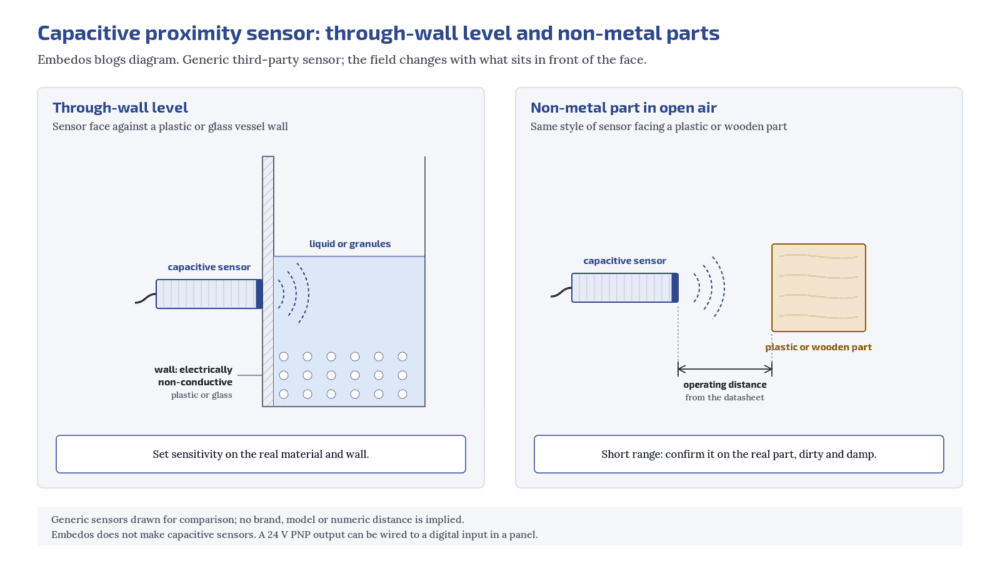
embedos-blogs-capacitive-embedos-level-non-metal: Embedos blogs diagram of a capacitive proximity sensor used for through-wall level and for a non-metal part in open air

Capacitive Proximity Sensor: Level and Non-Metal Distinction | Flush vs Non Flush | Guide

A capacitive proximity sensor is the right choice when the target is not a job for an inductive sensor: a liquid, a powder, a granule, or a non-metal solid such as plastic, wood or glass.

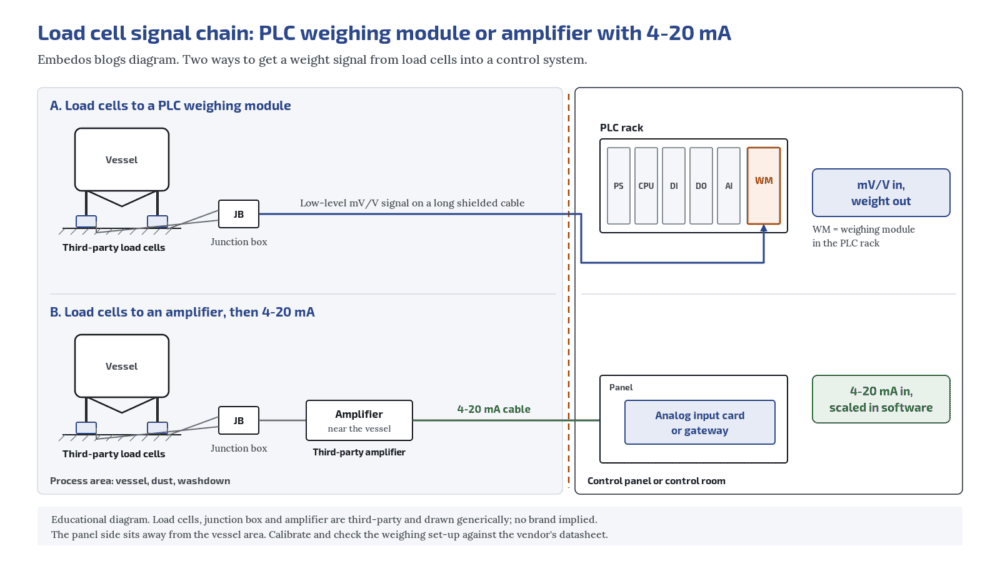
embedos-blogs-load-cell-embedos-signal-chain: Embedos blogs diagram comparing a load cell wired to a PLC weighing module with a load cell wired to an amplifier that sends 4-20 mA to a standard analog input

Load Cell Weighing Module for PLC: Buyer Guide

Load Cell Weighing Module for PLC: with Embedos.
PLC weighing module vs load cell amplifier with 4-20 mA vs edge logging: calibration, noise, excitation and how to choose for tank or batch weighing.

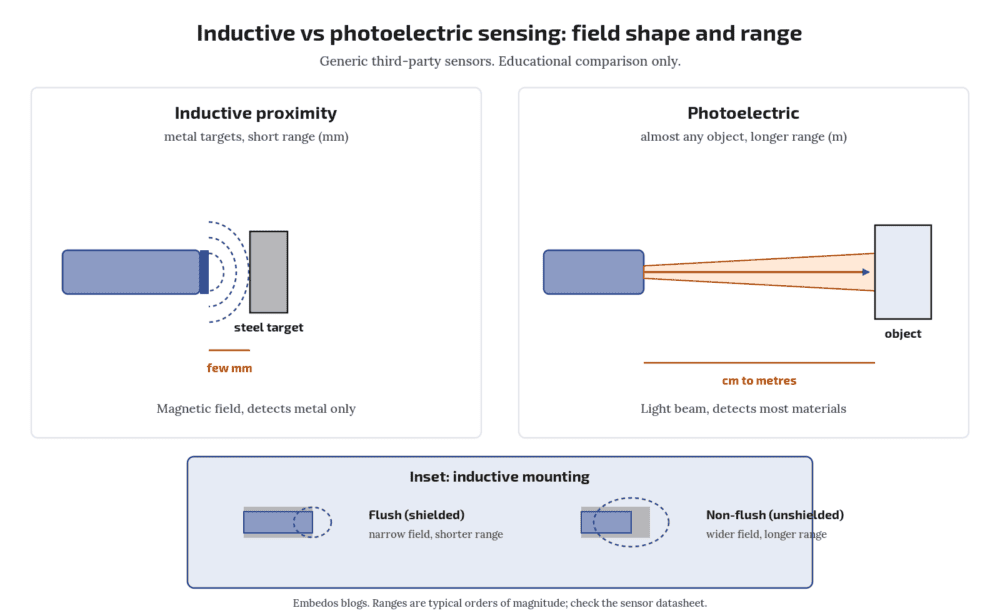
Embedos blogs embedos-blogs diagram: inductive sensor field detecting a steel target at short range versus photoelectric beam detecting an object at longer range

Inductive vs Photoelectric Sensor: Plant Selection Guide by Embedos Mumbai!

Inductive vs photoelectric Sensors. In proximity sensors for steel and power plants: Target, Flush vs Non-flush, 3-wire PNP/NPN, IP65 and dust checks. What to look for before purchasing?

When a timezone setting becomes a root shell: Four OT edge lessons in Cyber Security to learn in Industrial Automation

Four OT edge lessons from October 2026 CISA ICS advisories: timezone-to-shell, localhost bypass, Linux runtimes on controllers, and pollers without peer identity checks.

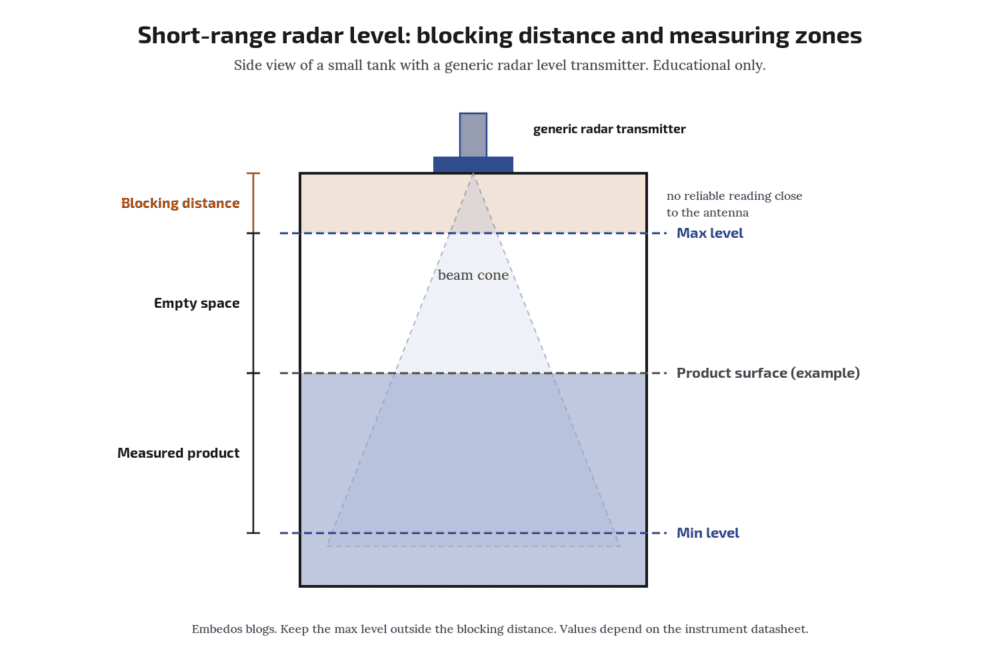
Embedos blogs embedos-blogs diagram: radar level transmitter on a small tank showing blocking distance, maximum level, minimum level and beam cone

Short-Range Radar Level Transmitter: Picking for 0.1-1.6 m

For a short range radar level transmitter on a vessel where the liquid sits 100 mm to 1600 mm below the flange, the spec that decides everything is the blocking distance (also called dead band or near-range limit).

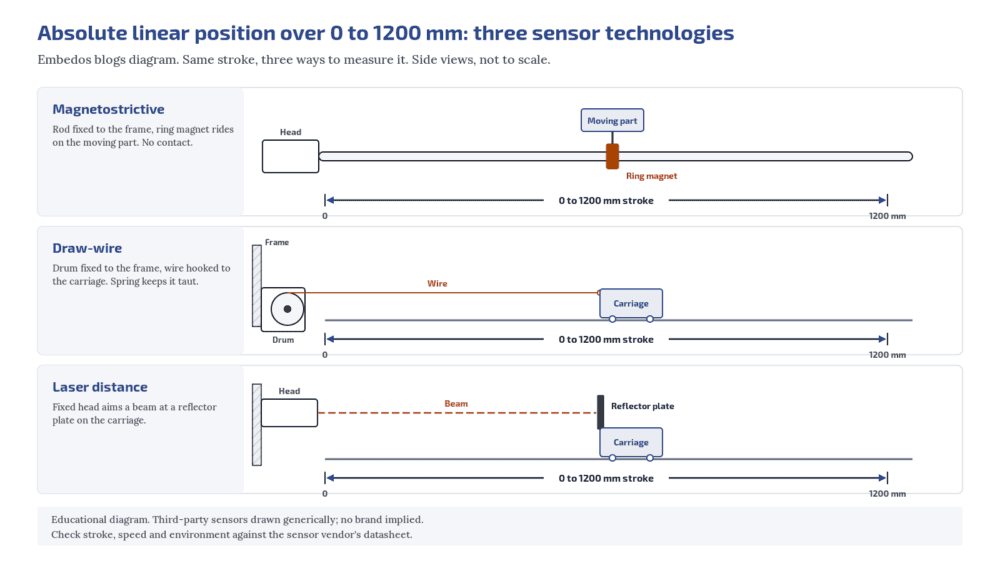
embedos-blogs-linear-position-embedos-technologies: Embedos blogs diagram comparing magnetostrictive, draw-wire and laser distance sensors measuring a 0 to 1200 mm stroke

Absolute Linear Position Sensor: 0-1200 mm | magnetostrictive vs laser vs lvdt vs draw wire |Guide

Choosing an absolute linear position sensor for 0-1200 mm: magnetostrictive vs draw-wire vs laser, SSI or digital vs 4-20 mA, stroke and mounting.

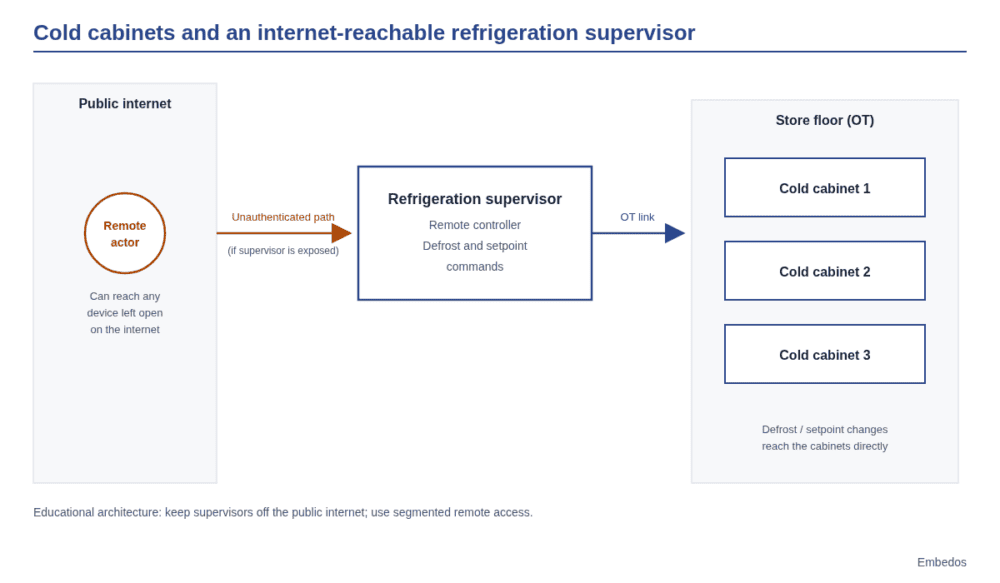
Embedos embedos-blogs diagram of supermarket cold cabinets controlled by an internet-exposed refrigeration supervisor.

When the fridge became the attack surface: France and Germany supermarket cyber lessons (2021 to 2026)

France and Germany supermarket refrigeration OT attacks in 2026, plus CERT-FR and BSI steps operators can take. Cold-chain lessons for India.

embedos-blogs: photo of warehousing godown sheds in Uttar Pradesh, India, where temperature and humidity are monitored for stored commodities

Warehouse temperature and humidity monitoring system for agri commodities

A warehouse temperature and humidity monitoring system for agri commodities measures two different things.

Ambient relative humidity (RH) and temperature tell you about the air in the shed;

Grain moisture tells you about the stock.

Vibration Transmitter 4-20mA 0-25 mm/s: Buyer Guide

Choosing a 0-25 mm/s 4-20 mA vibration transmitter for motors and fans: range, RMS velocity, frequency band, mounting and alarm limits.

Flow Meter Pulse Output vs 4-20mA: Which to Use and When

Pulse output or 4-20mA for your flow meter? Compare totalising accuracy, cable length, noise and PLC input needs, with simple examples for Indian plants.

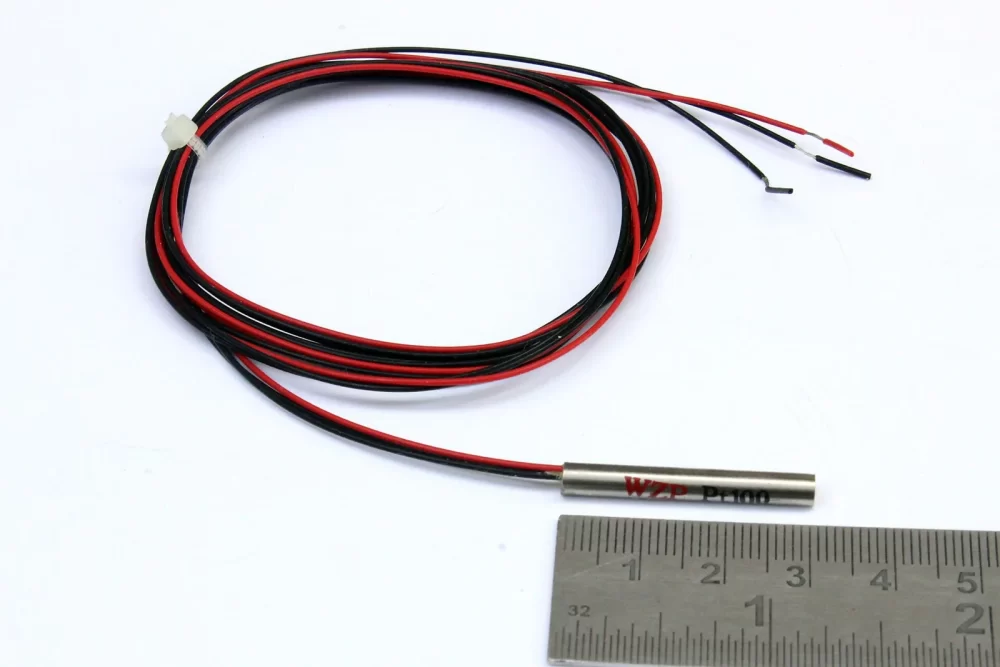
embedos-blogs-3-wire-pt100-to-4-20ma-transmitter-embedos-rtd: 3 wire PT100 sensor showing the three lead wires used for lead compensation

PT100 to 4-20mA Transmitter or Direct RTD Input?

PT100 for remote monitoring: wire it direct as 2, 3 or 4 wire RTD, or add a head mounted 4-20mA transmitter? Cable length, accuracy, noise and cost compared.

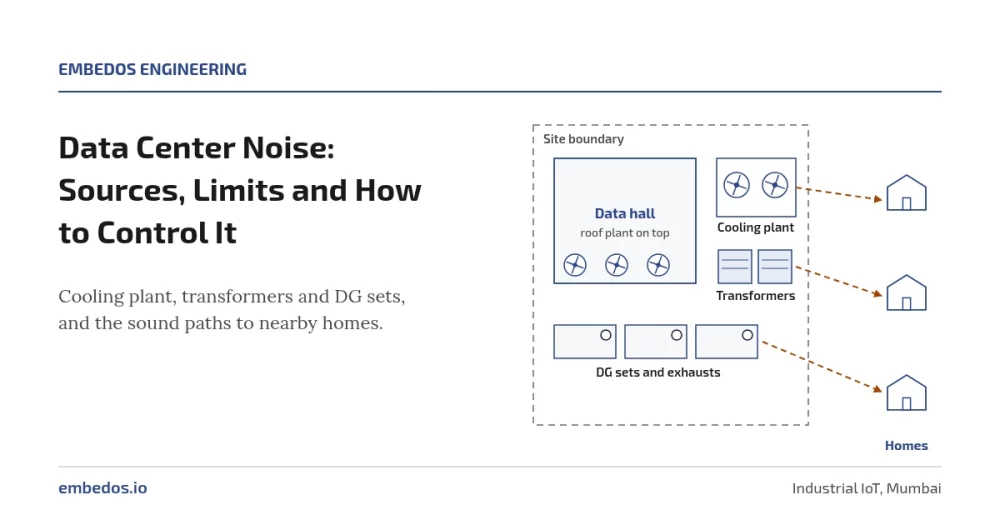
Embedos blogs featured image with the title Data Center Noise: Sources, Limits and How to Control It, beside a site plan with a data hall, cooling plant, transformers and DG sets, and dashed sound paths to nearby homes.

Data Center Noise: Sources, Limits and How to Control It

Why data centers are noisy, which sources reach neighbours, CPCB and WHO numbers, and how should engineers control and log boundary noise in India.

4G vs 5G Industrial Router: Which Suits Your Plant in India

4G or 5G industrial router for PLC and SCADA telemetry? Compare coverage, bandwidth, power, cost and dual SIM failover for Indian plants before you buy.

Embedos blogs embedos-blogs: PLC I/O rack wired in an industrial control panel, featured image for the Embedos guide to reading a Modbus register map

Modbus Register Map: How Do You Read It and Decode 32-bit Values (ABCD, CDAB, BADC, DCBA)?

How to read a Modbus register map: function codes, 40001 vs 0-based addresses, data types, scaling and a 32-bit float decoded. | Embedos Mumbai

embedos-blogs-din-rail-4-20ma-signal-isolator-ground-loop-embedos-panel: DIN rail clamp terminal block, the kind of panel where a 4-20mA signal isolator is fitted before a PLC or gateway

4-20mA Signal Isolator: When You Need One for Ground Loops

When does a 4-20mA or 0-10V loop need a signal isolator before a PLC or IoT gateway?

Ground loops, shared supplies, noise signs and isolator types.

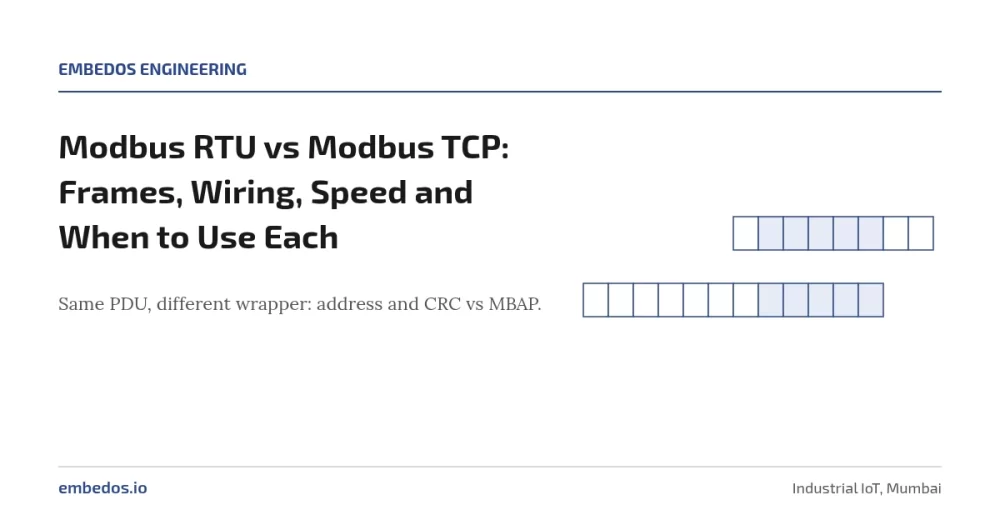
Embedos blogs featured image with the title Modbus RTU vs Modbus TCP: Frames, Wiring, Speed and When to Use Each, beside two rows of byte cells with the shared PDU shaded.

Modbus RTU vs Modbus TCP: Frames, Wiring, Speed and When to Use Each

Modbus RTU vs Modbus TCP from the official specs: framing, CRC vs MBAP header, addressing, port 502, RTU over TCP and gateways, for plant engineers.

Embedos blogs featured image with the title How to Build an OEE Baseline in Indian Plants Before You Buy an MES, beside stacked bars that shrink from shift time to fully productive time.

How to Build an OEE Baseline in Indian Plants Before You Buy an MES

Set a defensible OEE baseline before you choose MES software: what to measure, for how long, and how Indian plants can start with the machines they have.

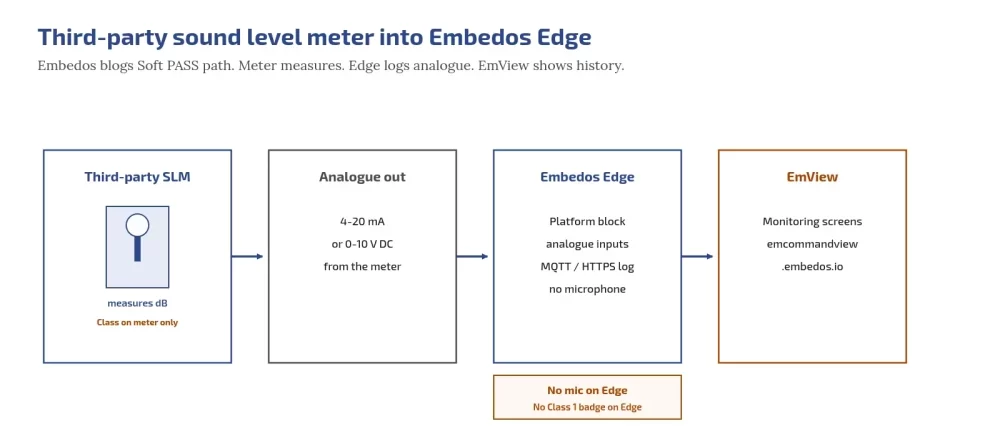
Embedos blogs embedos-blogs: third-party sound level meter analogue 4-20 mA or 0-10 V into Embedos Edge then EmView

How do you keep proving data center noise compliance after the site is built?

After a data center is built, one survey is not enough. How to run continuous boundary noise compliance logging against CPCB day and night limits in India.

OEE Monitoring System: What to Measure on Shop-Floor Machines

How to set up OEE monitoring on shop-floor machines: availability, performance and quality signals, legacy retrofit, and where an edge gateway fits.

Digitise a Bursting Strength Tester: Peak Hold to Wi-Fi Log

Upgrade a manual bursting strength tester with peak hold, auto bursting factor, RS-485 printer output and Wi-Fi data logging, without a new machine.

Public, Private & Hybrid Cloud Types! Also Community Cloud!

Cloud computing has become an essential part of modern business, providing organizations with the ability to scale their computing resources on-demand and reduce costs.

Among the various types of cloud computing, public, private, and hybrid clouds are the most commonly used by organizations.


Embedos_Private Cloud_4 Private Cloud Networks

A private cloud is a type of cloud computing service where the infrastructure, platform, or software is provided over a private network, typically owned and operated by the organization using it.

Private clouds are typically used by organizations that have strict security or compliance requirements, or that want more control over their data and infrastructure.

Embedos Cloud _3

Hybrid Cloud Networks

A hybrid cloud is a combination of a public and a private cloud, where an organization uses a public cloud provider for some services and a private cloud for others.

This allows organizations to take advantage of the scalability and cost-effectiveness of public clouds while still maintaining control over sensitive data and applications on a private cloud.

Embedos_cloud_computing_using_private_cloud_2

Public Cloud Networks

A public cloud is a type of cloud computing service where the infrastructure, platform, or software is provided over the internet by a third-party provider.

Examples of public cloud providers include Amazon Web Services (AWS), Microsoft Azure, and Google Cloud Platform (GCP).

 Public clouds are known for their scalability and cost-effectiveness, as organizations can easily add or remove resources as needed, and only pay for what they use.

Benefits / Types / Use Cases

One of the main benefits of public clouds is that they allow organizations to focus on their core business, rather than managing their own IT infrastructure.

Public cloud providers are responsible for the maintenance, updates, and security of the infrastructure, allowing organizations to spend more time developing their products or services.

However, public clouds may not be suitable for organizations that have strict security or compliance requirements, or that want more control over their data and infrastructure. In such cases, a private cloud may be a better option.

Private clouds provide organizations with a high level of control and customization, as they can configure the infrastructure to meet their specific needs.

They also offer a higher level of security, as the data is stored and processed within the organization’s own network.

However, private clouds can be more expensive and complex to manage than public clouds. Organizations need to invest in the necessary hardware, software, and personnel to set up and maintain a private cloud.

Hybrid clouds provide organizations with the best of both worlds, as they can leverage the cost-effectiveness and scalability of public clouds for non-sensitive tasks, while keeping sensitive data and applications on a private cloud for added security.

Hence, public, private, and hybrid clouds each have their own set of advantages and disadvantages, and the choice of which one to use depends on the specific needs of the organization.

Public clouds offer scalability and cost-effectiveness, while private clouds offer control and security.

Hybrid clouds offer the best of both worlds.

Feature Public Cloud Private Cloud Hybrid Cloud
Infrastructure ownership Provider owns and manages the infrastructure Organization owns and manages the infrastructure Combination of provider-owned and organization-owned infrastructure
Accessibility Available over the internet Available over a private network Combination of internet and private network access
Security Generally less secure, as resources are shared Generally more secure, as resources are dedicated and isolated Can provide a balance of security and accessibility
Scalability Highly scalable, as resources can be easily added or removed Scalable, but may require more planning and resources Combination of public and private scalability
Cost Generally more cost-effective, as resources are shared Can be more expensive, as resources are dedicated and isolated Can provide a balance of cost and customization
Control Limited control, as resources are shared Greater control, as resources are dedicated and isolated Combination of public and private control


What is a Community Cloud?

A community cloud is a type of cloud computing service that is shared by multiple organizations that have a common interest or need.

It is similar to a private cloud in that the infrastructure, platform, or software is provided over a private network, but it is shared among a specific community of users, rather than being dedicated to a single organization.

A community cloud can be set up and managed by one or more of the organizations in the community, or by a third-party service provider. The infrastructure is typically used by organizations that have similar requirements, such as those in the same industry or geographical region.

Advantages of a community cloud include:

  1. Shared resources: Organizations can share the costs and benefits of the infrastructure, making it more cost-effective than a private cloud.
  2. Enhanced security: Multiple organizations can work together to enhance security and compliance, as the community can pool resources and expertise.
  3. Improved collaboration: Organizations can collaborate and share best practices, leading to improved efficiency and productivity.
  4. Compliance: Community clouds can help organizations meet compliance requirements, such as those related to data storage and handling, as the infrastructure is shared among organizations that have similar requirements.
  5. Scalability: Community clouds can be easily scaled to meet the changing business needs of the community.
  6. Customizable: Community clouds can be customized to meet the specific needs of the community.
  7. Predictable costs: Community clouds can provide an organization with more predictable costs as the organization can plan and budget for its IT needs more effectively.

Community clouds can be a good option for organizations that have similar requirements and want to share resources and expertise while maintaining control over their IT environment.

Which is better?

Embedos_cloud_computing_using_public_cloud_2

Determining which type of cloud is better depends on the specific needs and requirements of an organization.

Each type of cloud (public, private, hybrid, and community) has its own set of advantages and disadvantages, and the best option for an organization will depend on a variety of factors such as security, scalability, cost, and compliance.

Public clouds are typically the most cost-effective and scalable option, and are well suited for organizations that have less strict security and compliance requirements.

They are also good for organizations that want to focus on their core business and leave the management of the IT infrastructure to the cloud provider.

Private clouds provide organizations with a higher level of control and customization, as well as increased security for sensitive data and applications.

They are often used by organizations that have strict security or compliance requirements, or that want more control over their data and infrastructure.

Hybrid clouds allow organizations to take advantage of the scalability and cost-effectiveness of public clouds while still maintaining control over sensitive data and applications on a private cloud.

They are a good option for organizations that want to balance the benefits of public and private clouds.

Community clouds are a shared infrastructure that is set up and managed by one or more organizations in the community, or by a third-party service provider.

They are often used by organizations that have similar requirements and want to share resources and expertise while maintaining control over their IT environment.

It is important for organizations to evaluate their specific needs and choose the type of cloud that best meets their requirements. It is also important to note that the cloud computing landscape is rapidly evolving and new options may become available in the future.


Looking for End to End Industrial Automation & IoT Solutions? 


Our Experts Want to speak to You!

Read More

embedos-blogs-capacitive-embedos-level-non-metal: Embedos blogs diagram of a capacitive proximity sensor used for through-wall level and for a non-metal part in open air

Capacitive Proximity Sensor: Level and Non-Metal Distinction | Flush vs Non Flush | Guide

A capacitive proximity sensor is the right choice when the target is not a job for an inductive sensor: a liquid, a powder, a granule, or a non-metal solid such as plastic, wood or glass.

embedos-blogs-load-cell-embedos-signal-chain: Embedos blogs diagram comparing a load cell wired to a PLC weighing module with a load cell wired to an amplifier that sends 4-20 mA to a standard analog input

Load Cell Weighing Module for PLC: Buyer Guide

Load Cell Weighing Module for PLC: with Embedos.
PLC weighing module vs load cell amplifier with 4-20 mA vs edge logging: calibration, noise, excitation and how to choose for tank or batch weighing.

Embedos blogs embedos-blogs diagram: inductive sensor field detecting a steel target at short range versus photoelectric beam detecting an object at longer range

Inductive vs Photoelectric Sensor: Plant Selection Guide by Embedos Mumbai!

Inductive vs photoelectric Sensors. In proximity sensors for steel and power plants: Target, Flush vs Non-flush, 3-wire PNP/NPN, IP65 and dust checks. What to look for before purchasing?

When a timezone setting becomes a root shell: Four OT edge lessons in Cyber Security to learn in Industrial Automation

Four OT edge lessons from October 2026 CISA ICS advisories: timezone-to-shell, localhost bypass, Linux runtimes on controllers, and pollers without peer identity checks.

Embedos blogs embedos-blogs diagram: radar level transmitter on a small tank showing blocking distance, maximum level, minimum level and beam cone

Short-Range Radar Level Transmitter: Picking for 0.1-1.6 m

For a short range radar level transmitter on a vessel where the liquid sits 100 mm to 1600 mm below the flange, the spec that decides everything is the blocking distance (also called dead band or near-range limit).

embedos-blogs-linear-position-embedos-technologies: Embedos blogs diagram comparing magnetostrictive, draw-wire and laser distance sensors measuring a 0 to 1200 mm stroke

Absolute Linear Position Sensor: 0-1200 mm | magnetostrictive vs laser vs lvdt vs draw wire |Guide

Choosing an absolute linear position sensor for 0-1200 mm: magnetostrictive vs draw-wire vs laser, SSI or digital vs 4-20 mA, stroke and mounting.

Embedos embedos-blogs diagram of supermarket cold cabinets controlled by an internet-exposed refrigeration supervisor.

When the fridge became the attack surface: France and Germany supermarket cyber lessons (2021 to 2026)

France and Germany supermarket refrigeration OT attacks in 2026, plus CERT-FR and BSI steps operators can take. Cold-chain lessons for India.

embedos-blogs: photo of warehousing godown sheds in Uttar Pradesh, India, where temperature and humidity are monitored for stored commodities

Warehouse temperature and humidity monitoring system for agri commodities

A warehouse temperature and humidity monitoring system for agri commodities measures two different things.

Ambient relative humidity (RH) and temperature tell you about the air in the shed;

Grain moisture tells you about the stock.

Vibration Transmitter 4-20mA 0-25 mm/s: Buyer Guide

Choosing a 0-25 mm/s 4-20 mA vibration transmitter for motors and fans: range, RMS velocity, frequency band, mounting and alarm limits.

Flow Meter Pulse Output vs 4-20mA: Which to Use and When

Pulse output or 4-20mA for your flow meter? Compare totalising accuracy, cable length, noise and PLC input needs, with simple examples for Indian plants.

embedos-blogs-3-wire-pt100-to-4-20ma-transmitter-embedos-rtd: 3 wire PT100 sensor showing the three lead wires used for lead compensation

PT100 to 4-20mA Transmitter or Direct RTD Input?

PT100 for remote monitoring: wire it direct as 2, 3 or 4 wire RTD, or add a head mounted 4-20mA transmitter? Cable length, accuracy, noise and cost compared.

Embedos blogs featured image with the title Data Center Noise: Sources, Limits and How to Control It, beside a site plan with a data hall, cooling plant, transformers and DG sets, and dashed sound paths to nearby homes.

Data Center Noise: Sources, Limits and How to Control It

Why data centers are noisy, which sources reach neighbours, CPCB and WHO numbers, and how should engineers control and log boundary noise in India.

4G vs 5G Industrial Router: Which Suits Your Plant in India

4G or 5G industrial router for PLC and SCADA telemetry? Compare coverage, bandwidth, power, cost and dual SIM failover for Indian plants before you buy.

Embedos blogs embedos-blogs: PLC I/O rack wired in an industrial control panel, featured image for the Embedos guide to reading a Modbus register map

Modbus Register Map: How Do You Read It and Decode 32-bit Values (ABCD, CDAB, BADC, DCBA)?

How to read a Modbus register map: function codes, 40001 vs 0-based addresses, data types, scaling and a 32-bit float decoded. | Embedos Mumbai

embedos-blogs-din-rail-4-20ma-signal-isolator-ground-loop-embedos-panel: DIN rail clamp terminal block, the kind of panel where a 4-20mA signal isolator is fitted before a PLC or gateway

4-20mA Signal Isolator: When You Need One for Ground Loops

When does a 4-20mA or 0-10V loop need a signal isolator before a PLC or IoT gateway?

Ground loops, shared supplies, noise signs and isolator types.

Embedos blogs featured image with the title Modbus RTU vs Modbus TCP: Frames, Wiring, Speed and When to Use Each, beside two rows of byte cells with the shared PDU shaded.

Modbus RTU vs Modbus TCP: Frames, Wiring, Speed and When to Use Each

Modbus RTU vs Modbus TCP from the official specs: framing, CRC vs MBAP header, addressing, port 502, RTU over TCP and gateways, for plant engineers.

Embedos blogs featured image with the title How to Build an OEE Baseline in Indian Plants Before You Buy an MES, beside stacked bars that shrink from shift time to fully productive time.

How to Build an OEE Baseline in Indian Plants Before You Buy an MES

Set a defensible OEE baseline before you choose MES software: what to measure, for how long, and how Indian plants can start with the machines they have.

Embedos blogs embedos-blogs: third-party sound level meter analogue 4-20 mA or 0-10 V into Embedos Edge then EmView

How do you keep proving data center noise compliance after the site is built?

After a data center is built, one survey is not enough. How to run continuous boundary noise compliance logging against CPCB day and night limits in India.

OEE Monitoring System: What to Measure on Shop-Floor Machines

How to set up OEE monitoring on shop-floor machines: availability, performance and quality signals, legacy retrofit, and where an edge gateway fits.

Digitise a Bursting Strength Tester: Peak Hold to Wi-Fi Log

Upgrade a manual bursting strength tester with peak hold, auto bursting factor, RS-485 printer output and Wi-Fi data logging, without a new machine.

How for organizations – it is cloud compliance that creates value and trust in security.

Cloud computing is a term that refers to the delivery of computing resources and services over the internet.

It enables organizations to access and use computing resources, such as storage, processing power, and software, on-demand and without the need to invest in and maintain their own infrastructure.

By leveraging cloud technology, organizations can realize many benefits such as cost savings, scalability, flexibility, improved collaboration and increased agility.


Embedos_enlightening-ai-technology-

The unfortunate conception!

There is a perception among some manufacturing organizations that cloud computing is not as secure as on-premises solutions and that there is a lack of control over their data when it is stored in the cloud.

Additionally, some organizations may be concerned about regulatory compliance when using cloud services and the potential for data breaches or other security incidents.

To address these concerns, cloud vendors have invested heavily in security and compliance measures to ensure that their services meet industry standards and regulations.

They also provide detailed documentation and transparency around their security practices and incident response plans.

However, building trust between manufacturing organizations and cloud vendors is a process that requires ongoing effort and communication.

Cloud vendors must continue to demonstrate their commitment to security and compliance, while also providing a high level of customer support and service.

Manufacturing organizations, on the other hand, need to educate themselves about the security and compliance measures in place, and perform due diligence in the selection of a cloud vendor that aligns with their specific needs.

Additionally, they should have a clear understanding of the regulatory requirements that apply to their industry and ensure that the vendor’s offering meets those requirements.

Cloud vendors, meanwhile, must continue to prioritize security and compliance to build trust with their customers and provide the level of service and support that is needed to foster long-term relationships.

Cloud compliance refers to the process of ensuring that an organization’s use of cloud computing services conforms to legal, regulatory, and industry standards.

Compliance with these standards helps organizations protect sensitive data and maintain the trust of their customers and stakeholders.


Embedos_industry-4-0-interface-automation-manufacturing

By ensuring cloud compliance, organizations can create value in several ways:

1.    Protection of sensitive data: Compliance with regulations such as HIPAA, SOC 2, and PCI DSS helps organizations protect sensitive data such as personal information, financial data, and healthcare records. This can prevent data breaches, which can be costly and damaging to an organization’s reputation.

2.    Mitigation of legal and regulatory risks: Compliance with laws and regulations such as GDPR and CCPA can help organizations avoid costly fines and legal penalties.

3.    Building trust with customers and stakeholders: Compliance with industry standards and regulations demonstrates to customers and stakeholders that an organization takes data security and privacy seriously. This can help build trust and confidence in the organization’s services.

4.    Improved incident management: Compliance with regulations such as ISO 27001 can help organizations establish effective incident management processes, which can help minimize the impact of security incidents and data breaches.

5.    Streamlined compliance reporting: Adopting cloud services, such as Software as a Service (SaaS) can help organizations automate compliance reporting, which can help reduce the burden of compliance on IT teams.

Cloud compliance creates value for organizations by protecting sensitive data, mitigating legal and regulatory risks, building trust with customers and stakeholders, improving incident management and streamlining compliance reporting.

Organizations should conduct regular assessments to ensure their cloud computing services are compliant with relevant laws, regulations, and industry standards.


Embedos_-Cloud-Security

Organizations that are not taking full advantage of cloud technology, should consider how cloud computing can benefit their business and address any concerns they may have about security and compliance.

They should also consider partnering with a reputable cloud vendor who can provide the necessary support and guidance to help them successfully implement and manage their cloud infrastructure.

Another important factor to consider is the development of a clear cloud strategy that aligns with the organization’s overall business objectives.

This should include an assessment of the current IT infrastructure, a plan for migrating applications and data to the cloud, and a clear understanding of the resources and services that will be needed to support the organization’s operations.

Additionally, organizations should also consider how they can leverage the power of IoT and big data to capture, analyze, and act on the vast amounts of data generated by their operations.

This can help improve decision-making, optimize production processes, and reduce downtime.

Cloud computing can deliver tremendous amounts of business value to organizations, but it requires a strategic approach and a willingness to embrace change. Organizations that are able to do this, can reap the benefits of cloud computing and gain a competitive advantage in the marketplace.


Today, almost every manufacturing customer that is digitally transforming becomes partly a software company.

This is because digital transformation in manufacturing involves the integration of advanced technologies such as software, cloud services, data analytics, and artificial intelligence into traditional manufacturing operations.

These technologies enable manufacturers to improve efficiency, increase productivity, and gain insights from data to make better decisions.

By incorporating software into their operations, manufacturers can automate and streamline processes, improve communication and collaboration within the organization, and gain access to advanced analytics tools to make data-driven decisions.

Additionally, the use of cloud services allows manufacturers to access powerful computing resources and scale up or down as needed, while also providing flexibility and cost savings.

Embedos Cloud _2 with input output

By becoming a “software company,” manufacturers are able to better compete in a rapidly changing industry, stay ahead of emerging trends and technologies, and drive innovation to improve their operations and remain competitive.

Technical advancements, the adoption of cloud services, data analytics, and artificial intelligence will accelerate this phenomenon.

The integration of these advanced technologies is driving the digital transformation in manufacturing and will continue to accelerate the trend of manufacturers becoming “software companies.”

Technical advancements such as the Internet of Things (IoT), Industry 4.0, and 5G networking are enabling manufacturers to connect and collect data from a wide range of devices and equipment, providing a wealth of data for analysis and decision-making.

The adoption of cloud services allows manufacturers to store, process, and analyze this data at scale and with greater efficiency. They can also leverage advanced analytics and machine learning tools to gain insights and improve decision-making, optimize operations, and drive innovation.

Artificial intelligence (AI) and machine learning (ML) are also becoming increasingly important in manufacturing. They enable manufacturers to automate processes, improve prediction and forecasting, and make real-time decisions based on data analysis.

Overall, these technological advancements and the adoption of cloud services, data analytics, and AI are allowing manufacturers to become more efficient, innovative, and competitive, and will continue to shape the manufacturing industry in the coming years.


Embedos_IP picture

With increasing customer collaboration comes more questions regarding who owns specific patents and the resulting intellectual property (IP).

As customers collaborate with Cloud hosting companies to develop new technology and solutions, there may be confusion or uncertainty about who owns the resulting intellectual property (IP) and the rights to use it.

This can create potential legal and financial risks for both parties and can also hinder future innovation and collaboration.

To address these concerns, many Cloud providers, have developed principles and guidelines for co-created technology and IP. These principles are designed to provide transparency, fairness and clarity in the ownership and use of IP generated through collaboration.

For example, the principles may include: Clarity of ownership, Fairness in licensing, Transparency in use, Respect for customer’s IP. These principles can provide both parties with a clear understanding of who owns the IP, the terms of use, and the rights to commercialize it.

By establishing clear and fair principles for co-created technology and IP, companies can build trust with their customers, mitigate legal and financial risks, and foster future innovation and collaboration.


Looking for End to End Industrial Automation & IoT Solutions? 


Our Experts Want to speak to You!

Read More

embedos-blogs-capacitive-embedos-level-non-metal: Embedos blogs diagram of a capacitive proximity sensor used for through-wall level and for a non-metal part in open air

Capacitive Proximity Sensor: Level and Non-Metal Distinction | Flush vs Non Flush | Guide

A capacitive proximity sensor is the right choice when the target is not a job for an inductive sensor: a liquid, a powder, a granule, or a non-metal solid such as plastic, wood or glass.

embedos-blogs-load-cell-embedos-signal-chain: Embedos blogs diagram comparing a load cell wired to a PLC weighing module with a load cell wired to an amplifier that sends 4-20 mA to a standard analog input

Load Cell Weighing Module for PLC: Buyer Guide

Load Cell Weighing Module for PLC: with Embedos.
PLC weighing module vs load cell amplifier with 4-20 mA vs edge logging: calibration, noise, excitation and how to choose for tank or batch weighing.

Embedos blogs embedos-blogs diagram: inductive sensor field detecting a steel target at short range versus photoelectric beam detecting an object at longer range

Inductive vs Photoelectric Sensor: Plant Selection Guide by Embedos Mumbai!

Inductive vs photoelectric Sensors. In proximity sensors for steel and power plants: Target, Flush vs Non-flush, 3-wire PNP/NPN, IP65 and dust checks. What to look for before purchasing?

When a timezone setting becomes a root shell: Four OT edge lessons in Cyber Security to learn in Industrial Automation

Four OT edge lessons from October 2026 CISA ICS advisories: timezone-to-shell, localhost bypass, Linux runtimes on controllers, and pollers without peer identity checks.

Embedos blogs embedos-blogs diagram: radar level transmitter on a small tank showing blocking distance, maximum level, minimum level and beam cone

Short-Range Radar Level Transmitter: Picking for 0.1-1.6 m

For a short range radar level transmitter on a vessel where the liquid sits 100 mm to 1600 mm below the flange, the spec that decides everything is the blocking distance (also called dead band or near-range limit).

embedos-blogs-linear-position-embedos-technologies: Embedos blogs diagram comparing magnetostrictive, draw-wire and laser distance sensors measuring a 0 to 1200 mm stroke

Absolute Linear Position Sensor: 0-1200 mm | magnetostrictive vs laser vs lvdt vs draw wire |Guide

Choosing an absolute linear position sensor for 0-1200 mm: magnetostrictive vs draw-wire vs laser, SSI or digital vs 4-20 mA, stroke and mounting.

Embedos embedos-blogs diagram of supermarket cold cabinets controlled by an internet-exposed refrigeration supervisor.

When the fridge became the attack surface: France and Germany supermarket cyber lessons (2021 to 2026)

France and Germany supermarket refrigeration OT attacks in 2026, plus CERT-FR and BSI steps operators can take. Cold-chain lessons for India.

embedos-blogs: photo of warehousing godown sheds in Uttar Pradesh, India, where temperature and humidity are monitored for stored commodities

Warehouse temperature and humidity monitoring system for agri commodities

A warehouse temperature and humidity monitoring system for agri commodities measures two different things.

Ambient relative humidity (RH) and temperature tell you about the air in the shed;

Grain moisture tells you about the stock.

Vibration Transmitter 4-20mA 0-25 mm/s: Buyer Guide

Choosing a 0-25 mm/s 4-20 mA vibration transmitter for motors and fans: range, RMS velocity, frequency band, mounting and alarm limits.

Flow Meter Pulse Output vs 4-20mA: Which to Use and When

Pulse output or 4-20mA for your flow meter? Compare totalising accuracy, cable length, noise and PLC input needs, with simple examples for Indian plants.

embedos-blogs-3-wire-pt100-to-4-20ma-transmitter-embedos-rtd: 3 wire PT100 sensor showing the three lead wires used for lead compensation

PT100 to 4-20mA Transmitter or Direct RTD Input?

PT100 for remote monitoring: wire it direct as 2, 3 or 4 wire RTD, or add a head mounted 4-20mA transmitter? Cable length, accuracy, noise and cost compared.

Embedos blogs featured image with the title Data Center Noise: Sources, Limits and How to Control It, beside a site plan with a data hall, cooling plant, transformers and DG sets, and dashed sound paths to nearby homes.

Data Center Noise: Sources, Limits and How to Control It

Why data centers are noisy, which sources reach neighbours, CPCB and WHO numbers, and how should engineers control and log boundary noise in India.

4G vs 5G Industrial Router: Which Suits Your Plant in India

4G or 5G industrial router for PLC and SCADA telemetry? Compare coverage, bandwidth, power, cost and dual SIM failover for Indian plants before you buy.

Embedos blogs embedos-blogs: PLC I/O rack wired in an industrial control panel, featured image for the Embedos guide to reading a Modbus register map

Modbus Register Map: How Do You Read It and Decode 32-bit Values (ABCD, CDAB, BADC, DCBA)?

How to read a Modbus register map: function codes, 40001 vs 0-based addresses, data types, scaling and a 32-bit float decoded. | Embedos Mumbai

embedos-blogs-din-rail-4-20ma-signal-isolator-ground-loop-embedos-panel: DIN rail clamp terminal block, the kind of panel where a 4-20mA signal isolator is fitted before a PLC or gateway

4-20mA Signal Isolator: When You Need One for Ground Loops

When does a 4-20mA or 0-10V loop need a signal isolator before a PLC or IoT gateway?

Ground loops, shared supplies, noise signs and isolator types.

Embedos blogs featured image with the title Modbus RTU vs Modbus TCP: Frames, Wiring, Speed and When to Use Each, beside two rows of byte cells with the shared PDU shaded.

Modbus RTU vs Modbus TCP: Frames, Wiring, Speed and When to Use Each

Modbus RTU vs Modbus TCP from the official specs: framing, CRC vs MBAP header, addressing, port 502, RTU over TCP and gateways, for plant engineers.

Embedos blogs featured image with the title How to Build an OEE Baseline in Indian Plants Before You Buy an MES, beside stacked bars that shrink from shift time to fully productive time.

How to Build an OEE Baseline in Indian Plants Before You Buy an MES

Set a defensible OEE baseline before you choose MES software: what to measure, for how long, and how Indian plants can start with the machines they have.

Embedos blogs embedos-blogs: third-party sound level meter analogue 4-20 mA or 0-10 V into Embedos Edge then EmView

How do you keep proving data center noise compliance after the site is built?

After a data center is built, one survey is not enough. How to run continuous boundary noise compliance logging against CPCB day and night limits in India.

OEE Monitoring System: What to Measure on Shop-Floor Machines

How to set up OEE monitoring on shop-floor machines: availability, performance and quality signals, legacy retrofit, and where an edge gateway fits.

Digitise a Bursting Strength Tester: Peak Hold to Wi-Fi Log

Upgrade a manual bursting strength tester with peak hold, auto bursting factor, RS-485 printer output and Wi-Fi data logging, without a new machine.

Why manufacturers don’t like cloud computing!

Some manufacturers may believe that their data is less secure if it is stored off-premises in the cloud, as opposed to being kept locally.

However, studies have shown that the majority of security issues are a result of problems with in-house processes, rather than the cloud itself.

There are several reasons why some manufacturers may not be using cloud computing.

One unfortunate reason is a lack of understanding of the technology and its capabilities.

Manufacturers may be hesitant to adopt something that is unfamiliar to them, especially if they have been successful using traditional methods.

Cost can also be a factor, as some manufacturers may believe that cloud computing is too expensive for their business.

However, many cloud providers offer pay-as-you-go models, which can be more cost-effective for #manufacturers, especially when compared to the costs of maintaining and upgrading on-premises systems.

Finally, some manufacturers may be resistant to change, and may be hesitant to adopt a new system that would require them to change the way they work.

They may see this as a disruption to their operations, and may not see the benefits of cloud computing as outweighing the costs.

Embedos_data _ Cloud _ Security


Manufacturers who have not yet adopted cloud computing may be hesitant to do so for a variety of reasons. Some of the most common reasons include:

  1. Familiarity with traditional methods: Long-standing businesses may be reluctant to move away from the familiar ways of working that have been successful for them in the past.
  2. Resistance to change: The adoption of new technology often requires a change in the way a business operates, which can be uncomfortable for some manufacturers.
  3. Concerns about security: Some manufacturers may be concerned about the security of their data if it is stored off-premises in the cloud, rather than being kept locally.
  4. Lack of understanding of the technology: Manufacturers who are not familiar with cloud computing may not understand its capabilities and may be hesitant to adopt it.
  5. Cost: Some manufacturers may believe that cloud computing is too expensive for their business.

However, despite these concerns, there are several reasons why manufacturers should consider adopting cloud computing.

One of the main benefits is the ability to access and analyze data in real-time, which can help to improve efficiencies and make better-informed business decisions.

Additionally, cloud computing can help to reduce the costs of maintaining and upgrading on-premises systems. Furthermore, many cloud providers offer built-in security features that can help to protect data from external threats.


Are Security risks too high?

The perception that the cloud is less secure than storing data locally is a common misconception.

Many manufacturers are concerned about the security risks of storing their business-critical data off-premises, and it’s understandable that manufacturers want to ensure that their data is kept safe.

However, a study by Scalar found that almost 90% of security issues are a result of problems with in-house processes rather than the cloud itself.

This belief that the cloud is insecure may have originated from the newness of the technology, as with any new development, issues can arise.

Emedos_Cloud-Security_2

However, the cloud’s security has evolved and improved over time, and with continued development, security measures have increased significantly.

Unlike manufacturers who have to source industry experts and bring the burden of IT security in-house, cloud providers specialize in IT security as it’s their core business.

They invest heavily in security measures to ensure that their clients’ data is safe.

This means that manufacturers can benefit from the expertise of dedicated security professionals, rather than having to rely on in-house IT teams who may not have the same level of knowledge or resources.

In conclusion, while the perception that the cloud is less secure than storing data locally is a common misconception, cloud providers specialize in IT security and have invested heavily in security measures to ensure that their clients’ data is safe.

This can provide manufacturers with access to expertise and resources that might not be available to them in-house, which can help to ensure the security of their business-critical data.


The Misconception!

The belief that a new technology will be around soon and it’s not worth investing in is a common misconception when it comes to cloud computing.

Cloud computing has proven to be a valuable technology for manufacturers, and it’s here to stay.

Using software as a service (SaaS) through the cloud provides manufacturers with the advantage of having the software updated automatically, without the burden of having to do it themselves.

This ensures that the software is always up-to-date and at the cutting edge of the industry, which can provide a competitive advantage.

Another benefit of using cloud computing is the flexibility it provides.

As the technology and its capabilities continue to evolve, manufacturers can take advantage of new features and functionalities without having to invest in new hardware or software.

Additionally, the cloud allows manufacturers to store and access their data from anywhere, at any time, which can improve collaboration and communication within the organization.

This can lead to more efficient processes and better decision-making.

The cloud is no longer a new technology and it’s here to stay.

It offers numerous possibilities and is fast becoming the foundation of how businesses operate. By using cloud computing, manufacturers can take advantage of its capabilities, reduce costs and improve their competitiveness.


Embedos_cloud-computing-transfer-data


The Cost of Cloud Computing!

When new technology emerges to the market, the natural association is that new equals expensive. However, as cloud software has proven time and time again, the cost-savings are in-fact generous.

As a form of SaaS, the cost of expensive software upgrades, expensive hardware and product licenses are eliminated, giving you more available cash to invest across your business.

Likewise, a third party takes the IT management aspect from your businesses, reducing the need for specialist IT skills.

One survey found that cloud-based manufacturing software can actually reduce costs by up to 54%, refuting any pre-existing views about costs.

Whether it’s reducing the need for highly skilled team members or improving operational savings across your business, the cloud presents numerous ways for manufacturers to enjoy greater efficiencies across their business.


Building trust into cloud computing!

Building trust into cloud computing is crucial for businesses as they transition their IT services to the cloud.

  1. Security: Ensuring that the cloud provider has robust security measures in place to protect the data and systems from unauthorized access, breaches, and attacks.
  2. Compliance: Making sure that the cloud provider’s services comply with relevant laws, regulations, and industry standards.
  3. Governance: Ensuring that the cloud provider has clear policies and procedures in place for data management, incident response, and risk management.
  4. Transparency: Making sure that the cloud provider is open and transparent about its operations, including its data center locations, ownership, and certifications.

By evaluating and managing the implications of transferring services to the cloud, businesses can build trust in their cloud computing services and feel confident that their data and systems are secure, compliant, and well-governed.

Additionally, businesses should also consider implementing their own internal policies and procedures to ensure that they are using the cloud services in a secure and compliant manner.

In summary, building trust into cloud computing is crucial for businesses as they transition their IT services to the cloud.

Hence, business’s should evaluate and manage the implications of transferring services to the cloud by considering security, compliance, governance and transparency.


Looking for End to End Industrial Automation & IoT Solutions? 


Our Experts Want to speak to You!

Read More

embedos-blogs-capacitive-embedos-level-non-metal: Embedos blogs diagram of a capacitive proximity sensor used for through-wall level and for a non-metal part in open air

Capacitive Proximity Sensor: Level and Non-Metal Distinction | Flush vs Non Flush | Guide

A capacitive proximity sensor is the right choice when the target is not a job for an inductive sensor: a liquid, a powder, a granule, or a non-metal solid such as plastic, wood or glass.
embedos-blogs-load-cell-embedos-signal-chain: Embedos blogs diagram comparing a load cell wired to a PLC weighing module with a load cell wired to an amplifier that sends 4-20 mA to a standard analog input

Load Cell Weighing Module for PLC: Buyer Guide

Load Cell Weighing Module for PLC: with Embedos.
PLC weighing module vs load cell amplifier with 4-20 mA vs edge logging: calibration, noise, excitation and how to choose for tank or batch weighing.

Embedos blogs embedos-blogs diagram: inductive sensor field detecting a steel target at short range versus photoelectric beam detecting an object at longer range

Inductive vs Photoelectric Sensor: Plant Selection Guide by Embedos Mumbai!

Inductive vs photoelectric Sensors. In proximity sensors for steel and power plants: Target, Flush vs Non-flush, 3-wire PNP/NPN, IP65 and dust checks. What to look for before purchasing?

When a timezone setting becomes a root shell: Four OT edge lessons in Cyber Security to learn in Industrial Automation

Four OT edge lessons from October 2026 CISA ICS advisories: timezone-to-shell, localhost bypass, Linux runtimes on controllers, and pollers without peer identity checks.

Embedos blogs embedos-blogs diagram: radar level transmitter on a small tank showing blocking distance, maximum level, minimum level and beam cone

Short-Range Radar Level Transmitter: Picking for 0.1-1.6 m

For a short range radar level transmitter on a vessel where the liquid sits 100 mm to 1600 mm below the flange, the spec that decides everything is the blocking distance (also called dead band or near-range limit).

embedos-blogs-linear-position-embedos-technologies: Embedos blogs diagram comparing magnetostrictive, draw-wire and laser distance sensors measuring a 0 to 1200 mm stroke

Absolute Linear Position Sensor: 0-1200 mm | magnetostrictive vs laser vs lvdt vs draw wire |Guide

Choosing an absolute linear position sensor for 0-1200 mm: magnetostrictive vs draw-wire vs laser, SSI or digital vs 4-20 mA, stroke and mounting.

Embedos embedos-blogs diagram of supermarket cold cabinets controlled by an internet-exposed refrigeration supervisor.

When the fridge became the attack surface: France and Germany supermarket cyber lessons (2021 to 2026)

France and Germany supermarket refrigeration OT attacks in 2026, plus CERT-FR and BSI steps operators can take. Cold-chain lessons for India.

embedos-blogs: photo of warehousing godown sheds in Uttar Pradesh, India, where temperature and humidity are monitored for stored commodities

Warehouse temperature and humidity monitoring system for agri commodities

A warehouse temperature and humidity monitoring system for agri commodities measures two different things.

Ambient relative humidity (RH) and temperature tell you about the air in the shed;

Grain moisture tells you about the stock.

Vibration Transmitter 4-20mA 0-25 mm/s: Buyer Guide

Choosing a 0-25 mm/s 4-20 mA vibration transmitter for motors and fans: range, RMS velocity, frequency band, mounting and alarm limits.

Flow Meter Pulse Output vs 4-20mA: Which to Use and When

Pulse output or 4-20mA for your flow meter? Compare totalising accuracy, cable length, noise and PLC input needs, with simple examples for Indian plants.

embedos-blogs-3-wire-pt100-to-4-20ma-transmitter-embedos-rtd: 3 wire PT100 sensor showing the three lead wires used for lead compensation

PT100 to 4-20mA Transmitter or Direct RTD Input?

PT100 for remote monitoring: wire it direct as 2, 3 or 4 wire RTD, or add a head mounted 4-20mA transmitter? Cable length, accuracy, noise and cost compared.

Embedos blogs featured image with the title Data Center Noise: Sources, Limits and How to Control It, beside a site plan with a data hall, cooling plant, transformers and DG sets, and dashed sound paths to nearby homes.

Data Center Noise: Sources, Limits and How to Control It

Why data centers are noisy, which sources reach neighbours, CPCB and WHO numbers, and how should engineers control and log boundary noise in India.

4G vs 5G Industrial Router: Which Suits Your Plant in India

4G or 5G industrial router for PLC and SCADA telemetry? Compare coverage, bandwidth, power, cost and dual SIM failover for Indian plants before you buy.

Embedos blogs embedos-blogs: PLC I/O rack wired in an industrial control panel, featured image for the Embedos guide to reading a Modbus register map

Modbus Register Map: How Do You Read It and Decode 32-bit Values (ABCD, CDAB, BADC, DCBA)?

How to read a Modbus register map: function codes, 40001 vs 0-based addresses, data types, scaling and a 32-bit float decoded. | Embedos Mumbai

embedos-blogs-din-rail-4-20ma-signal-isolator-ground-loop-embedos-panel: DIN rail clamp terminal block, the kind of panel where a 4-20mA signal isolator is fitted before a PLC or gateway

4-20mA Signal Isolator: When You Need One for Ground Loops

When does a 4-20mA or 0-10V loop need a signal isolator before a PLC or IoT gateway?

Ground loops, shared supplies, noise signs and isolator types.

Embedos blogs featured image with the title Modbus RTU vs Modbus TCP: Frames, Wiring, Speed and When to Use Each, beside two rows of byte cells with the shared PDU shaded.

Modbus RTU vs Modbus TCP: Frames, Wiring, Speed and When to Use Each

Modbus RTU vs Modbus TCP from the official specs: framing, CRC vs MBAP header, addressing, port 502, RTU over TCP and gateways, for plant engineers.

Embedos blogs featured image with the title How to Build an OEE Baseline in Indian Plants Before You Buy an MES, beside stacked bars that shrink from shift time to fully productive time.

How to Build an OEE Baseline in Indian Plants Before You Buy an MES

Set a defensible OEE baseline before you choose MES software: what to measure, for how long, and how Indian plants can start with the machines they have.

Embedos blogs embedos-blogs: third-party sound level meter analogue 4-20 mA or 0-10 V into Embedos Edge then EmView

How do you keep proving data center noise compliance after the site is built?

After a data center is built, one survey is not enough. How to run continuous boundary noise compliance logging against CPCB day and night limits in India.

OEE Monitoring System: What to Measure on Shop-Floor Machines

How to set up OEE monitoring on shop-floor machines: availability, performance and quality signals, legacy retrofit, and where an edge gateway fits.

Digitise a Bursting Strength Tester: Peak Hold to Wi-Fi Log

Upgrade a manual bursting strength tester with peak hold, auto bursting factor, RS-485 printer output and Wi-Fi data logging, without a new machine.

System on Module ( SOM ) vs System on Chip ( SOC ) – Which is better ?

System-on-Module (SOM)

is a design strategy that involves using modularized hardware components to create a system. The SOM approach allows for faster and simpler design cycles by providing pre-tested and pre-integrated hardware modules that can be easily integrated into a system.

Advantages of SOM Design Strategy:

1.    Faster Time-to-Market: SOMs can greatly reduce the time required for the development and integration of hardware components.

This is because the SOMs are pre-tested and pre-integrated, which eliminates the need for a lengthy design and integration process.

2.    Simplified Hardware Design: SOMs allow for a simpler hardware design process, as the hardware components are already integrated into a single module.

This eliminates the need to design and integrate multiple hardware components separately, which can be time-consuming and error-prone.

3.    Enhanced Performance: SOMs often use advanced and high-performance hardware components, which can improve the overall performance of the system.

This can be especially useful in applications that require high-speed data processing or real-time processing capabilities.

4.    Reduced Development Costs: Using SOMs can help reduce development costs by eliminating the need for a lengthy hardware design and integration process.

In addition, SOMs can often be sourced at a lower cost compared to designing and sourcing hardware components separately.

SOM design strategy offers several benefits for faster and simpler design cycles. By using pre-tested and pre-integrated hardware modules, SOMs can reduce the time required for the development and integration of hardware components, simplify the hardware design process, improve system performance, and reduce development costs.

SOMs offer a cost-effective and efficient solution for the development of hardware systems.

Embedos_ System on Chip & Module _ 2

One of the main benefits of using a SOM design strategy is that it allows design teams to take advantage of pre-tested and pre-integrated hardware modules, which can greatly reduce the time and effort required to develop and integrate hardware components.

This is especially important in the fast-paced and competitive world of product development, where time-to-market is a key factor in success.

In addition, SOMs often include advanced and high-performance hardware components, which can improve the overall performance of a product.This is particularly useful in applications that require high-speed data processing or real-time processing capabilities.

SOMs can help improve the security of a product by using hardware components that are designed with security in mind.This is especially important in markets such as healthcare, finance, industrial, and enterprise computing, where data security is a top concern.

SOMs are flexible and scalable, which means that they can be easily modified or customized to meet the specific needs of a product.This can be useful in cases where a product requires additional hardware capabilities or needs to be adapted to meet changing requirements.

The SOM design strategy offers a range of benefits that can help design teams speed up product development, improve performance, and enhance security.

By using SOMs, design teams can create products that are faster, simpler, and more reliable, which can help them outpace their competitors and succeed in today’s fast-paced market.


The SOM design strategy is a powerful tool for the development of hardware systems and has the potential to revolutionize the way hardware is designed and developed.

1.    Scalability: SOMs are designed to be scalable, which means that they can be easily modified or customized to meet the specific needs of a system. This can be useful in cases where a system requires additional hardware capabilities or needs to be adapted to meet changing requirements.

2.    Reusability: SOMs can be easily reused in different systems, which can help reduce development costs and speed up the design process. This is because the SOMs are modularized and can be easily integrated into different systems without the need for significant redesign.

3.    Ease of Maintenance: SOMs are designed to be easy to maintain, as the modularized hardware components can be easily replaced or upgraded if needed. This can help reduce downtime and improve the overall reliability of a system.

4.    Improved Reliability: SOMs are often designed with high-quality and reliable hardware components, which can improve the overall reliability of a system. This is especially important in applications where downtime or system failure is not an option.

5.    Compatibility: SOMs are designed to be compatible with a range of operating systems and software platforms, which makes them flexible and easy to integrate into a variety of systems.

Embedos_System on Chip2


What is an SOC?

A System on Chip (SoC) is an integrated circuit that integrates all the components of a computer or electronic system into a single chip. It typically includes a microprocessor or microcontroller, memory, and peripheral interfaces, as well as other components that are necessary for the specific application of the SoC.

The microprocessor or microcontroller is the central processing unit (CPU) of the SoC and is responsible for executing instructions and controlling the other components of the SoC. Memory, such as RAM and flash memory, is used to store data and program code. Peripheral interfaces, such as I/O interfaces, allow the SoC to communicate with other devices and systems.

In addition to these basic components, SoCs may also include additional specialized components such as digital signal processors (DSPs), graphics processors, and specialized I/O interfaces.

For example, SoCs used in mobile devices often include a graphics processing unit (GPU) to handle the display and 3D graphics, as well as a digital signal processor (DSP) to handle audio and video processing.

SoCs are widely used in a variety of electronic devices and applications, including mobile phones, tablets, and other mobile devices, as well as embedded systems and IoT devices.

One of the main advantages of SoCs is that they can provide a high level of integration, which leads to smaller form factors, lower power consumption, and lower costs compared to systems that use separate components.

SoCs also allow for good flexibility in design as it is possible to integrate various components into one chip, also it allows for higher performance as all the components are integrated in a single chip, which means that data doesn’t have to be transferred between multiple chips, leading to lower power consumption and a reduction in latency.

SoCs can be manufactured using a variety of technologies, such as CMOS (complementary metal-oxide-semiconductor), BCD (bipolar-CMOS-DMOS), and BiCMOS (bipolar-CMOS).

Embedos_motherboard-chip-with-processor_1


Hence, SOM vs SOC which is better?

Whether a System-on-Module (SOM) or a System-on-Chip (SoC) is better depends on the specific requirements and constraints of your project. Both have their own advantages and disadvantages and the choice between the two will depend on the specific needs of your application.

SOMs are pre-fabricated modules that contain a microcontroller or microprocessor and other components such as memory and peripheral interfaces, which are required to build an embedded system.

SOMs are designed to be integrated into a larger system and provide a compact, easy-to-use solution for embedded systems design. They are often used in applications such as industrial automation, medical devices, and transportation.

On the other hand, SoCs are complete systems that integrate all the components of a computer or device into a single chip.

It typically includes a microprocessor, memory, and peripheral interfaces as well as additional components such as digital signal processors (DSPs), graphics processors, and specialized I/O interfaces. SoC are widely used in mobile phones, tablets, and other mobile devices, as well as in embedded systems and IoT devices.

Here are a few general points that might help you to decide:

  • SoC is typically the better choice when you have a high-performance or low-power requirement application, because SoC can integrate all components into a single chip, it provides high-performance computing and lower power consumption.
  • SOM is a better choice when you have a need for flexibility, scalability and modularity, because SOM are a pre-integrated module that can be easily replaced and upgraded as needed, which can greatly reduce the costs and time required for new product developments and maintenance.
  • SOM also is a good choice when you are working on projects with tight schedules, since SOMs can greatly reduce the time required for the development and integration of hardware components.
  • SOM also can be a cost-effective solution in comparison to a SoC, SOMs can often be sourced at a lower cost compared to designing and sourcing hardware components separately.

It is important to keep in mind that, both SOM and SoC have their own advantages and disadvantages, the choice between the two should depend on the specific needs of your application.


Looking for End to End Industrial Automation & IoT Solutions? 


Our Experts Want to speak to You!

Read More

embedos-blogs-capacitive-embedos-level-non-metal: Embedos blogs diagram of a capacitive proximity sensor used for through-wall level and for a non-metal part in open air

Capacitive Proximity Sensor: Level and Non-Metal Distinction | Flush vs Non Flush | Guide

A capacitive proximity sensor is the right choice when the target is not a job for an inductive sensor: a liquid, a powder, a granule, or a non-metal solid such as plastic, wood or glass.

embedos-blogs-load-cell-embedos-signal-chain: Embedos blogs diagram comparing a load cell wired to a PLC weighing module with a load cell wired to an amplifier that sends 4-20 mA to a standard analog input

Load Cell Weighing Module for PLC: Buyer Guide

Load Cell Weighing Module for PLC: with Embedos.
PLC weighing module vs load cell amplifier with 4-20 mA vs edge logging: calibration, noise, excitation and how to choose for tank or batch weighing.

Embedos blogs embedos-blogs diagram: inductive sensor field detecting a steel target at short range versus photoelectric beam detecting an object at longer range

Inductive vs Photoelectric Sensor: Plant Selection Guide by Embedos Mumbai!

Inductive vs photoelectric Sensors. In proximity sensors for steel and power plants: Target, Flush vs Non-flush, 3-wire PNP/NPN, IP65 and dust checks. What to look for before purchasing?

When a timezone setting becomes a root shell: Four OT edge lessons in Cyber Security to learn in Industrial Automation

Four OT edge lessons from October 2026 CISA ICS advisories: timezone-to-shell, localhost bypass, Linux runtimes on controllers, and pollers without peer identity checks.

Embedos blogs embedos-blogs diagram: radar level transmitter on a small tank showing blocking distance, maximum level, minimum level and beam cone

Short-Range Radar Level Transmitter: Picking for 0.1-1.6 m

For a short range radar level transmitter on a vessel where the liquid sits 100 mm to 1600 mm below the flange, the spec that decides everything is the blocking distance (also called dead band or near-range limit).

embedos-blogs-linear-position-embedos-technologies: Embedos blogs diagram comparing magnetostrictive, draw-wire and laser distance sensors measuring a 0 to 1200 mm stroke

Absolute Linear Position Sensor: 0-1200 mm | magnetostrictive vs laser vs lvdt vs draw wire |Guide

Choosing an absolute linear position sensor for 0-1200 mm: magnetostrictive vs draw-wire vs laser, SSI or digital vs 4-20 mA, stroke and mounting.

Embedos embedos-blogs diagram of supermarket cold cabinets controlled by an internet-exposed refrigeration supervisor.

When the fridge became the attack surface: France and Germany supermarket cyber lessons (2021 to 2026)

France and Germany supermarket refrigeration OT attacks in 2026, plus CERT-FR and BSI steps operators can take. Cold-chain lessons for India.

embedos-blogs: photo of warehousing godown sheds in Uttar Pradesh, India, where temperature and humidity are monitored for stored commodities

Warehouse temperature and humidity monitoring system for agri commodities

A warehouse temperature and humidity monitoring system for agri commodities measures two different things.

Ambient relative humidity (RH) and temperature tell you about the air in the shed;

Grain moisture tells you about the stock.

Vibration Transmitter 4-20mA 0-25 mm/s: Buyer Guide

Choosing a 0-25 mm/s 4-20 mA vibration transmitter for motors and fans: range, RMS velocity, frequency band, mounting and alarm limits.

Flow Meter Pulse Output vs 4-20mA: Which to Use and When

Pulse output or 4-20mA for your flow meter? Compare totalising accuracy, cable length, noise and PLC input needs, with simple examples for Indian plants.

embedos-blogs-3-wire-pt100-to-4-20ma-transmitter-embedos-rtd: 3 wire PT100 sensor showing the three lead wires used for lead compensation

PT100 to 4-20mA Transmitter or Direct RTD Input?

PT100 for remote monitoring: wire it direct as 2, 3 or 4 wire RTD, or add a head mounted 4-20mA transmitter? Cable length, accuracy, noise and cost compared.

Embedos blogs featured image with the title Data Center Noise: Sources, Limits and How to Control It, beside a site plan with a data hall, cooling plant, transformers and DG sets, and dashed sound paths to nearby homes.

Data Center Noise: Sources, Limits and How to Control It

Why data centers are noisy, which sources reach neighbours, CPCB and WHO numbers, and how should engineers control and log boundary noise in India.

4G vs 5G Industrial Router: Which Suits Your Plant in India

4G or 5G industrial router for PLC and SCADA telemetry? Compare coverage, bandwidth, power, cost and dual SIM failover for Indian plants before you buy.

Embedos blogs embedos-blogs: PLC I/O rack wired in an industrial control panel, featured image for the Embedos guide to reading a Modbus register map

Modbus Register Map: How Do You Read It and Decode 32-bit Values (ABCD, CDAB, BADC, DCBA)?

How to read a Modbus register map: function codes, 40001 vs 0-based addresses, data types, scaling and a 32-bit float decoded. | Embedos Mumbai

embedos-blogs-din-rail-4-20ma-signal-isolator-ground-loop-embedos-panel: DIN rail clamp terminal block, the kind of panel where a 4-20mA signal isolator is fitted before a PLC or gateway

4-20mA Signal Isolator: When You Need One for Ground Loops

When does a 4-20mA or 0-10V loop need a signal isolator before a PLC or IoT gateway?

Ground loops, shared supplies, noise signs and isolator types.

Embedos blogs featured image with the title Modbus RTU vs Modbus TCP: Frames, Wiring, Speed and When to Use Each, beside two rows of byte cells with the shared PDU shaded.

Modbus RTU vs Modbus TCP: Frames, Wiring, Speed and When to Use Each

Modbus RTU vs Modbus TCP from the official specs: framing, CRC vs MBAP header, addressing, port 502, RTU over TCP and gateways, for plant engineers.

Embedos blogs featured image with the title How to Build an OEE Baseline in Indian Plants Before You Buy an MES, beside stacked bars that shrink from shift time to fully productive time.

How to Build an OEE Baseline in Indian Plants Before You Buy an MES

Set a defensible OEE baseline before you choose MES software: what to measure, for how long, and how Indian plants can start with the machines they have.

Embedos blogs embedos-blogs: third-party sound level meter analogue 4-20 mA or 0-10 V into Embedos Edge then EmView

How do you keep proving data center noise compliance after the site is built?

After a data center is built, one survey is not enough. How to run continuous boundary noise compliance logging against CPCB day and night limits in India.

OEE Monitoring System: What to Measure on Shop-Floor Machines

How to set up OEE monitoring on shop-floor machines: availability, performance and quality signals, legacy retrofit, and where an edge gateway fits.

Digitise a Bursting Strength Tester: Peak Hold to Wi-Fi Log

Upgrade a manual bursting strength tester with peak hold, auto bursting factor, RS-485 printer output and Wi-Fi data logging, without a new machine.